Tired of playing digital musical chairs with your TV’s HDMI ports? You’re not alone. In today’s entertainment ecosystem, the average household juggles streaming devices, gaming consoles, Blu-ray players, and sound systems—often with only two or three HDMI inputs available on their display. The result is a frustrating dance of cable swapping, dusty port covers, and that inevitable moment when you can’t remember which device was in HDMI 3. An HDMI switcher eliminates this chaos, serving as your home theater’s traffic controller by routing multiple sources through a single port while preserving pristine audio and video quality. Whether you’re building a dedicated gaming command center or simply want seamless access to all your streaming gadgets, understanding what separates a reliable switcher from a budget dud can save you hours of troubleshooting and hundreds of dollars in unnecessary upgrades.
Top 10 HDMI Switchers for Multiple Device Setups
Detailed Product Reviews
1. Anker HDMI Switch, 4K@60Hz HDMI Switcher, 2 in 1 Out with Smooth Finish, Supports HDR, 3D, Dolby, Compatible with Laptops, PC, Xbox Series, PS5 / PS4, Projector, and More

Overview: The Anker HDMI Switch delivers a minimalist 2-in-1-out solution for users needing simple toggling between two devices on a single display. Supporting 4K@60Hz with HDR, 3D, and Dolby, this compact switcher prioritizes plug-and-play reliability over advanced features. At $12.99, it targets budget-conscious buyers who want trustworthy performance without complexity. The device requires manual button-pressing to switch sources and maintains signal integrity through strict cable length requirements—each HDMI cable must stay under 3.3 feet with 30AWG, with combined length not exceeding 6.5 feet for guaranteed 4K60 performance.
What Makes It Stand Out: Its dead-simple one-button operation eliminates confusing menus or finicky auto-switching. Anker’s engineering focus shines through the cable length specifications, which prevent signal degradation—a common issue in budget switches. The 18-month warranty and Anker’s proven customer service provide reassurance rarely found in this price tier. The smooth finish and compact design allow discreet placement behind TVs or monitors.
Value for Money: Exceptional. At $12.99, it’s among the most affordable 4K@60Hz switches from a reputable manufacturer. While it lacks remote control and CEC support, the omissions fairly reflect the price. Competing budget switches may match the specs but lack Anker’s warranty and reliability track record. It’s ideal for simple setups where the switch remains within arm’s reach, such as desk-bound laptop-to-console configurations.
Strengths and Weaknesses: Strengths: Ultra-affordable pricing; reliable brand reputation; true 4K@60Hz support; compact, durable design; 18-month warranty Weaknesses: No remote control; manual switching only; strict cable length limitations; no HDMI CEC support; limited to two inputs
Bottom Line: Perfect for minimalists with straightforward two-device setups who prioritize reliability and price over convenience. If you can manage cable lengths and don’t mind pressing a button, this delivers premium performance at a bargain price. For more complex setups, look elsewhere.
2. Anker HDMI Switch, 4K@60Hz HDMI Switcher, 4 in 1 Out with Smooth Finish, Supports HDR/3D/Dolby/DTS, Compatible with Laptops,PC,Xbox,PS5/PS4,Projector(Charger and Remote Control Batteries Not Included)

Overview: Anker’s 4-in-1-out HDMI switch expands connectivity while maintaining the brand’s reliability focus. Priced at $42.99, it supports 4K@60Hz with HDR, 3D, Dolby, and DTS, accommodating users with multiple gaming consoles, streaming devices, and computers. The package includes a USB power cable and remote control, though HDMI cables and remote batteries require separate purchase. It delivers stable signal delivery through adequate power provisioning, preventing the dropouts that plague underpowered switches. The 18-month warranty and Anker’s customer service network support the investment.
What Makes It Stand Out: The four-input configuration with remote control creates a seamless entertainment experience, allowing couch-based switching without reaching behind equipment. One-click functionality works both on-device and via remote, providing flexibility. Anker’s power-packed performance ensures consistent operation across all ports simultaneously. The smooth finish and LED indicators offer a polished, user-friendly design that integrates cleanly into modern media centers.
Value for Money: Strong. At $42.99, it bridges budget and premium tiers effectively. While pricier than 2-port switches, the four inputs and remote justify the cost. Competing 4-port switches with remotes typically range $35-$50, making this competitively priced given Anker’s quality assurance. The omission of HDMI cables is industry-standard, but requiring self-supplied remote batteries is a minor inconvenience that adds negligible expense.
Strengths and Weaknesses: Strengths: Four input ports; reliable remote control; stable power delivery; Anker warranty and support; true 4K@60Hz with advanced audio Weaknesses: No HDMI CEC support; remote batteries not included; no HDMI cables included; significantly more expensive than 2-port models
Bottom Line: An excellent mid-range choice for users needing multiple device connections with remote convenience. The premium over budget options is justified by reliability and support. Ideal for gaming setups with three to four consoles. Skip only if you require CEC or the absolute cheapest solution.
3. [Upgrade] HDMI Switch 3 in 1 Out, 4K@60Hz HDMI 2.0 Switch Splitter with 2.6FT Long HDMI Cable, 3-Port HDMI Switcher Selector, Supports 4K 30Hz 3D 1080P HDCP2.2 for PS5 Xbox DVD Player Fire Stick PC
![[Upgrade] HDMI Switch 3 in 1 Out, 4K@60Hz HDMI 2.0 Switch Splitter with 2.6FT Long HDMI Cable, 3-Port HDMI Switcher Selector, Supports 4K 30Hz 3D 1080P HDCP2.2 for PS5 Xbox DVD Player Fire Stick PC](https://m.media-amazon.com/images/I/415OBm-7G7L._SL160_.jpg)
Overview: This upgraded 3-in-1-out HDMI switch occupies the sweet spot between budget 2-port and pricier 4-port models. At $15.98, it includes a 2.6-foot HDMI cable and supports 4K@60Hz with HDCP 2.2 compliance. The key-press switching requires no external power in most scenarios, simplifying installation. However, the manufacturer acknowledges a significant caveat: some devices may experience signal loss when only one input is powered on due to insufficient power. This limitation requires strategic device management but doesn’t overshadow the value proposition for users with multiple always-on sources.
What Makes It Stand Out: The included HDMI cable adds immediate value and eliminates a separate purchase. Its ability to support cable runs up to 10 feet per side when using AWG22 standard cables offers unusual flexibility. Gold-plated corrosion-resistant connectors and 18Gbps bandwidth ensure stable, lag-free transmission. The three-port configuration perfectly suits users with a console, streaming stick, and PC.
Value for Money: Outstanding. At $15.98 with an included cable, it undercuts most competitors while offering three inputs. The potential power limitation is manageable by keeping multiple devices powered. Compared to Anker’s 2-port at $12.99, this provides an extra input and cable for just $3 more. For trade shows, conference rooms, or bedrooms where manual switching is acceptable, the value is undeniable.
Strengths and Weaknesses: Strengths: Includes HDMI cable; three inputs; affordable price; supports long cable runs; gold-plated connectors; no power needed for most uses Weaknesses: Potential power issues with single active device; no remote control; brand less established; no CEC support
Bottom Line: A fantastic budget pick for three-device setups where manual switching is acceptable. The included cable and price make it compelling, but be prepared to keep multiple devices powered to avoid signal issues. Ideal for cost-conscious buyers comfortable with occasional manual intervention.
4. UGREEN 8K@60Hz HDMI Switch 5 in 1 Out Aluminum Support 4K@240Hz HDR10+ HDCP 2.3 CEC HDMI 2.1 Switcher Splitter with Power Adapter Compatible with PS5/4 Xbox Nintendo Switch Roku Apple TV Fire Stick

Overview: UGREEN’s premium 5-in-1-out HDMI switch targets enthusiasts with bleeding-edge 8K@60Hz support and full HDMI 2.1 compliance. At $69.99, the aluminum-built switcher supports 4K@240Hz, HDR10+, Dolby Atmos, HDCP 2.3, and crucially, HDMI CEC—features absent in cheaper models. The included power adapter and remote provide a complete premium experience. With 40Gbps bandwidth and VRR support, it ensures next-gen gaming consoles and future 8K sources operate at peak performance. Five LED indicators clearly show active ports, eliminating guesswork.
What Makes It Stand Out: True HDMI 2.1 with 8K capability distinguishes it from 4K-only switches. VRR (Variable Refresh Rate) enhances PS5 and Xbox Series X gaming with smoother, tear-free visuals and low latency. The aluminum construction provides superior heat dissipation and durability compared to plastic alternatives. CEC support enables synchronized power and volume control across devices—a convenience feature that streamlines the entire entertainment experience.
Value for Money: Justifiable for enthusiasts. At $69.99, it’s premium-priced but delivers features competitors lack. Cheaper 8K switches exist, but UGREEN’s build quality, brand reputation, and comprehensive feature set justify the cost. For users with PS5, Xbox Series X, or future 8K sources, the investment ensures compatibility for years. Casual users with 4K setups should consider cheaper alternatives, as the 8K capability remains unused.
Strengths and Weaknesses: Strengths: 8K@60Hz and HDMI 2.1 support; VRR for gaming; premium aluminum build; CEC compatibility; five inputs; remote and power adapter included Weaknesses: Premium pricing; strict 1-meter input/2-meter output cable limits; overkill for 4K-only users; requires power adapter
Bottom Line: The ultimate choice for gamers and videophiles needing future-proof connectivity. Its 8K capability and VRR support justify the premium. For standard 4K setups, save money with simpler switches. If you’re invested in next-gen hardware, this is your best long-term bet.
5. HDMI Switch 4 in 1 Out 8K@60Hz 4K@120Hz, 4 Ports HDMI 2.1 Switcher Selector with Remote Support 48Gbps HDR 10+ Dolby Vision/Atmos HDCP 2.3 CEC for PS5/4 Xbox Apple TV Game PC Roku(1 Pack)

Overview: This 4-in-1-out HDMI switch disrupts the market by delivering 8K@60Hz capability at a mid-range $37.99 price point. Supporting 4K@120Hz, 48Gbps bandwidth, HDR10+, Dolby Vision/Atmos, and HDCP 2.3, it offers next-gen features typically reserved for premium models. The included remote control and power adapter provide convenience that budget 4K switches lack. Four LED indicators show active ports clearly. The manufacturer emphasizes using HDMI 2.1 compliant cables and keeping the switch continuously powered, indicating stable performance when properly configured.
What Makes It Stand Out: 8K resolution support under $40 represents exceptional value that challenges both budget 4K and premium 8K options. The 48Gbps bandwidth exceeds HDMI 2.1’s minimum 40Gbps, providing headroom for demanding content. While CEC support is listed, the explicit power requirement note suggests reliable performance over feature gimmicks. It successfully balances future-proofing with affordability, making 8K accessible to mainstream users.
Value for Money: Excellent. At $37.99, it’s nearly half the price of UGREEN’s 5-port while delivering comparable 8K specs. This positions it as a value champion, though likely with compromises in build quality or brand support versus premium options. The included power adapter and remote add significant value. For budget-conscious gamers planning PS5 or Xbox Series X upgrades, the feature-to-price ratio is unmatched in the current market.
Strengths and Weaknesses: Strengths: 8K@60Hz at budget price; 4K@120Hz support; included remote and power adapter; 48Gbps bandwidth; CEC support Weaknesses: Brand reliability unproven; likely plastic construction; may lack advanced gaming features like VRR; cable length restrictions
Bottom Line: The value champion for users wanting 8K future-proofing without premium cost. It sacrifices build quality for affordability but retains core performance. Perfect for budget-conscious gamers planning next-gen console upgrades. Verify seller support before purchasing, but the specifications are compelling and hard to beat at this price.
6. HDMI Switch 4k@60hz Splitter, GANA Aluminum Bidirectional HDMI Switcher 2 in 1 Out, Manual HDMI Hub Supports HD Compatible with Xbox PS5/4/3 Blu-Ray Player Fire Stick Roku (Grey)
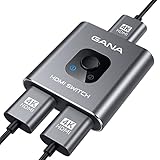
Overview: The GANA Aluminum Bidirectional HDMI Switcher delivers impressive versatility for users juggling multiple devices on a single display. This compact hub supports two distinct configurations: either two sources to one display or one source toggling between two displays (with only one active at a time). Operating at 4K@60Hz resolution with 3D support, it handles modern gaming consoles, streaming devices, and Blu-ray players without introducing noticeable lag or quality degradation.
What Makes It Stand Out: True bidirectional functionality sets this apart from standard switches at this price point. The aluminum construction provides superior heat dissipation and durability compared to plastic alternatives, while integrated LED indicators offer at-a-glance confirmation of active ports. Requiring no external power supply, it draws energy directly from connected devices, simplifying setup and reducing cable clutter. The manual button delivers reliable switching without complex software or drivers.
Value for Money: At $9.99, this represents exceptional value for budget-conscious buyers needing bidirectional flexibility. Competing products with similar aluminum builds and dual-mode operation typically cost $15-20. While the 3.4Gbps bandwidth limits some advanced features, it’s sufficient for standard 4K content, making it a cost-effective solution for basic home theater or gaming setups.
Strengths and Weaknesses: Pros: Bidirectional operation doubles utility; durable aluminum housing; plug-and-play simplicity; LED status indicators; no power adapter required; lifetime technical support. Cons: Manual switching only (no remote); 3.4Gbps bandwidth insufficient for HDR10+ or Dolby Vision; maximum 3-meter cable length for stable 4K; only one display works in reverse mode; no auto-switching capability.
Bottom Line: The GANA switch is an excellent entry-level choice for users needing occasional source swapping without premium features. Its bidirectional design and solid build quality make it ideal for dorm rooms, small apartments, or secondary entertainment systems where simplicity and affordability trump advanced functionality.
7. NEWCARE HDMI Switch 4 in 1 Out 4K@60Hz, Aluminum 4-Port HDMI Switcher Splitter with Remote, Supports HDR10 Dolby Vision HDCP 2.2 18Gbps 3D for TV PS5 Xbox Laptop Projector Fire Stick

Overview: The NEWCARE 4-in-1 HDMI Switch addresses complex entertainment setups by consolidating four source devices into a single display. Supporting pristine 4K@60Hz resolution with HDR10 and Dolby Vision, it transforms your home theater with cinema-grade visuals. The aluminum chassis ensures reliable performance during extended gaming sessions or movie marathons, while HDCP 2.2 compliance guarantees seamless playback of protected content from modern streaming services and Blu-ray players.
What Makes It Stand Out: Three intelligent switching modes—remote control, manual button, and automatic input detection—provide unprecedented flexibility. The included IR remote enables couch-side convenience, while auto-switching instantly activates the most recently powered device. Unlike passive switches, the Type-C power connection maintains stable 18Gbps bandwidth, eliminating signal dropouts and ensuring consistent performance with high-bitrate content. This professional-grade feature set rivals switches costing twice as much.
Value for Money: Priced at $26.99, this switch delivers premium features at a mid-range price point. The combination of four inputs, remote functionality, HDR support, and powered operation typically commands $40-50 from major brands. The inclusion of a power cable and remote (minus batteries) makes it ready for immediate deployment in sophisticated setups.
Strengths and Weaknesses: Pros: Four HDMI inputs; HDR10/Dolby Vision support; 18Gbps bandwidth; remote and auto-switching; aluminum construction; stable powered operation; HDCP 2.2 compliant. Cons: Requires external power; IR sensor must remain visible; no HDMI cables included; AAA batteries not provided; slightly larger footprint than passive switches.
Bottom Line: Perfect for serious home theater enthusiasts and gamers with multiple consoles, the NEWCARE switch eliminates cable-swapping frustration while preserving cutting-edge video quality. The remote control and auto-switching features justify every penny for users managing four or more HDMI sources daily.
8. avedio links HDMI Switch 3 in 1 Out 4K@60Hz Aluminum Alloy【with 4FT HDMI 2.0 Cable】, 3x1 4K HDMI Switch Box, 3-Port HDMI Selector Switcher Support HDCP 2.2, HDR 10, for Fire TV Stick, PS5

Overview: The avedio links 3-in-1 HDMI Switch balances performance and convenience for users with moderate connectivity needs. This switcher seamlessly routes three HDMI sources to a single display at 4K@60Hz, supporting HDR10 and HDCP 2.2 for vibrant, protected content. The included 4-foot HDMI 2.0 cable eliminates the need for separate purchases, while the aluminum alloy body ensures durability and effective heat management during continuous operation with devices like PS5, Apple TV, or Fire Stick.
What Makes It Stand Out: Comprehensive audio format support distinguishes this switch from competitors. It handles Dolby Atmos, Dolby TrueHD, DTS-HD, and DSD without compression or distortion, making it ideal for audiophiles and home theater purists. The latest-generation chipset maintains signal integrity at 18Gbps, while the manual key-press switching provides deliberate control over input selection. Drawing power directly from source devices simplifies installation and reduces adapter clutter.
Value for Money: At $17.99 including a certified HDMI cable, this package offers outstanding value. Comparable aluminum switches without cables cost $15-20 separately, while premium audio support often commands a $25+ price tag. For users prioritizing sound quality alongside 4K video, this represents a smart, cost-effective investment.
Strengths and Weaknesses: Pros: Includes 4FT HDMI 2.0 cable; robust aluminum construction; extensive audio format support (Atmos/DTS-HD); HDR10 and HDCP 2.2 compliant; 18Gbps bandwidth; plug-and-play operation; no external power needed. Cons: Manual switching only; no remote control; limited to three inputs; no auto-switching function; button placement may be inconvenient in tight spaces.
Bottom Line: An excellent choice for audio-focused users seeking reliable 4K switching without premium complexity. The included cable and superior audio codec support make it particularly attractive for home theater enthusiasts who want cinematic sound and picture without breaking the bank.
9. UGREEN HDMI 2.1 Switch 2 in 1 Out 8K@60Hz Ultra HD Supports 4K@240Hz 4K@120Hz VRR HDR10+ Dolby Atmos 48Gbps HDMI Switcher Compatible with Switch/Switch 2 PS5 Xbox Roku Firestick Apple TV

Overview: The UGREEN HDMI 2.1 Switch represents the cutting edge of consumer video technology, future-proofing your setup for the 8K era. This 2-in-1-out switcher handles breathtaking 8K@60Hz resolution while supporting ultra-high refresh rates up to 4K@240Hz, making it a dream for competitive gamers and tech enthusiasts. Variable Refresh Rate (VRR) technology eliminates screen tearing and stuttering by synchronizing display refresh rates with source device output, delivering buttery-smooth motion in fast-paced games and action sequences.
What Makes It Stand Out: Unprecedented 48Gbps bandwidth ensures zero compression of next-gen signals, supporting Dynamic HDR, HDR10+, and Dolby Atmos for unmatched audiovisual fidelity. The HDMI 2.1 standard enables advanced gaming features like Auto Low Latency Mode (ALLM) and Quick Frame Transport, giving competitive players a measurable edge. Backward compatibility with HDMI 2.0/1.4 devices ensures seamless integration into existing systems while preparing for upcoming hardware upgrades.
Value for Money: At $29.99, this switch delivers flagship specifications typically found in $50+ products. For gamers investing in PS5, Xbox Series X, or high-end PC graphics cards, the VRR and 4K@120Hz support alone justify the premium over basic 4K switches. The investment protects against obsolescence as 8K content becomes mainstream.
Strengths and Weaknesses: Pros: 8K@60Hz and 4K@240Hz support; 48Gbps bandwidth; VRR/FreeSync/G-Sync compatibility; HDR10+ and Dolby Atmos; HDMI 2.1 compliance; compact design; LED indicators. Cons: Only two inputs limits device connections; requires premium certified HDMI 2.1 cables (not included); maximum 9.9ft cable length for 8K; no remote control; price may exceed casual users’ needs.
Bottom Line: Essential for next-gen gamers and 8K early adopters demanding the absolute best performance. The UGREEN switch eliminates bottlenecks in premium setups, ensuring your display never compromises the capabilities of your cutting-edge source devices.
10. HDMI Switch 4k@60hz, BD&M Bidirectional HDMI Switcher 2 in 1 Out, Manual HDMI Hub Supports HD Compatible with Laptop PC Xbox PS5/4/3 Blu-Ray Player Fire Stick Roku and More

Overview: The BD&M Bidirectional HDMI Switcher delivers fundamental connectivity at an unbeatable price point. This no-frills hub handles 4K@60Hz switching in two configurations: dual sources to one display or one source alternating between two displays (single output active). Its compact footprint and passive operation make it ideal for minimalist setups where simplicity and cost savings outweigh advanced features. The manual button provides reliable source selection without software dependencies or complex configuration.
What Makes It Stand Out: At $5.99, it’s among the most affordable HDMI switches available while maintaining bidirectional functionality—a feature rare in this price tier. The LED indicators provide essential feedback about active connections, and the plug-and-play design requires zero technical expertise. For users needing only occasional source swapping without premium audio/video formats, it delivers the core functionality without superfluous additions.
Value for Money: Exceptional value defines this product. Competing bidirectional switches cost 2-3 times more, while basic one-way switches rarely dip below $8-10. The lifetime technical support and 12-hour response commitment provide surprising peace of mind for such an inexpensive device. However, the 3.4Gbps bandwidth limitation means it cannot handle HDR10+ or lossless audio codecs found on modern 4K Blu-rays.
Strengths and Weaknesses: Pros: Unbeatable price; bidirectional operation; no external power required; LED status lights; lifetime support; extremely compact; broad device compatibility. Cons: Limited 3.4Gbps bandwidth; no HDR or advanced audio support; manual switching only; maximum 3-meter cable length for 4K; likely plastic construction (less durable); no remote or auto-switching.
Bottom Line: Perfect for budget-conscious users with basic 4K needs or as a temporary solution while planning a premium setup. The BD&M switch accomplishes its limited mission reliably, but serious home theater enthusiasts and gamers should invest in higher-bandwidth alternatives to unlock their equipment’s full potential.
What Is an HDMI Switcher and Why Do You Need One?
An HDMI switcher is a compact hub that connects multiple HDMI source devices to a single HDMI input on your TV, monitor, or projector. Think of it as a digital doorman that intelligently manages which device’s signal gets through to your display. Unlike simple cable splitters, true switchers actively process and route signals, often enhancing compatibility between devices with different specifications.
The modern need is undeniable: 4K streaming sticks demand HDR10+ support, PlayStation 5 and Xbox Series X require HDMI 2.1 bandwidth, and legacy devices still output at 1080p. A quality switcher bridges these generations without forcing you to compromise on features or constantly rewire your setup. For wall-mounted TVs where accessing rear ports requires furniture moving, the convenience factor alone justifies the investment.
HDMI Switcher vs. HDMI Splitter: Understanding the Difference
These terms are often confused, but they serve opposite functions. A switcher takes multiple inputs and sends one signal to a single display—perfect for connecting several devices to one TV. A splitter takes one input and duplicates it across multiple displays simultaneously, useful for digital signage or mirroring content in different rooms.
Using the wrong device creates immediate problems. Connect a splitter when you need a switcher, and you’ll see four identical, overlapping images on your screen. Connect a switcher when you need a splitter, and only one display will work at a time. Some advanced units combine both functions, but these hybrid devices typically cost more and introduce unnecessary complexity for most home users. Always verify the product description specifies “switcher” or “splitter” based on your actual need.
Key Features to Consider When Buying an HDMI Switcher
Number of Input Ports
Start by counting your current devices, then add two more. That gaming console you plan to buy next year or the media server you’ll eventually build needs a port waiting for it. Three-port switchers work for minimal setups, but five to eight ports offer real flexibility. Remember that daisy-chaining multiple switchers often introduces handshake delays and HDCP errors, making a single, adequately-sized unit the smarter long-term choice.
Video Resolution and HDR Support
Don’t just check for “4K support”—dig into the specifics. True 4K60Hz switching requires 18Gbps bandwidth minimum, while 8K or 4K120Hz gaming demands the full 48Gbps of HDMI 2.1. HDR support should include HDR10, Dolby Vision, and HLG for maximum compatibility. Some budget switchers claim “4K support” but downsample color depth or chroma subsampling (4:4:4 vs. 4:2:0), visibly degrading picture quality in high-contrast scenes.
Audio Format Compatibility
Your switcher must passthrough every audio format your system uses. Basic Dolby Digital and DTS are table stakes, but modern home theaters require eARC support for uncompressed Dolby Atmos and DTS:X. Check for LPCM support if you connect a gaming PC, and verify the switcher doesn’t convert multi-channel audio to stereo—a common issue with subpar units that can neuter your surround sound investment.
Understanding HDMI Standards: From 1.4 to 2.1
HDMI versions aren’t just marketing numbers—they define hard technical limits. HDMI 1.4 maxes out at 4K30Hz, making it obsolete for modern gaming and streaming. HDMI 2.0 brings 4K60Hz and basic HDR but lacks bandwidth for 4K120Hz or dynamic HDR metadata. HDMI 2.1 delivers the full 48Gbps pipeline needed for next-gen gaming, 8K content, and advanced features like variable refresh rate (VRR) and auto low-latency mode (ALLM).
When shopping, don’t trust vague “HDMI 2.1 compatible” claims. True HDMI 2.1 switchers explicitly list bandwidth specifications and supported features. Many manufacturers label HDMI 2.0 devices as “2.1 compatible” simply because they accept 2.1 cables—a misleading practice that will leave your PS5 running at reduced performance. Look for specific feature support: FRL (Fixed Rate Link) signaling, VRR, QMS (Quick Media Switching), and QFT (Quick Frame Transport).
Automatic vs. Manual Switching: Which Is Right for You?
Automatic switchers detect active signals and switch to the powered-on device, offering hands-free convenience. This works beautifully for setups where only one device runs at a time—like a streaming stick and a cable box. However, auto-switching can become erratic with devices that never fully power down (Apple TV, many gaming consoles in rest mode), causing unwanted input changes.
Manual switchers require button presses or remote commands but give you absolute control. High-end units offer priority-based auto-switching with manual override, combining both benefits. For gaming setups, manual control prevents the switcher from grabbing input when a console downloads updates in standby. Consider your usage patterns: if you binge-watch on one device for hours, auto-switching shines. If you frequently hop between devices, manual control reduces frustration.
The Importance of HDCP Compliance in Modern Setups
HDCP (High-bandwidth Digital Content Protection) is Hollywood’s copy protection scheme, and it’s non-negotiable. Every link in your chain—source, switcher, and display—must support the same HDCP version. HDCP 2.2 is required for 4K content; HDCP 2.3 is the current standard for 8K and premium streaming.
A switcher with outdated HDCP will display a black screen or error message when you try streaming 4K Netflix or playing a UHD Blu-ray. Worse, some switchers advertise HDCP 2.2 compliance but only on select ports, creating a frustrating guessing game. Verify that all ports support the required version, and look for “full HDCP 2.3 compliance” in specifications. Gaming PCs using capture cards need HDCP stripping disabled—another reason to ensure your switcher properly handles the handshake without introducing latency.
Remote Control Options: IR, Bluetooth, and App-Based Control
Infrared remotes are standard but require line-of-sight and add another clicker to your coffee table clutter. Bluetooth remotes work through cabinets and walls, perfect for hidden installations. The newest switchers offer smartphone app control via Wi-Fi, enabling input switching from anywhere in your home and often providing advanced settings like custom EDID profiles and CEC (Consumer Electronics Control) management.
Consider integration with universal remotes like Logitech Harmony or SofaBaton. These require IR or IP control compatibility. Some switchers include RS-232 ports for professional control systems like Crestron or Control4—overkill for most homes but essential for complex automation. Voice control through Alexa or Google Assistant is emerging in premium models, letting you switch inputs with verbal commands when your hands are full.
Build Quality and Design Considerations
A switcher’s internal components directly impact signal integrity. Look for metal enclosures that provide EMI shielding against interference from Wi-Fi routers and other electronics. Plastic cases might save money but can introduce video artifacts and audio dropouts in congested equipment racks. Port placement matters—side-facing ports reduce cable strain and improve airflow in tight spaces.
LED indicators should be dimmable or defeatable; nothing ruins movie night like a blinking blue light in your peripheral vision. Heat dissipation is critical—48Gbps switching generates warmth, and units without ventilation slots will throttle performance or fail prematurely. For rack mounting, check for included ears or third-party compatibility. Desktop users should prioritize rubber feet and vertical stand options to save space.
Power Requirements: Active vs. Passive Switchers
Passive switchers draw power from the HDMI cables themselves, requiring no external adapter. These work only with short cable runs (under 10 feet) and low-power devices. They often fail with 4K signals or longer cables because the HDMI spec’s 5V pin provides just 55mA—insufficient for clean signal amplification.
Active switchers use external power supplies to boost and clean signals, supporting longer cable runs (up to 50 feet) and maintaining full bandwidth. They’re essential for 4K HDR content and mandatory for HDMI 2.1. When evaluating active switchers, check the power adapter’s quality—cheap wall warts introduce noise. USB-powered options offer flexibility but verify they deliver sufficient amperage; underpowered units cause random black screens and audio sync issues.
Gaming-Specific Features to Look For
Console gaming demands features that passive video watching doesn’t. Variable Refresh Rate (VRR) eliminates screen tearing by synchronizing your TV’s refresh rate to the game’s frame rate—non-negotiable for Xbox Series X and PS5. Auto Low Latency Mode (ALLM) automatically switches your TV to game mode, cutting input lag without manual menu diving.
Quick Frame Transport (QFT) reduces latency further, crucial for competitive gaming. Some switchers advertise “gaming mode” but only pass through basic 4K60Hz without these HDMI 2.1 features. Verify the switcher supports the full 48Gbps bandwidth; many “gaming” switchers are just HDMI 2.0 devices with aggressive marketing. Input lag should be under 1ms—any higher introduces noticeable delay. Look for switchers with dedicated gaming ports that prioritize these features if you mix gaming and media devices.
Home Theater Integration Tips
Place your switcher at the heart of your setup, not as an afterthought. Connect all sources to the switcher first, then run a single cable to your TV or receiver. This centralizes control and reduces cable clutter. If using a receiver, connect the switcher to a receiver input—not directly to the TV—to ensure audio processing works correctly.
Label your cables at both ends using color-coded tags or printed labels. When troubleshooting, you’ll thank yourself. Keep switcher firmware updated; manufacturers often release updates to fix HDCP handshake issues with new streaming devices. For wall-mounted TVs, install the switcher in a ventilated cabinet below or use a recessed wall box to hide it completely. Never stack switchers directly on heat-generating devices like amplifiers or consoles—give them breathing room.
Troubleshooting Common HDMI Switcher Issues
Black screens usually signal HDCP handshake failures. Power-cycle the entire chain: turn off TV, switcher, and source, unplug for 30 seconds, then power on in sequence (TV first, then switcher, then source). Audio dropouts often stem from EDID mismatches—your switcher telling the source it supports formats it can’t actually handle. Manually set EDID to the lowest common denominator (usually 4K60Hz with stereo audio) and work up from there.
Flickering or sparkles indicate insufficient bandwidth, typically from cheap cables or an underpowered switcher. Replace cables with certified Ultra High Speed (HDMI 2.1) options, even if running 4K60Hz—the headroom prevents issues. If inputs switch randomly, disable CEC on all devices or use a switcher with CEC management to block errant signals. For persistent issues, some switchers offer “troubleshooting mode” that disables advanced features one by one to isolate the culprit.
Installation Best Practices for Optimal Performance
Cable length matters more than most realize. Keep source-to-switcher cables under 6 feet when possible. The switcher-to-display cable can be longer (up to 10 feet for HDMI 2.1, 25 feet for HDMI 2.0) but use active cables for runs exceeding these distances. Avoid right-angle adapters—they stress ports and can cause signal loss. If space is tight, use cables with 90-degree connectors designed for low clearance.
Power sequencing prevents HDCP errors. Connect everything while powered off, then turn on devices in order: display first, then switcher, then sources. This ensures each device negotiates HDCP correctly. Use cable management to avoid electromagnetic interference—don’t run HDMI parallel to power cables; cross them at 90-degree angles if they must intersect. For rack installations, place the switcher on a separate power conditioner from amplifiers to prevent ground loop hum.
Future-Proofing Your HDMI Switcher Investment
The HDMI 2.1 specification will remain relevant for at least five years, but new features emerge constantly. Look for firmware upgrade capability via USB or network connection—this lets manufacturers add support for new HDR formats or fix compatibility issues with future consoles. A switcher with replaceable power supplies extends lifespan; when wall warts fail (and they do), swapping a $10 adapter beats replacing the entire unit.
Consider emerging standards like DisplayPort 2.1 conversion if you plan to connect a gaming PC. While rare now, hybrid HDMI/DisplayPort switchers future-proof against graphics card evolution. Buy from manufacturers with 3+ year warranties and responsive support; this indicates confidence in build quality and ensures help when new devices cause unexpected issues. Spending 20% more on a truly future-proof switcher costs less than replacing it in two years when your new 8K projector arrives.
Frequently Asked Questions
Will an HDMI switcher degrade my video or audio quality?
A quality active switcher with adequate bandwidth maintains perfect digital fidelity—it’s a bit-perfect passthrough. However, cheap switchers may compress chroma subsampling or strip high-bitrate audio formats. Always verify bandwidth specs match your content’s requirements.
Can I use an HDMI switcher with a soundbar or AV receiver?
Yes, but connection order matters. For soundbars, connect sources to the switcher, then switcher to soundbar, then soundbar to TV. For receivers with HDMI switching, you typically don’t need a separate switcher—use the receiver’s inputs instead.
Why does my screen go black for 2-3 seconds when switching inputs?
This is HDCP re-authentication. High-quality switchers with Quick Media Switching (QMS) eliminate this blackout. Without QMS, the delay is normal but shouldn’t exceed 3-4 seconds. Persistent longer blackouts indicate compatibility issues.
Do I need a powered HDMI switcher?
For 4K60Hz or higher, absolutely. Passive switchers lack the amplification needed for stable signals and will cause random dropouts. HDMI 2.1 mandates active switching. Only use passive units for 1080p setups with very short cables.
Can a switcher fix HDCP errors between my devices?
No, a switcher cannot bypass HDCP. It must comply with the same HDCP version as your source and display. However, some switchers handle the HDCP handshake more robustly than others, reducing errors caused by finicky TV firmware.
Is it better to buy a switcher with more ports than I currently need?
Yes. Adding two extra ports beyond your current device count prevents daisy-chaining headaches later. The cost difference between a 3-port and 5-port switcher is minimal compared to replacing the entire unit when you add one more device.
Will my HDMI switcher work with a long cable run to my projector?
It depends on cable length and resolution. For runs over 15 feet at 4K, use an active switcher with a built-in signal booster or add an HDMI extender. Standard passive cables lose signal integrity beyond 10 feet at high bandwidth.
Can I control my switcher with my TV remote?
If both devices support HDMI-CEC, yes. However, CEC implementation varies wildly between brands. Many users disable CEC due to unwanted auto-switching. Dedicated switcher remotes or universal remotes with IR learning provide more reliable control.
What’s the difference between EDID management and EDID emulation?
EDID management lets you manually select resolution and audio capabilities. Emulation stores your display’s EDID and constantly presents it to sources, preventing resolution changes when switching inputs. Emulation is superior for mixed-use setups.
Are expensive HDMI switchers worth the premium?
For basic 1080p setups, mid-range units suffice. For 4K HDR, gaming, or home theaters, premium switchers justify their cost through stable HDCP handling, proper bandwidth, VRR/ALLM passthrough, and firmware updates. The price difference is far less than replacing a failed cheap switcher that damages your signal chain.