If you’re running a dual 32-inch monitor setup, you’ve already embraced the power of expansive screen real estate. But here’s the challenge most people underestimate: finding a stand-up desk converter that can safely and stably support that much weight, width, and visual real estate is like searching for a specialized piece of industrial equipment disguised as office furniture. Standard converters designed for single 24-inch displays simply won’t cut it. The wrong choice doesn’t just mean wobbling screens—it means potential equipment damage, chronic neck strain, and a productivity setup that fights you every time you transition from sitting to standing.
This comprehensive guide cuts through the marketing fluff to address the unique demands of dual 32-inch monitor configurations. We’ll explore the engineering principles, ergonomic requirements, and real-world considerations that separate robust, reliable converters from glorified monitor stands. Whether you’re a creative professional, financial trader, or data analyst who lives by your multi-screen command center, understanding these factors will save you from costly returns and ensure your investment delivers years of seamless performance.
Top 10 Stand-Up Desk Converters for Dual Monitors
Detailed Product Reviews
1. Mount-It! Standing Desk Converter Dual Monitor, 2 Screen Mounts Included, Height Adjustable Desk Riser in Black, Stand Up Desk Convertor Large 36" Wide, Sit Stand Convertor with Manual Lift Gas Spring

Overview: The Mount-It! dual monitor standing desk converter combines a spacious work surface with integrated monitor arms for a streamlined ergonomic setup. At 36 inches wide, it accommodates two monitors up to 32 inches each while providing dedicated space for keyboards and accessories. The manual gas spring lift enables smooth height transitions from 6.5 to 16.3 inches.
What Makes It Stand Out: This converter eliminates the need for separate monitor mounts, saving both money and desk space. The fully integrated dual-arm system offers tilt, swivel, and rotation adjustments for optimal viewing angles. Built-in cable management keeps wires organized, while nonskid pads protect your existing desk surface.
Value for Money: At $279.99, it sits in the mid-range category. The included monitor mounts represent significant savings compared to purchasing a converter and separate arms. For professionals requiring dual-screen ergonomics, the integrated design justifies the investment over budget alternatives lacking mount compatibility.
Strengths and Weaknesses: Strengths include the all-in-one design, generous surface area, and robust 33-pound weight capacity. The manual gas spring operates smoothly. Weaknesses include a limited height range that may not suit taller users, and the fixed monitor mount position reduces flexibility. Assembly, while quick, requires more steps than basic converters.
Bottom Line: An excellent choice for dual-monitor users seeking an integrated solution. The Mount-It! converter delivers professional-grade ergonomics and organization, making it worth the premium over basic models for those who value streamlined aesthetics and functionality.
2. VIVO Height Adjustable 32 inch Standing Desk Converter with Dual 13 to 30 inch Monitor Stand, Sit Stand Monitor Mount and Desk Riser, Black, DESK-V000K-M2

Overview: The VIVO DESK-V000K-M2 offers an affordable entry into ergonomic dual-monitor setups. This 32-inch converter features integrated monitor mounts supporting two screens from 13 to 30 inches. The height lock mechanism provides smooth transitions between 4.5 and 20 inches, accommodating various user heights.
What Makes It Stand Out: Its patented full-motion monitor mount delivers exceptional flexibility with 45-degree tilt, 180-degree swivel, and 360-degree rotation. The grommet mount system ensures rock-solid stability, while portrait or landscape orientation options cater to diverse workflows. Minimal assembly means you’ll be productive within minutes.
Value for Money: At $169.99, this represents exceptional value. Competing solutions often require separate monitor arm purchases costing $100+. The robust steel frame and comprehensive adjustment range rival premium options, making it ideal for budget-conscious professionals unwilling to compromise on functionality.
Strengths and Weaknesses: Strengths include the unbeatable price, full-motion monitor mounts, and generous 20-inch maximum height. The steel construction ensures durability. Weaknesses include the smaller 31.5-inch surface that limits accessory space, and the 30-inch monitor size restriction may exclude ultrawide users. The keyboard tray design reduces usable space in the center.
Bottom Line: The best budget dual-monitor converter available. VIVO delivers professional-grade monitor mounting and height adjustment at a price point that undercuts competitors significantly. Perfect for home offices and corporate environments seeking cost-effective ergonomic solutions without sacrificing quality.
3. Mount-It! Double Monitor Electric Standing Desk Converter - 2 Screens Stand Up Desk Riser - Height Adjustable Desktop & 2 Mounts for Screens up to 32", Sit-Stand Convertor for Home, Office, School

Overview: The Mount-It! Electric Standing Desk Converter brings push-button convenience to ergonomic workspaces. This premium converter features motorized height adjustment and integrated dual monitor mounts for screens up to 32 inches. The 28-inch base provides compact efficiency while supporting a full workstation setup.
What Makes It Stand Out: Electric adjustment eliminates manual lifting, ensuring effortless transitions throughout the day. The integrated phone/tablet slot keeps devices accessible, while the 45-degree tilt capability optimizes viewing angles. Modern aesthetics complement any office decor, and cable management maintains a clean appearance.
Value for Money: At $399.99, this is a significant investment. However, the electric mechanism saves time and encourages more frequent position changes, potentially justifying the cost for users with mobility issues or those prioritizing convenience. It competes with premium electric desks while retaining existing furniture.
Strengths and Weaknesses: Strengths include effortless electric operation, sleek design, and sturdy construction. The motor provides smooth, consistent movement. Weaknesses include the high price point, smaller work surface compared to manual alternatives, and potential long-term reliability concerns with the motor. The 28-inch width may feel cramped for some users.
Bottom Line: Ideal for professionals who value convenience and will utilize electric adjustment frequently. While expensive, the Mount-It! electric converter delivers premium features and modern design. Consider your budget and whether manual adjustment is a dealbreaker before investing in this high-end solution.
4. FITUEYES Height Adjustable Standing Desk 32” Wide Sit to Stand Converter Stand Up Desk Tabletop Workstation for Dual Monitor Riser FSD308001WB
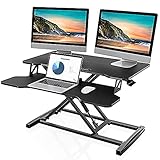
Overview: The FITUEYES FSD308001WB offers straightforward sit-stand functionality at an accessible price point. This 32-inch converter arrives fully assembled, delivering immediate ergonomic benefits. The dual gas spring mechanism provides smooth height adjustment from 4.3 to 19.8 inches, supporting users of various statures.
What Makes It Stand Out: True plug-and-play convenience sets this apart—no assembly required. The impressive height range exceeds many competitors, accommodating taller individuals. The minimalist design focuses on core functionality without unnecessary complexity, making it approachable for ergonomic newcomers.
Value for Money: At $111.99, this is the most budget-friendly option reviewed. It provides essential sit-stand capabilities without premium features that drive up costs. For users content with placing monitors directly on the surface, it delivers core benefits at nearly half the price of mounted alternatives.
Strengths and Weaknesses: Strengths include immediate usability, excellent height range, and solid 33-pound capacity. The simple design ensures reliability. Weaknesses include the lack of integrated monitor mounts, basic aesthetics, and potential stability concerns at maximum extension. The keyboard tray is integrated rather than separate, limiting layout flexibility.
Bottom Line: Perfect for first-time standing desk users or those on tight budgets. The FITUEYES converter covers essential needs without frills. While it lacks advanced features, its ready-to-use design and adequate performance make it a smart entry-level purchase for simple dual-monitor setups.
5. VIVO 42 inch Height Adjustable Stand Up Desk Converter, V Series, Quick Sit to Stand Tabletop Dual Monitor Riser Workstation, Black, DESK-V000VL

Overview: The VIVO DESK-V000VL commands attention with its expansive 42-inch surface, providing generous space for complex dual-monitor setups and accessories. This converter uses dual pneumatic springs for smooth height adjustment from 6 to 17 inches, creating a comfortable workstation without replacing your existing desk.
What Makes It Stand Out: The massive surface area distinguishes this model, accommodating dual monitors, documents, and peripherals simultaneously. The synchronized keyboard tray moves with the main surface, maintaining ergonomic alignment. Minimal assembly and underside padding demonstrate thoughtful design for user convenience and desk protection.
Value for Money: Priced at $239.99, it offers strong value for users prioritizing space. While lacking integrated monitor mounts, the savings can fund separate arms if needed. The steel frame and 33-pound capacity ensure durability, justifying the investment over cheaper, smaller alternatives.
Strengths and Weaknesses: Strengths include the unparalleled surface area, sturdy steel construction, and smooth lift mechanism. The large workspace enhances productivity. Weaknesses include the absence of integrated monitor mounts, substantial footprint requiring a large desk, and a keyboard tray that feels proportionally small for the main surface.
Bottom Line: Excellent for professionals needing maximum workspace. The VIVO 42-inch converter excels in surface area and build quality. If you prioritize desk space over integrated mounting and have room to accommodate its size, this converter delivers exceptional functionality and value.
6. VIVO 36 inch Height Adjustable Stand Up Desk Converter, V Series, Quick Sit to Stand Tabletop Dual Monitor Riser Workstation, Black, DESK-V000V
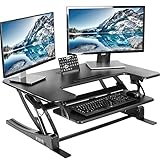
Overview: The VIVO V Series desk converter transforms any standard desk into an ergonomic standing workstation. Measuring 91cm x 56cm, the spacious surface accommodates dual monitors or a laptop setup, while the 64cm x 27cm keyboard tray syncs with the main platform. The dual pneumatic spring system provides smooth 15kg lift assistance across a 17-43cm height range, enabling effortless transitions between sitting and standing throughout your workday.
What Makes It Stand Out: This converter’s patented design prioritizes user experience with its innovative simple-touch height locking mechanism. The generous surface area rivals premium competitors without consuming excessive desk space. Assembly requires mere minutes—just attach the keyboard tray and feet. VIVO backs their steel construction with a confidence-inspiring 3-year manufacturer warranty and responsive tech support, demonstrating serious commitment to product longevity.
Value for Money: At $199.99, this manual converter hits the sweet spot between budget-friendly options and expensive electric models. The 15kg capacity handles most dual-monitor configurations, and the pneumatic assist delivers near-electric smoothness without the motor premium. Comparable converters with similar surface area typically cost $50-100 more, making this an intelligent investment for productivity and health.
Strengths and Weaknesses: Strengths: Exceptionally smooth pneumatic lift mechanism; spacious 36-inch surface; minimal assembly required; robust 3-year warranty; stable steel frame design. Weaknesses: Manual adjustment requires physical effort; height range may be insufficient for users over 6'2"; keyboard tray depth could be limiting for some ergonomic preferences.
Bottom Line: The VIVO V Series delivers premium manual standing desk functionality at a mid-tier price. Ideal for professionals seeking reliable dual-monitor support without the electric premium, it’s a smart compromise of performance, durability, and value that will serve most users excellently for years.
7. Mount-It! Standing Desk Converter, Stand Up Desk Riser with Dual Monitor Mount, Adjustable Workstation in Black, Top Platform 23" Wide, Keyboard Mouse Tray 27" Wide, Raises 5" to 17" Tall

Overview: Mount-It!’s integrated solution combines a sit-stand converter with a dedicated dual monitor mount, creating a streamlined ergonomic command center. The gas spring system enables smooth height adjustments from 5.7" to 17.1", while the 23.6" x 15.7" top platform and expansive 26.7" x 11.8" keyboard tray provide organized workspace. VESA-compatible arms support two 32" monitors up to 22 lbs each, making this a complete vertical workstation upgrade.
What Makes It Stand Out: The built-in monitor mount eliminates desk clutter while offering superior ergonomic positioning. Integrated cable management maintains a clean aesthetic, and the included gel wrist pad demonstrates thoughtful ergonomics. Despite its robust functionality, the compact footprint preserves valuable desk real estate. The space-saving design proves you don’t need massive dimensions for comprehensive dual-monitor support.
Value for Money: Priced at $239.99, this converter justifies its cost by bundling a $100+ monitor mount with a quality riser. Competing solutions requiring separate purchases easily exceed $300. The sturdy construction and monitor-specific engineering deliver professional-grade stability that cheaper alternatives can’t match, representing genuine savings for dual-screen users.
Strengths and Weaknesses: Strengths: All-in-one monitor mounting solution; excellent cable management; comfortable gel wrist pad; compact footprint; smooth gas spring operation; generous keyboard tray. Weaknesses: Smaller top platform limits additional accessories; 22 lb per monitor capacity may restrict some professional displays; assembly more complex than basic converters.
Bottom Line: For dual-monitor users seeking an organized, space-efficient upgrade, this Mount-It! converter eliminates purchasing guesswork. The integrated design and ergonomic extras make it worth every penny for professionals prioritizing clean aesthetics and monitor positioning flexibility.
8. FLEXISPOT 36-inch Standing Desk Converter Height Adjustable Sit to Stand Up Workstation, Dual Monitor and Laptop Riser with Wide Keyboard Tray, Black

Overview: FLEXISPOT’s budget-conscious converter delivers essential sit-stand functionality through a robust X-frame structure supporting 33 lbs on the desktop and 6.6 lbs on the keyboard tray. The 36-inch surface features a unique U-shaped design optimizing laptop placement, while the quick-adjust mechanism spans 4.7" to 16.6" height range. Streamlined assembly requires only keyboard tray attachment, making this immediately ready for productivity gains.
What Makes It Stand Out: The X-frame architecture provides exceptional stability typically found in premium models, eliminating wobble during height transitions. The clever U-shaped upper deck creates laptop-specific ergonomics rarely seen in this price category. FLEXISPOT’s commitment to user-friendly design shines through the simplified setup process and ergonomic edge profiling that reduces wrist strain during extended use.
Value for Money: At $114.00, this converter dramatically undercuts competitors while maintaining respectable build quality. Manual adjusters in the $150-180 range offer minimal improvements. For budget-restricted home offices or corporate bulk purchasing, the cost-to-function ratio is outstanding. The sturdy construction ensures you won’t sacrifice longevity for savings.
Strengths and Weaknesses: Strengths: Unbeatable price point; surprisingly stable X-frame design; extremely simple assembly; U-shaped laptop optimization; smooth height transitions; lightweight yet durable. Weaknesses: Lower weight capacity restricts heavy monitor setups; manual adjustment requires effort; limited height range unsuitable for taller users; basic feature set lacks premium extras.
Bottom Line: FLEXISPOT proves affordability doesn’t require instability. Perfect for laptop-first users, remote workers, or cost-conscious offices, this converter delivers core standing desk benefits without financial strain. It’s the practical choice for those prioritizing function over frills.
9. Mount-It! Electric Standing Desk Converter with Dual Monitor Arms for 2 Screens (Max 32"), Large 35.4" Wide Desktop, Motorized Stand Up Desk Riser, Keyboard Tray, USB, Black Stand up Desk Convertor

Overview: This premium electric converter represents the pinnacle of sit-stand convenience, featuring push-button height adjustment from 6.3" to 19.3" via a powerful motorized mechanism. The expansive 35.4" x 23" desktop supports 33 lbs while integrated dual monitor arms handle two 32" screens. A built-in USB charging station and device channel transform this into a modern productivity hub, eliminating cable clutter and keeping technology within easy reach.
What Makes It Stand Out: Effortless electric operation removes physical effort from transitions, encouraging more frequent position changes. The integrated USB charging station is a rare premium feature that genuinely enhances daily workflow. Height-adjustable monitor arms offer independent screen positioning beyond standard converter capabilities. The device channel cleverly secures tablets and phones at optimal viewing angles, demonstrating forward-thinking design.
Value for Money: At $429.99, this converter targets professionals who value convenience and comprehensive features. While expensive, purchasing separate electric riser ($250), dual monitor arm ($150), and USB hub ($30) would exceed this price. The seamless integration and premium build quality justify the investment for users spending 8+ hours at their workstation.
Strengths and Weaknesses: Strengths: Effortless motorized adjustment; integrated USB charging; independent monitor arm positioning; spacious work surface; superior height range; excellent cable management. Weaknesses: Premium pricing limits accessibility; electric components introduce potential failure points; heavier construction reduces portability; may be over-featured for casual users.
Bottom Line: For executives, programmers, and power users seeking the ultimate sit-stand experience, this electric converter’s convenience and feature integration are unmatched. The investment pays dividends in comfort, productivity, and long-term health for serious professionals.
10. VIVO Electric Height Adjustable 36 inch Standing Desk Converter with Dual Monitor Stand for 13 to 30 inch Screens, Sit Stand Monitor Mount and Desk Riser, Black, DESK-KIT-VE36B2

Overview: VIVO’s electric converter bridges the gap between manual risers and premium motorized units, offering push-button height adjustment from 5.7" to 19.5" at just $219.99. The 36" x 15.7" surface supports 28.6 lbs while the integrated dual monitor mount handles two 13"-30" screens up to 16.5 lbs each. Full motion capabilities include ±90° tilt, 180° swivel, and 360° rotation, plus additional height adjustment along the center pole for precise ergonomic alignment.
What Makes It Stand Out: This kit delivers electric convenience and monitor mounting at a price point typically commanding $300+. The patented design incorporates professional-grade adjustability with portrait/landscape orientation flexibility. Minimal assembly requirements and the heavy-duty grommet mount ensure secure monitor positioning without complex installation. VIVO successfully democratizes premium features for budget-conscious professionals.
Value for Money: Exceptional value proposition—electric adjustment alone justifies the price compared to manual competitors. Adding a full-motion dual monitor mount creates a package that would cost $150+ separately. For users wanting electric operation without $400+ investment, this represents the market’s best price-to-feature ratio while maintaining VIVO’s reliable construction standards.
Strengths and Weaknesses: Strengths: Affordable electric operation; comprehensive monitor mount adjustability; minimal assembly; patented stable design; excellent height range; supports portrait orientation. Weaknesses: 16.5 lb monitor weight limit restricts some displays; 30" maximum screen size may exclude ultrawide users; keyboard tray smaller than some competitors.
Bottom Line: VIVO’s electric converter kit eliminates the manual-vs-premium dilemma. It’s the smartest choice for professionals wanting motorized convenience and dual-monitor flexibility without budget-breaking costs. This hybrid approach delivers 90% of premium features at 50% of the price.
Understanding the Dual 32-Inch Monitor Challenge
Why Size Matters More Than You Think
Dual 32-inch monitors present a physics problem that goes beyond simple measurements. These displays typically span 56-60 inches in combined width when placed side-by-side, creating a massive lever arm that amplifies any instability in your converter’s frame. The center of gravity shifts dramatically forward, especially with curved monitors that concentrate weight toward the front edge. This isn’t just about fitting the screens—it’s about managing torque, vibration harmonics, and weight distribution across a surface that will be raised and lowered multiple times daily.
Weight Distribution and Center of Gravity
A single 32-inch monitor averages 15-20 pounds, putting your dual setup at 30-40 pounds before you add monitor arms, cables, or accessories. But static weight ratings tell only half the story. When you raise the converter, the combined center of gravity moves upward and outward, creating a tipping moment that tests the converter’s base stability. Premium converters counter this with weighted bases, cross-bracing, and strategic engineering that keeps the center of mass within the footprint during full height extension. Always calculate your total payload weight with a 20% safety margin to account for monitor arms, cable management hardware, and any items stored on the desktop surface.
Weight Capacity: The Non-Negotiable Metric
Static vs. Dynamic Load Ratings
Manufacturers often advertise impressive weight capacities, but discerning buyers must distinguish between static load (stationary weight) and dynamic load (weight during movement). A converter might support 50 pounds when locked in place but struggle with 35 pounds while lifting. Dynamic load ratings are typically 15-20% lower than static ratings due to stress on lift mechanisms, hinges, and gas springs during transition. For dual 32-inch monitors, prioritize converters with dynamic load ratings of at least 40 pounds, ensuring smooth operation even at maximum capacity.
Calculating Your True Monitor Weight
Don’t rely on manufacturer specs alone. Weigh each monitor with its power cable and any attached accessories. Add 5-7 pounds for a dual monitor arm system, which most setups require for proper positioning. If using curved 32-inch displays, note that their weight distribution is less uniform than flat panels—often 60% concentrated in the front third of the display. This front-heavy bias means your converter must handle uneven loading, a challenge that single-post designs struggle with compared to dual-post or wide-base systems.
Stability: The Foundation of Productivity
Front-to-Back Wobble
The ultimate test of a dual 32-inch converter is its resistance to front-to-back wobble when fully extended. Press gently on the front edge of your monitors in standing position—any perceptible movement indicates inadequate base support or flex in the lift mechanism. Quality converters employ anti-wobble technology: tapered leg designs that increase contact area at height, reinforced steel crossbars, and precision-engineered pivot points with nylon bushings rather than simple metal-on-metal contact. For minimal wobble, look for converters with base depths exceeding 24 inches and a total unit weight over 50 pounds.
Side-to-Side Shake
Typing on a keyboard tray should never create visible monitor shake. Side-to-side instability stems from insufficient lateral bracing in the converter’s frame or a keyboard tray that acts as a vibration amplifier. The best designs integrate the keyboard tray into the main structural frame rather than attaching it as a secondary component. Test by performing aggressive typing motions—if monitors jiggle, your productivity will suffer, and prolonged exposure to micro-movements can cause eye strain and headaches. Dual-column lift designs inherently reduce lateral flex compared to single-post alternatives.
Ergonomic Excellence for Large Displays
Ideal Monitor Height and Distance
With 32-inch monitors, the top of your screens should sit 2-3 inches above eye level when standing, allowing a slight downward gaze that reduces neck extension. This requires a converter that reaches at least 20 inches above your seated desk height. More importantly, the distance from your eyes to screens should be 28-32 inches—farther than smaller monitors due to increased viewing angles. Ensure your converter’s monitor arm mounting system can push displays back sufficiently without compromising stability.
The 20-20-20 Rule for Large Screens
The 20-20-20 rule (every 20 minutes, look at something 20 feet away for 20 seconds) becomes crucial with dual 32-inch setups that dominate your visual field. Your converter should facilitate quick, intuitive height adjustments that encourage regular position changes. Electric converters with programmable height presets excel here, allowing seamless transitions that maintain ergonomic positioning without breaking workflow. Manual converters with smooth gas-spring operation can work equally well if the adjustment mechanism is accessible without reaching over large monitors.
Types of Stand-Up Desk Converters
Electric vs. Manual Lift Mechanisms
Electric converters offer effortless adjustment and precise height control—critical when balancing heavy dual monitors. Look for dual-motor systems that distribute load evenly and provide 1.5 inches per second lift speed. Manual gas-spring converters can handle the weight but require significant force to initiate movement (often 40-50 pounds of lift pressure). This isn’t problematic for occasional adjustments but becomes tiresome with frequent transitions. Premium manual models feature adjustable tension controls to fine-tune the assist force based on your exact payload.
Z-Lift vs. X-Lift vs. Post-and-Shelf Designs
Z-lift mechanisms arc forward as they rise, potentially bringing massive monitors too close to your face. X-lift designs maintain consistent horizontal position but require more rear clearance. For dual 32-inch setups, post-and-shelf designs with independent monitor mounting offer superior stability, though they sacrifice some surface area. The optimal choice depends on your desk depth: use Z-lift for desks deeper than 30 inches, X-lift for standard 24-30 inch depths, and post-and-shelf for maximum stability regardless of geometry.
Workspace Geometry and Footprint
Desk Depth Requirements
Your existing desk must accommodate the converter’s base while leaving room for proper monitor distance. Most dual 32-inch converters require minimum desk depths of 24 inches, with 30 inches optimal for Z-lift models that arc forward. Measure from the wall to your desk’s front edge, then subtract 6 inches for cable clearance and monitor arm adjustment. If your desk is shallower than 24 inches, consider wall-mounted monitor arms paired with a converter that handles only keyboard and laptop weight.
Vertical Travel Range
The usable height range matters more than maximum height. Your converter should lower to within 1-2 inches of your desk surface for seated ergonomics and rise to at least 20 inches above the desk for standing. Calculate your ideal standing height: elbow height minus desk height equals required converter lift. For users over 6'2", seek converters with 22+ inches of vertical travel to prevent hunching. Remember that monitor arms add 4-6 inches of height above the converter’s top surface.
Material Quality and Construction
Steel Frames vs. Aluminum Alloys
Steel frames provide superior rigidity and vibration dampening for heavy monitor loads, with 14-gauge steel offering the best strength-to-weight ratio. Aluminum alloys reduce overall weight but can transmit high-frequency vibrations from typing or desk impacts. Powder-coated steel resists scratches and maintains appearance under heavy use. Inspect weld quality—continuous welds outperform spot welds by 40% in stress tests. For dual 32-inch setups, avoid converters with plastic structural components; they fatigue and crack under cyclic loading.
Desktop Surface Materials
The platform supporting your monitors should be high-pressure laminate (HPL) or solid wood at least 0.75 inches thick to prevent sagging. Thinner MDF platforms will bow under 30+ pound loads within months, creating uneven monitor alignment. Water-resistant surfaces protect against spills, while textured finishes prevent keyboard and mouse drift. Some converters offer replaceable desktop surfaces—a valuable feature if you plan to upgrade your setup over time.
Keyboard Tray Considerations
Depth and Width for Ergonomic Typing
Keyboard trays for dual 32-inch setups must be at least 26 inches wide to accommodate a full-size keyboard and mouse comfortably. Depth of 10-12 inches allows proper wrist positioning without pushing you too far from monitors. The tray should sit 4-6 inches below the monitor platform to achieve negative tilt ergonomics. Avoid trays that flex under typing pressure; they should support at least 15 pounds without deflection.
Negative Tilt and Adjustability
Negative tilt (angling keyboard tray away from you) reduces wrist extension and prevents carpal tunnel strain during extended use. Premium converters offer 15-20 degrees of negative tilt adjustment independent of height. Ensure the tilt mechanism locks securely; a slipping tray during use indicates poor engineering. For standing positions, a slight positive tilt can improve wrist alignment—look for converters with tool-free tilt adjustment to fine-tune on the fly.
Cable Management for Complex Setups
Integrated Solutions vs. DIY Approaches
Dual 32-inch monitor setups generate massive cable bundles: two power cords, two video cables, USB hubs, and peripherals. Integrated cable management systems with routed channels and weighted bases prevent cable strain during height transitions. Avoid converters with simple adhesive clips; they fail under the weight of thick monitor cables. The best designs feature removable cable spines that run from the monitor platform to the base, keeping cables taut but not stretched throughout the lift range.
Power Brick Placement Strategies
Large monitors often have external power bricks adding 2-3 pounds each. Never mount these on monitor arms—they amplify wobble. Quality converters include dedicated power brick holders that attach to the frame near the base, maintaining low center of gravity. If your converter lacks this, use industrial-strength Velcro to secure bricks to the converter’s base column, ensuring they don’t interfere with the lift mechanism. This simple step improves stability by 15-20%.
Installation and Setup Realities
Assembly Time and Complexity
Expect 45-90 minutes for proper assembly of a heavy-duty dual-monitor converter. Most units ship partially assembled, requiring you to attach the lift mechanism to the base and platform. Electric models need additional steps: routing power cables, syncing dual motors, and programming height presets. The most common assembly error is overtightening bolts, which can bind the lift mechanism. Use a torque wrench set to 12-15 Nm for structural bolts to avoid this issue.
Tools Required
While many converters include basic Allen keys, invest in a quality hex key set and a torque wrench for proper assembly. A second person is essential for lifting the monitor platform onto the lift mechanism—attempting this solo risks damaging precision components. Keep a level handy; even a 1-degree tilt in the base translates to 3-4 inches of monitor misalignment at full height. Electric converters require proximity to a wall outlet; plan for a 10-12 gauge extension cord if your desk lacks nearby power.
Budget vs. Performance Tradeoffs
Entry-Level Options and Their Limitations
Converters under $300 claiming dual 32-inch support typically achieve this through compromised stability—thinner materials, narrower bases, and single-post designs. While they may handle the static weight, expect noticeable wobble and shorter lifespans (2-3 years vs. 7-10 years for premium models). These can work for stationary users who rarely adjust height, but frequent sit-stand cyclers will quickly notice performance degradation. Budget models also lack proper cable management, leaving you to engineer solutions that may interfere with operation.
Premium Features Worth the Investment
Spending $500-800 unlocks critical features: dual-motor electric lifts, 14-gauge steel construction, integrated cable management, and 5-year warranties. Programmable height presets become invaluable with heavy monitors—manually adjusting to exact ergonomic positions is nearly impossible. Anti-collision sensors prevent damage if objects block the descent path, protecting your investment. Consider the cost per use: a $700 converter used twice daily for five years costs less than $0.20 per adjustment, while a $250 wobbly unit that gets abandoned after six months costs over $1.30 per use.
Warranty and Customer Support
What to Look for in Coverage
Seek warranties covering the lift mechanism for 5+ years and the frame for 10+ years. Gas springs should have separate coverage, as they’re wear items typically rated for 30,000 cycles. Read the fine print: many warranties exclude “commercial use,” which can be interpreted to include home offices with heavy equipment. Premium manufacturers offer cross-shipping for defective parts, minimizing downtime. Check customer service responsiveness by emailing a pre-purchase question; response times under 24 hours indicate strong support infrastructure.
Red Flags in Policy Language
Warranties requiring “professional installation” or “regular maintenance logs” create loopholes for denial of claims. Avoid converters with weight capacity disclaimers like “capacity reduces by 10% per year of use”—this indicates poor engineering. Policies that prorate coverage after the first year suggest the manufacturer expects failures. Look for transferable warranties if you might resell; they indicate confidence in product longevity. Beware of “lifetime” warranties from unknown brands; they often mean the lifetime of the company, not the product.
Transition Smoothness and Speed
Gas Spring vs. Electric Motor Performance
High-quality gas springs provide smooth, controlled movement but require consistent force throughout the lift. As springs age, this force increases by 10-15%, making adjustments harder. Electric motors maintain consistent speed regardless of load age, with premium models lifting 1.5 inches per second while staying under 50 decibels. Dual-motor systems automatically balance torque, preventing the jerky starts common in single-motor units under heavy loads. For dual 32-inch monitors, electric is strongly recommended unless you adjust height fewer than 2-3 times per day.
Noise Levels During Adjustment
Manual converters operate silently, while electric models produce 45-60 decibels—comparable to quiet conversation. However, cheaper electric units can emit high-pitched whines from gearboxes under heavy loads. Look for brushless DC motors, which run quieter and last longer than brushed alternatives. If working in shared spaces, consider the acoustic impact: 50 decibels for 10 seconds, four times daily, adds up to audible disruption. Some premium models include “quiet mode” that reduces speed by 30% to cut noise to 40 decibels.
Desk Compatibility and Clamping
C-Frame vs. T-Frame Desk Obstacles
Many modern desks feature C-frame legs for aesthetics, but these can obstruct converter bases requiring full desk depth. Measure the clearance between your desk’s support beam and the back edge—most converters need 4-6 inches of unobstructed space. T-frame desks offer better compatibility but may have crossbars that interfere with clamp-on monitor arms. For glass-top desks, avoid any converter that clamps or applies point pressure; the distributed weight of a freestanding unit is safer, though it requires a weight capacity verification of the glass itself.
Edge Thickness Limitations
Clamp-on keyboard trays and monitor arms have edge thickness limits of 1.5-3.5 inches. Measure your desk’s edge, including any bevel or radius. Desks with thick live edges or reinforced profiles may require adapters or alternative mounting methods. Some converters include shims for uneven desk surfaces; these are critical for maintaining stability. Never use a converter on a desk with a bowed surface—even 0.25 inches of concavity over 48 inches creates stress points that can crack the converter’s base.
Long-Term Durability Factors
Cycle Testing and Lifespan
Quality converters undergo 20,000+ cycle tests simulating 10 years of use. Ask manufacturers for cycle test data; reputable brands provide this transparently. Gas springs degrade predictably, losing 5% assist force per 10,000 cycles. Electric motors should be rated for 50,000+ cycles with brushless designs. The weakest point is often the height adjustment paddle or button—mechanical switches rated for 100,000 actuations outlast membrane buttons by 5:1. For heavy daily use (5+ transitions per day), expect to replace gas springs every 3-4 years; factor this $50-75 cost into total ownership.
Maintenance Requirements
Quarterly maintenance extends converter life significantly: lubricate lift columns with dry PTFE spray (not oil-based lubricants that attract dust), tighten all bolts to torque specs, and inspect gas springs for oil leakage. Electric models need motor brush inspection every 6 months (if brushed) and gearbox greasing annually. Keep the lift mechanism clean; dust and debris increase friction by 10-15%, forcing motors and springs to work harder. Store manuals digitally; many manufacturers update torque specs and maintenance procedures online.
Frequently Asked Questions
1. Can I use my existing monitor arms with a new stand-up desk converter?
Yes, but verify the mounting interface (VESA pattern) and weight compatibility. Most dual 32-inch setups require 100x100mm or 75x75mm VESA mounts rated for 20+ pounds per arm. Ensure the converter’s top platform can support the monitor arm base’s clamping force, which can exceed 50 pounds per square inch. Some converter warranties are voided if the top surface is penetrated or excessively compressed.
2. How much desk space will I lose with a converter that supports dual 32-inch monitors?
Expect to sacrifice 18-24 inches of desk depth for the converter’s base footprint, plus the converter’s platform will sit 4-6 inches above your desk surface when lowered. However, you gain vertical space underneath for storage. The net usable area often remains similar, but the elevated platform creates a two-tier workspace that some users find less cohesive than a full standing desk.
3. Is it better to get one large converter or two smaller ones for dual 32-inch monitors?
A single, unified converter provides superior stability through integrated engineering and maintains consistent height across both monitors. Two separate converters introduce height mismatch risks and double the failure points. The only scenario where dual converters make sense is if you need independent height adjustment for each monitor for specialized tasks, but this creates a complex, less reliable setup.
4. How do I prevent my monitors from shaking when I type?
First, ensure your converter’s base sits on a solid, level surface without wobble. Second, use monitor arms with independent tension adjustment for each pivot point. Third, add mass to the converter’s base—some users place 10-pound barbell plates on the base frame (not the moving platform) to lower the center of gravity. Finally, switch to a mechanical keyboard with o-ring dampeners to reduce typing impact force by 30%.
5. What’s the ideal standing desk converter height for someone 6'5" using dual 32-inch monitors?
You need a converter with at least 22 inches of vertical lift, placing monitor tops at 68-70 inches from the floor. The keyboard tray should reach 44-46 inches high. Few converters meet these specs; you’ll likely need to add a monitor arm with 8-10 inches of additional height adjustment. Consider electric models with extended-height columns designed for tall users, often marketed as “XL” or “pro” versions.
6. Can I assemble a heavy-duty converter alone, or do I need help?
The monitor platform assembly typically weighs 35-50 pounds and requires precise alignment with lift columns. Attempting this alone risks dropping the platform onto precision components or injuring yourself. At minimum, recruit a helper for the 10-minute step of mounting the platform. For electric models, having two people simplifies cable routing and motor synchronization. Many retailers offer assembly services for $75-100—worthwhile for units over $500.
7. How do I know if my desk can support the weight of a loaded converter?
Calculate total weight: converter (50-70 lbs) + monitors (30-40 lbs) + arms (5-7 lbs) + peripherals (5 lbs) = 90-122 lbs. Check your desk’s weight capacity in its specifications. For particleboard desks, ensure the load spreads across at least 200 square inches of surface area to prevent permanent deformation. Solid wood and steel-frame desks handle this load easily, while glass tops require verification that the weight doesn’t exceed the tempered glass rating (typically 50 lbs per square foot).
8. Will switching to a stand-up desk converter help with eye strain from large monitors?
Absolutely, but only with proper implementation. The ability to adjust monitor height precisely to eye level reduces upward gaze strain by 60%. Standing also encourages micro-movements that prevent fixed focal distance fatigue. Combine converter use with the 20-20-20 rule and ensure monitors sit 28-32 inches from your eyes. Some users benefit from a +0.50 diopter computer glasses prescription specifically for their standing monitor distance.
9. How often should I expect to replace the gas springs in a manual converter?
With dual 32-inch monitors (35-40 lb load) and 5 daily adjustments, quality gas springs last 3-4 years before assist force degrades noticeably. Heavy users (10+ cycles daily) may see performance drop after 18-24 months. Replacement costs $25-40 per spring plus 30 minutes of installation time. Premium converters use rebuildable gas springs with replaceable seals, while budget units require complete replacement. Track your adjustment frequency to predict replacement timing and avoid sudden failures.
10. Are there any fire safety concerns with electric converters supporting heavy monitors?
Electric converters draw 2-4 amps during operation—well within safe limits. However, daisy-chaining power strips to accommodate monitors, the converter, and peripherals can overload circuits. Always plug the converter directly into a wall outlet, and use a separate 15-amp circuit for your monitors if possible. Check for UL or ETL certification, which ensures the converter’s motor system has undergone thermal testing. Inspect power cords quarterly for damage from the moving mechanism, as pinched cords are the primary fire risk in standing desk setups.