You’ve finally made the leap to an ultrawide display—that glorious, expansive canvas that transforms everything from spreadsheet warfare to immersive gaming. But that excitement quickly fades when you realize the included stand is eating half your desk real estate and offering all the flexibility of a brick. Ultrawide monitors aren’t just wider; they’re heavier, more demanding, and require fundamentally different support than their standard 16:9 cousins. The right monitor arm becomes less of an accessory and more of a critical infrastructure decision for your workspace.
Choosing the perfect mount for your ultrawide display involves far more than checking a weight rating. You’re balancing physics, ergonomics, desk compatibility, and future-proofing against a market flooded with options that look identical but perform worlds apart. This guide cuts through the marketing noise to equip you with the technical knowledge and practical insights needed to make a confident, informed decision—whether you’re mounting a 34-inch productivity workhorse or a 49-inch curved behemoth.
Top 10 Monitor Arms for Ultrawide Displays
Detailed Product Reviews
1. WALI Heavy Duty Single Monitor Arm for 17-49 Inch Flat Curved Ultrawide Screens, up to 33 Lbs, Adjustable Gas Spring Single Monitor Desk Mount for Home Office Gaming, VESA 75/100mm (GSM001XLN), Black

Overview: The WALI GSM001XLN is a budget-conscious heavy-duty monitor arm designed to support ultrawide displays up to 49 inches and 33 pounds. Built with a gas spring system and industrial-grade materials, it targets gamers and professionals seeking ergonomic flexibility without premium pricing.
What Makes It Stand Out: This arm’s “Zero-Drift” stability ensures your monitor stays perfectly positioned after adjustment—a rare feature at this price point. The impressive 20.79-inch height adjustment range surpasses many competitors, while the aircraft-grade aluminum construction provides durability typically found in $70+ mounts.
Value for Money: At $29.99, this represents exceptional value. Competing arms with similar 49-inch compatibility and gas spring systems typically start at $60. You’re getting premium features like integrated cable management and dual mounting options for less than half the market rate.
Strengths and Weaknesses: Strengths:
- Unbeatable price for 33 lbs capacity and 49" support
- Zero-drift gas spring maintains position reliably
- Exceptional 20.79" height adjustment range
- Includes both C-clamp and grommet mounting Weaknesses:
- Tilt range limited to ±75° (narrower than ±90° standard)
- C-clamp only accommodates desks up to 1.96" thick
- May struggle with top-heavy 49" monitors at full extension
Bottom Line: The WALI GSM001XLN is the go-to choice for budget-minded users seeking heavy-duty performance. It delivers core premium features at an entry-level price, making it ideal for most ultrawide setups.
2. VIVO Heavy Duty Aluminum Ultrawide Monitor Tension Arm for up to 49 inch Screens, Holds 44 lbs, Premium Desk Mount Stand Designed for Samsung Odyssey G9 and More, Black, STAND-V101V

Overview: The VIVO STAND-V101V is a premium aluminum monitor arm engineered specifically for massive ultrawide displays like the Samsung Odyssey G9. Supporting up to 49 inches and 44 pounds, it combines robust construction with refined adjustability for demanding gaming and professional environments.
What Makes It Stand Out: This arm’s spring-assist mechanism is optimized for super-ultrawide monitors, providing smooth repositioning even with 44-pound loads. The premium aluminum build and dedicated Odyssey G9 compatibility demonstrate VIVO’s focus on high-end gaming setups, while integrated cable management covers maintain a pristine aesthetic.
Value for Money: At $79.99, it sits in the mid-premium tier. While nearly triple the WALI’s price, the aircraft-grade aluminum construction, 44-pound capacity, and specialized engineering for 1000R curved monitors justify the cost for owners of heavy, premium displays.
Strengths and Weaknesses: Strengths:
- Exceptional 44-pound weight capacity
- Premium aluminum construction ensures durability
- Excellent tilt range (+50° to -20°) for curved screens
- Heavy-duty C-clamp fits desks up to 3.2" thick Weaknesses:
- Limited 11-inch height adjustment range
- Grommet mounting restricted to 1.4" desk thickness
- Spring tension adjustment can be finicky
Bottom Line: Perfect for Samsung Odyssey G9 owners or anyone with a 40+ pound ultrawide. The premium build quality and specialized design make it worth the investment for high-end setups.
3. HUANUO TitanLift Heavy Duty Monitor Arm for Screens up to 49", Holds 44 lbs, Aluminum Ultrawide Screen Desk Mount, Fully Adjustable Single Gaming Monitor Mount with Dual C-Clamp, Max VESA 100x100mm
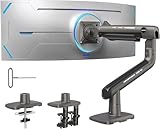
Overview: The HUANUO TitanLift positions itself as a user-friendly heavy-duty solution for ultrawide monitors up to 49 inches and 44 pounds. Emphasizing tool-free tension adjustment and rapid installation, it targets users who frequently reposition their displays.
What Makes It Stand Out: The side-access tension bolt allows effortless one-handed adjustments—eliminating the frustrating trial-and-error process common with other arms. With 22.5-inch extension and rigorous 50,000-cycle testing, it combines exceptional reach with proven long-term reliability.
Value for Money: At $89.98, it’s the priciest standard single-arm option here. The premium reflects its reinforced construction (30% wider base, 20% thicker arms) and user-centric design. Worth it for those prioritizing convenience and durability over absolute cost savings.
Strengths and Weaknesses: Strengths:
- Effortless tension adjustment with included Allen key
- Impressive 22.5-inch arm extension
- Reinforced aluminum alloy with extensive stress testing
- Quick-install VESA head simplifies setup Weaknesses:
- 360° rotation limited for screens larger than 35"
- Most expensive single-arm mount reviewed
- Dual C-clamp mentioned in title but not detailed in specs
Bottom Line: Ideal for users who value hassle-free adjustments and maximum extension. The premium is justified if you frequently change positions or need the extra reach.
4. VIVO Single 13 to 38 inch Ultrawide Monitor Arm Desk Mount, Regular Screens up to 32 inches, 22 lbs capacity, Fully Adjustable Stand with C-Clamp and Grommet Base, Black, STAND-V001

Overview: The VIVO STAND-V001 is an entry-level monitor arm designed for modest ultrawide monitors up to 38 inches and standard displays up to 32 inches. With a 22-pound capacity, it serves users with lighter setups seeking essential ergonomic benefits.
What Makes It Stand Out: Its toolless C-clamp installation requires only hand-tightening, making it the fastest mounting solution available. The exceptional ±90° tilt range and 360° rotation provide flexibility that rivals premium models, while the $35 price point makes it highly accessible.
Value for Money: At $34.99, this is among the most affordable quality monitor arms available. It sacrifices heavy-load capacity for simplicity and cost savings, making it perfect for users with 34-38 inch ultrawides that don’t exceed the 22-pound limit.
Strengths and Weaknesses: Strengths:
- Toolless installation—no Allen keys required
- Exceptional ±90° tilt range for versatile positioning
- Affordable entry into monitor arm ergonomics
- Supports ultrawides up to 38 inches Weaknesses:
- Limited 22-pound weight capacity
- Only 16 inches of height adjustment
- Not suitable for heavy 49-inch ultrawides
- Basic cable management clips
Bottom Line: An excellent starter arm for lighter monitors. Choose this if you have a 34-38 inch ultrawide under 22 pounds and want maximum value with minimal fuss.
5. ULTRARM Heavy Duty Monitor Arm for Ultrawide Monitors up to 57" and 44 lbs, Single Desk Stand, Pneumatic Height Adjustable, Modular Extension Arms - Max VESA 100x100, Black, MA20P-S

Overview: The ULTRARM MA20P-S is a flagship monitor arm engineered for the largest ultrawide displays up to 57 inches and 44 pounds. Its pneumatic spring system and modular architecture cater to enthusiasts with massive screens or plans for future multi-monitor expansions.
What Makes It Stand Out: This is the only arm reviewed supporting 57-inch displays, making it uniquely suited for upcoming super-ultrawide generations. The modular base accepts extension kits for dual or triple monitor configurations, while the pneumatic spring provides smoother height adjustment than traditional gas springs.
Value for Money: At $129.59, it’s the most expensive option but offers forward compatibility that others lack. For users with 57-inch monitors or upgrading plans, it’s a worthwhile investment. For standard 49-inch setups, the premium is harder to justify.
Strengths and Weaknesses: Strengths:
- Exclusive 57-inch monitor support
- Modular design upgrades to dual or triple mounts
- Pneumatic spring for ultra-smooth adjustments
- Accommodates desks up to 3.3" thick Weaknesses:
- Very expensive for single-monitor use
- Limited ±25° tilt range restricts positioning
- Only 13 inches of height adjustment
- Overkill for current 49-inch monitors
Bottom Line: Buy this if you own or plan to own a 57-inch monitor, or want a modular foundation for future expansion. For standard 49-inch setups, more cost-effective options exist.
6. ARES WING Ultrawide Monitor Arm, Heavy Duty Single Monitor Mount for 13"-49" Curved Screens, Adjustable Stand for Desk with C-clamp & Grommet Base up to 40 LBS, Black

Overview: The ARES WING heavy-duty monitor arm tackles the challenge of mounting massive displays with confidence. Supporting screens from 13 to 49 inches and up to 40 pounds (31 pounds for curved models), this versatile mount addresses the growing demand for ultrawide monitor support. Its VESA compatibility and dual mounting options make it adaptable to nearly any workspace configuration.
What Makes It Stand Out: This arm’s exceptional size range and weight capacity set it apart in the mid-tier category. Explicit Samsung G9 compatibility (new version) demonstrates its readiness for premium ultrawide displays. The built-in gas spring system provides smooth, precise adjustments without sudden movements, while the three-step installation process eliminates complexity. Full motion capabilities—including 45° tilt, 90° swivel, and 360° rotation—ensure ergonomic positioning for any task.
Value for Money: At $51.99, this arm strikes an excellent balance between capability and cost. It undercuts premium competitors while delivering the muscle needed for 49-inch displays. For users stepping up from basic mounts, it offers professional-grade features without the premium price tag, making it a smart investment for serious ultrawide owners.
Strengths and Weaknesses: Pros include broad compatibility, high weight capacity, smooth gas spring adjustment, and straightforward installation. The integrated cable management keeps desks tidy. However, curved monitor support drops to 31 pounds, potentially limiting some ultrawide configurations. Some users may need VESA adapters for non-standard monitors.
Bottom Line: An outstanding choice for ultrawide monitor users seeking robust support and smooth adjustability. The ARES WING delivers premium performance at a mid-range price, making it ideal for gaming and professional setups with displays up to 49 inches.
7. WALI Single Monitor Mount, Gas Spring Monitor Arm for 17-34 inch Screens, Adjustable Computer Monitors Stand up to 26.4lbs, with Clamp and Grommet Base, Mounting Holes 75 and 100mm (GSMP001N), Black

Overview: WALI’s budget-friendly gas spring monitor arm delivers essential ergonomic benefits for standard and medium-sized displays. Designed for 17 to 34-inch monitors weighing up to 26.4 pounds, this mount provides full articulation without breaking the bank. It’s an ideal entry point for users seeking to reclaim desk space and improve viewing angles.
What Makes It Stand Out: The exceptional value proposition dominates here—offering gas spring technology at a price point where mechanical springs are typical. The extensive adjustment range impresses, with 180° swivel, 70° tilt, and 360° rotation providing professional-level positioning. US-based customer support available seven days a week adds confidence for first-time buyers. The 19.3-inch extension and 17.3-inch height adjustment offer remarkable flexibility for its class.
Value for Money: At $29.99, this represents one of the best price-to-performance ratios in monitor arms. It delivers core premium features—gas spring adjustment, full motion, and dual mounting options—at nearly half the cost of competitors. For monitors under 34 inches, it makes expensive alternatives difficult to justify.
Strengths and Weaknesses: Strengths include unbeatable pricing, smooth gas spring action, wide adjustability, and reliable customer support. Installation is straightforward with included hardware. Limitations are the 26.4-pound capacity restricting heavier ultrawides, reduced 19.8-pound rating for curved screens, and plastic components that may wear faster than premium metal alternatives.
Bottom Line: The WALI GSMP001N is the definitive budget champion for monitors up to 34 inches. It democratizes ergonomic mounting, making it perfect for home offices, students, and anyone wanting premium adjustability without the premium cost.
8. ARES WING Ultrawide Monitor Arm for 17 to 49 Inch Heavy Duty Curved Screen, Holds 44 Lbs, Adjustable Gas Spring Monitor Arm Desk Mount with C Clamp, Grommet Base, 75/100 Vesa Mount, Black

Overview: This premium ARES WING variant pushes the boundaries of single-monitor mounting, accommodating the heaviest ultrawide displays on the market. With a 44-pound capacity and 17 to 49-inch size range, it targets enthusiasts with flagship monitors like the Samsung Odyssey G9. The robust construction ensures stability where lesser arms would sag or fail.
What Makes It Stand Out: The extraordinary 44-pound weight capacity distinguishes this model, supporting even the most massive curved displays without compromise. Premium materials including high-quality steel and aluminum, combined with fatigue-tested gas springs, guarantee long-term reliability. The 22.4-inch maximum extension and generous height range provide exceptional positioning freedom. Explicit compatibility with major 49-inch ultrawide brands demonstrates thorough engineering validation.
Value for Money: Priced at $69.99, this arm commands a premium over its siblings but remains competitive against brand-name alternatives costing twice as much. For owners of heavy 49-inch monitors, it’s an essential purchase that protects their investment. The durability and precision justify the price for power users.
Strengths and Weaknesses: Pros include class-leading weight capacity, premium build quality, extensive adjustability, and broad compatibility. The easy topside installation and detachable VESA plate simplify setup. Cons are the higher price point that may be unnecessary for smaller monitors, and potential overkill for displays under 40 inches. Some users report needing adapters for proprietary VESA implementations.
Bottom Line: If you own a heavyweight 49-inch ultrawide, this ARES WING is non-negotiable. It combines brute strength with refined adjustment, ensuring your premium display is held securely and positioned perfectly. The investment pays dividends in stability and peace of mind.
9. VIVO Pneumatic Arm Triple Ultrawide Monitor Extra Tall Desk Mount for Up to 49 inch Screens, Heavy Duty Clamp, Holds 3 Ultra Wides Up to 44 lbs, Black, STAND-V300D

Overview: The VIVO STAND-V300D addresses a hyper-specific need: mounting three ultrawide monitors simultaneously. This industrial-grade solution accommodates one 49-inch display flanked by two 38-inch screens, each up to 44 pounds. The extra-tall design and pneumatic arms create a commanding multi-display workspace for traders, developers, and simulation enthusiasts.
What Makes It Stand Out: Triple ultrawide support remains exceedingly rare, making this a niche-defining product. Premium cast aluminum construction provides exceptional rigidity, while pneumatic counterbalance enables effortless height adjustment across all three arms. The high-capacity tilt joints prevent sagging even under heavy loads. Detachable VESA plates streamline the complex installation process.
Value for Money: At $179.99, this mount is expensive but justified by its unique capability. Purchasing three separate heavy-duty arms would cost more and consume excessive desk space. For users requiring this specific configuration, it’s the only practical solution, delivering value through its singular purpose and robust engineering.
Strengths and Weaknesses: Strengths include unmatched triple ultrawide support, premium materials, pneumatic adjustment, and high weight capacity per arm. The clamp base fits thick desktops securely. Weaknesses are the steep price, substantial desk space requirements, and complexity of aligning three large monitors. It’s over-engineered for standard multi-monitor setups and may not suit smaller workspaces.
Bottom Line: This is a specialized tool for specialized needs. If your workflow demands three ultrawide monitors, the VIVO STAND-V300D is your only practical choice. For everyone else, it’s excessive. It excels at its intended purpose but serves a very narrow audience.
10. ARES WING Single Monitor Mount - Ultrawide Monitor Arm for 40 34 32 27 Inch Heavy Duty Curved Screen Up to 26.4 lbs with Clamp/Grommet Desk Mount, 75/100 Vesa Mount, Black

Overview: Positioned as the mid-tier option in ARES WING’s lineup, this mount targets the sweet spot for popular ultrawide sizes. Supporting 17 to 40-inch displays up to 26.4 pounds, it’s tailored for 34-inch and 38-inch curved monitors that dominate the market. The extended column design provides enhanced height adjustment for ergonomic positioning.
What Makes It Stand Out: The 12.3-inch extended column delivers superior height range compared to standard arms, enabling true eye-level positioning for taller users. Integrated cable management transforms cable chaos into a clean aesthetic. The mechanical spring, tested to 25,000+ cycles, offers durability assurance. Quick-release VESA plate and simplified three-step installation reduce setup frustration significantly.
Value for Money: At $39.99, this arm competes aggressively in the crowded mid-range segment. It undercuts gas spring competitors while offering comparable adjustability through its mechanical spring system. For monitors under 40 inches, it provides 90% of premium arm functionality at 60% of the cost, making it a smart value play.
Strengths and Weaknesses: Pros include excellent height adjustment range, integrated cable management, durable mechanical spring, easy installation, and attractive pricing. The wide C-clamp compatibility (0.39"-3.3") fits most desks. Cons are the lower 26.4-pound capacity restricting some 40-inch models, and mechanical springs requiring more adjustment effort than gas springs. Limited to single monitor setups.
Bottom Line: ARES WING’s 40-inch model hits the mainstream ultrawide bullseye. It delivers premium ergonomics and clean aesthetics at a budget-conscious price. Perfect for 34-inch curved monitor owners wanting maximum adjustability without paying for unnecessary 49-inch capacity.
Why Ultrawide Displays Demand Specialized Monitor Arms
Standard monitor arms are engineered for displays weighing 10-15 pounds, but ultrawide monitors routinely tip scales at 20-35 pounds. That weight isn’t distributed evenly either—it’s concentrated across a longer lever arm, creating torque that cheap mounts simply can’t handle. The physics are unforgiving: a 34-inch ultrawide exerts significantly more rotational force than a 27-inch standard display of equal weight.
Beyond raw weight, ultrawide displays introduce unique center-of-gravity challenges. Curved models shift weight forward, while some super-ultrawides (49 inches and beyond) require arms with specific depth compensation. The mounting pattern itself can be problematic—many ultrawides use non-standard VESA placements or require adapter plates that add complexity. Generic arms often sag, drift, or outright fail under these conditions, turning your premium display into a wobbly liability.
Understanding Weight Capacity: The Critical First Step
Weight capacity isn’t a suggestion—it’s a hard ceiling dictated by mechanical engineering. For ultrawide monitors, you must calculate not just the display’s weight, but the total payload including cables, adapters, and any accessories mounted to the screen. Industry best practice dictates selecting an arm rated for at least 20% more than your actual load to account for dynamic forces when adjusting.
Dynamic load differs dramatically from static load. When you tilt or swivel your monitor, you’re introducing acceleration forces that momentarily increase effective weight. A 25-pound monitor might exert 30+ pounds of force during aggressive repositioning. Premium gas spring arms excel here, maintaining consistent resistance throughout their range, while mechanical arms can feel jerky under load. Always check the manufacturer’s specifications for both maximum weight and the weight range—some high-end arms have minimum weight requirements too light for ultrawides.
VESA Mount Standards: What Ultrawide Owners Must Know
The VESA FDMI (Flat Display Mounting Interface) standard governs mounting hole patterns, but ultrawide displays love to break the rules. While 100x100mm remains common on smaller ultrawides, 34-inch and larger models increasingly adopt 200x100mm, 200x200mm, or even proprietary patterns hidden behind removable panels. Some manufacturers recess the mounting points, requiring longer M4 screws or spacers to achieve proper engagement.
Before purchasing any arm, physically inspect your monitor’s back panel. Measure hole spacing precisely and note depth requirements. Many ultrawide owners discover too late that their monitor’s “VESA compatible” label means compatibility with an included adapter that adds weight and instability. Premium monitor arms often include comprehensive VESA hardware kits with multiple screw lengths and spacers—this isn’t just convenience, it’s necessity. For monitors with non-standard patterns, dedicated VESA adapter plates exist, but factor their weight into your capacity calculations.
Desk Mounting Options: Clamps, Grommets, and Beyond
Your desk’s construction fundamentally limits your mounting options. Clamp mounts, the most popular choice, require a vertical lip (desk edge) with sufficient clearance underneath—typically 2-4 inches of uninterrupted space. But many modern desks feature metal support bars, cable trays, or decorative aprons that interfere with clamp placement. Measure twice, purchase once: check both thickness (most clamps accommodate 0.4-3.5 inches) and the presence of any obstructions within 4 inches of the edge.
Grommet mounting offers an elegant alternative for desks with cable management holes, providing superior stability by centering the load. However, the grommet hole must be positioned correctly relative to your seating position—too far back and you’ll lose adjustability; too close and you’ll hit the pole. Wall mounting delivers ultimate stability and desk space savings but sacrifices flexibility and requires locating wall studs or using appropriate anchors. For glass, IKEA-style honeycomb, or exceptionally thick hardwood desks, specialized solutions exist, including through-bolt mounting kits and weight-distributing reinforcement plates.
Gas Spring vs. Mechanical Spring Arms: The Mechanics of Smooth Movement
Gas spring arms use compressed nitrogen cylinders to provide counterbalance, offering buttery-smooth, fingertip adjustments that hold position instantly. They’re ideal for ultrawides because they maintain consistent force across their entire range and can be fine-tuned to exact monitor weights via tension adjustment. The downside? Higher cost and eventual cylinder fatigue—expect 5-7 years of optimal performance before noticeable degradation.
Mechanical spring arms (often torsion or coil spring designs) use physical springs and friction-based locking mechanisms. They’re more affordable and potentially longer-lasting but require manual tightening at desired positions and can develop “stick-slip” behavior under heavy loads. For ultrawides over 30 pounds, mechanical arms need robust construction to avoid gradual sagging. Some hybrid designs combine both technologies, using gas springs for height adjustment and mechanical joints for tilt/swivel, offering a middle ground for budget-conscious buyers.
Articulation and Range of Motion: Defining Your Workspace Flexibility
Ultrawide displays require generous depth adjustment—look for arms extending 20-24 inches forward to position the screen at proper viewing distance. Retractability matters equally; the arm should fold back to within 4-6 inches of the mounting point when you need desk space. Height range needs to accommodate both seated and standing positions, typically 12-14 inches of travel for proper ergonomic alignment.
Tilt range becomes critical with curved ultrawides, which need -5° to +20° adjustment to eliminate glare on their expansive surfaces. Swivel capability (±90°) allows for collaborative viewing but requires a stable base to prevent monitor wobble. Rotation (portrait mode) is largely irrelevant for ultrawides but check that the arm’s design doesn’t obstruct ports or ventilation. Premium arms offer independent joint locking, letting you restrict certain movements while keeping others fluid—perfect for preventing accidental height changes while maintaining tilt flexibility.
Ergonomic Positioning: The Science Behind Proper Ultrawide Setup
The ergonomic equation changes dramatically with ultrawide displays. The viewing distance formula (screen diagonal × 1.5) suggests 51 inches for a 34-inch monitor—impractical for most desks. Reality-based ergonomics recommend positioning the screen so eye level falls 1-2 inches below the top bezel, with the center of the screen 20-30 inches from your eyes. For ultrawides, this often means mounting higher than intuition suggests to prevent neck flexion.
The arm’s height adjustment mechanism must accommodate this without bottoming out. Consider your seated elbow height (keyboard position) and ensure the arm can position the monitor’s bottom edge at least 3 inches above desk height. For 49-inch super-ultrawides, the curve radius affects optimal positioning—1800R monitors need to be closer than 2300R models to maintain consistent viewing angles. The arm should allow micro-adjustments of 0.5-inch increments to dial in perfect alignment.
Cable Management: Taming the Tangle
Ultrawide monitors amplify cable management challenges. You’re routing thick power cables, DisplayPort or HDMI cables, USB hubs, and potentially Ethernet or audio lines across a moving arm. Cheap monitor arms treat cable management as an afterthought, providing a few plastic clips that crack under cable weight. Look for integrated channels with removable covers that can accommodate 5-7 cables of varying thicknesses.
Cable length becomes critical—purchase cables 1.5-2 times the arm’s maximum extension to prevent tension during movement. Premium arms include strain relief points at both the monitor and desk ends, preventing connector damage. Consider cable weight in your calculations; a bundle of thick cables can add 1-2 pounds to the effective load. Some ultrawides have downward-facing ports that require extra cable slack to avoid port stress, making arms with generous internal routing space essential. Magnetic cable management systems offer the cleanest aesthetic but may interfere with monitor speakers or other sensitive components.
Build Quality and Materials: From Budget to Premium
The difference between a $50 arm and a $300 arm isn’t just branding—it’s metallurgy. Budget arms use stamped steel with minimal thickness (1.5-2mm) that flexes under ultrawide loads, while premium arms employ die-cast aluminum alloys or 3mm+ steel construction. The pivot points reveal true quality: look for steel or brass bushings with lubrication ports, not plastic sleeves that wear into oblong shapes.
Finish quality matters beyond aesthetics. Powder-coated surfaces resist scratches and maintain smooth operation, while painted finishes chip and create friction. The pole diameter indicates stability—1.5-inch poles are minimum for ultrawides, with 2-inch poles providing rock-solid support for displays over 30 pounds. Check the clamp mechanism’s construction; cast aluminum clamps with steel reinforcement bolts outperform all-steel designs that can deform under torque. Warranty length directly correlates with expected lifespan—10-year warranties indicate confidence in mechanical longevity.
Installation Complexity: What to Expect
Installing a monitor arm for an ultrawide display is a two-person job, period. The monitor’s size and weight make solo mounting dangerous for both you and the screen. Budget 45-90 minutes for first-time installation, including desk preparation. Before ordering, verify you have access to the underside of your desk—some clamp designs require tightening from below while supporting the arm’s weight simultaneously.
Tool requirements vary: most arms include basic Allen keys, but you’ll need a drill for grommet installation, a level for wall mounting, and potentially a stud finder. The most common installation failure point is insufficient clamp torque—use a torque wrench to achieve manufacturer specifications, typically 15-20 Nm. For ultrawides, consider professional installation if your desk requires modification or if you’re wall mounting. Many vendors offer installation services for 10-15% of the arm’s cost, which includes load testing and ergonomic positioning consultation.
Budget Considerations: Balancing Cost and Performance
The ultrawide monitor arm market segments into three tiers. Entry-level ($50-$100) offers basic functionality for monitors under 25 pounds, typically with mechanical springs and limited articulation. Mid-range ($100-$200) provides gas spring counterbalance and better build quality, suitable for most 34-inch ultrawides. Premium ($200-$400) delivers the stability and smoothness required for 38-inch+ displays, with superior materials and 10+ year lifespans.
Consider total cost of ownership. A $150 arm that lasts 8 years costs less annually than a $60 arm replaced every 2 years. Factor in potential desk damage from failed clamps—saving $50 on an arm that cracks your $800 desk is false economy. For dual-arm setups (ultrawide + secondary display), budget $250-$350 for a quality system that can handle the combined weight and maintain independent adjustment. Remember to allocate 10-15% of your arm budget for quality cables and potential installation assistance.
Common Pitfalls and How to Avoid Them
The number one mistake is underestimating weight by excluding cables and adapters. Always weigh your fully-equipped monitor with all peripherals attached. Second is ignoring desk thickness variations—many modern desks taper at edges, making clamp measurements at the center misleading. Measure at the exact clamp location. Third is purchasing based on maximum extension without considering retraction; an arm that extends 24 inches but only retracts to 12 inches leaves your monitor permanently dominating desk space.
Another frequent error is assuming VESA compatibility means direct mounting. Some ultrawides require OEM adapter plates that shift the center of gravity forward, effectively increasing the load on the arm. Test the arm’s tilt mechanism with your actual monitor before finalizing installation—some arms hold static weight fine but drift under the dynamic load of tilting. Finally, don’t overlook port accessibility. Arms with low-profile mounting plates can block bottom-facing ports, forcing you to dismount the monitor for cable changes.
Future-Proofing Your Monitor Arm Investment
Your next ultrawide will likely be heavier, larger, or have a different VESA pattern. Smart buyers select arms with 30+ pound capacity even for current 25-pound monitors, anticipating the inevitable upgrade. Look for arms with interchangeable mounting heads—some premium systems allow swapping between clamp, grommet, and wall mounts without replacing the entire arm. USB-C power delivery integration is emerging; arms with built-in cable channels designed for thick USB-C cables will handle tomorrow’s single-cable solutions better.
Consider modularity. Some systems allow adding extension arms or secondary monitor brackets later. The pole mounting standard (typically 1-7/8 inch or 2-inch diameter) should be compatible with accessories from multiple manufacturers, preventing vendor lock-in. Gas spring arms with externally accessible tension adjustments future-proof against monitor weight changes, while sealed systems require replacement when your setup evolves. Think five years ahead: will this arm handle a potential 42-inch OLED ultrawide? The answer should influence your purchase today.
Maintenance and Care for Long-Term Performance
Even premium monitor arms require periodic maintenance to maintain smooth operation. Every six months, inspect all adjustment points for loosening—vibrations from typing and desk movement gradually reduce bolt torque. Apply a single drop of light machine oil to each pivot point annually; avoid over-lubrication that attracts dust. For gas spring arms, cycle the height adjustment through its full range monthly to distribute lubricant and prevent seal sticking.
Clean the pole and joints with a microfiber cloth to remove abrasive dust particles that accelerate wear. Check cable management channels quarterly for tension—cables can gradually pull tight, stressing connectors and affecting arm balance. If you notice drift or sagging, immediately reduce the load and check for mechanical damage. Most manufacturers offer rebuild kits for premium arms, replacing worn bushings and seals for 20-30% of new arm cost. Store your original packaging and hardware; warranty claims often require specific components. With proper care, a quality arm will outlast multiple monitor generations.
Frequently Asked Questions
1. Can I use a regular monitor arm for my 34-inch ultrawide?
Only if the arm’s weight capacity exceeds your monitor’s total weight (including cables) by at least 20% and it supports your VESA pattern. Most standard arms top out at 15-20 pounds, insufficient for most ultrawides. Even if weight ratings match, the extended leverage of a 34-inch screen can cause sagging and instability. Always choose an arm specifically rated for ultrawide or heavy-duty use.
2. How do I measure my monitor’s VESA pattern correctly?
Measure the horizontal and vertical distance between the centers of the mounting holes in millimeters. Common ultrawide patterns include 100x100mm, 200x100mm, and 200x200mm. Check for recessed mounting points that require longer screws. Some monitors hide VESA holes behind removable panels or require adapter plates that add weight. Always consult your monitor’s manual and physically inspect the back panel before ordering an arm.
3. What’s the ideal viewing distance for an ultrawide monitor on an arm?
Position the screen 20-30 inches from your eyes, with the top bezel 1-2 inches above eye level. For curved ultrawides, adjust distance based on curvature—1800R models work best at 20-24 inches, while 2300R can be slightly farther. The arm should allow you to maintain this distance while keeping your neck in a neutral position and elbows at 90 degrees when typing.
4. Will a monitor arm damage my desk?
Quality clamp mounts distribute load across a 4-6 square inch area, typically safe for solid wood and most engineered wood desks thicker than 0.75 inches. However, IKEA-style honeycomb desks, glass tops, and thin particle board can crack under pressure. Use reinforcement plates for questionable surfaces. Grommet mounting generally poses less risk but requires a properly positioned hole. Always check desk manufacturer guidelines.
5. How much should I spend on a monitor arm for my ultrawide?
Budget $100-$200 for a reliable gas spring arm supporting 25-35 pounds, suitable for most 34-38 inch ultrawides. For 43-inch+ super-ultrawides or heavy professional displays, invest $250-$350 in a premium arm with 30+ pound capacity and superior build quality. Remember that a quality arm protects a $500-$1500 monitor investment and lasts 8-10 years, making the cost-per-year minimal.
6. Can I mount two ultrawide monitors on one arm?
Standard single arms cannot safely support two ultrawides. Use a dual-arm system with independent mounting points, ensuring the combined weight doesn’t exceed the pole or base capacity. For side-by-side ultrawides, you’ll need a heavy-duty pole system rated for 50+ pounds total. Consider ergonomics—two ultrawides create extreme width requiring significant head rotation, often better served by a primary ultrawide and secondary standard monitor.
7. How do I prevent my ultrawide from sagging or drifting?
Sagging indicates insufficient spring tension or worn components. Increase gas spring tension according to manufacturer instructions, typically via a hex screw at the arm base. For mechanical arms, tighten friction joints to specified torque. If sagging persists, your monitor exceeds the arm’s dynamic load capacity. Drifting (slow movement after adjustment) suggests worn bushings or insufficient clamping force—inspect and replace worn parts immediately to prevent damage.
8. Is professional installation worth the cost?
For most clamp or grommet installations, DIY is feasible if you follow instructions and have a helper. Professional installation ($50-$100) becomes worthwhile for wall mounting, desks requiring modification, or ultra-heavy monitors (40+ pounds) where precise balancing is critical. Installers also handle cable management and ergonomic positioning, saving you 1-2 hours of trial-and-error. Many retailers bundle installation at discounted rates.
9. How do I know if my desk is too thick for a clamp mount?
Measure the exact thickness where the clamp will sit, not the desk’s average thickness. Most quality clamps accommodate 0.4-3.5 inches. If your desk exceeds this, consider gromet mounting (requires a 0.4-3.5 inch thick mounting surface) or a wall mount. For exceptionally thick desks, some manufacturers offer extended clamp bolts, but these reduce stability. Never modify a clamp to fit—this voids warranties and creates safety hazards.
10. Can monitor arms improve my posture and reduce neck pain?
Absolutely. Proper monitor arm positioning aligns the screen with your natural line of sight, reducing forward head posture and neck strain. Studies show optimal monitor placement can reduce neck flexion by 15-20 degrees, significantly decreasing muscle fatigue. The ability to easily adjust height for sitting vs. standing positions promotes movement and reduces static loading. However, the arm is only a tool—you must still position it correctly and maintain good overall ergonomics.