Your MacBook Pro is a powerhouse of portability, but that sleek design comes with a trade-off: limited ports. As you’ve probably discovered, juggling dongles and adapters quickly turns your minimalist workspace into a cable nightmare. Thunderbolt 4 docks are the elegant solution that transforms your laptop into a full desktop workstation with a single cable connection—delivering power, data, display output, and peripheral connectivity all at once. But not all docks are created equal, and choosing the right one requires understanding a complex landscape of specifications, compatibility issues, and performance trade-offs.
This comprehensive guide cuts through the marketing jargon to give you the technical knowledge you need to make an informed decision. Whether you’re a creative professional managing 8K video workflows, a developer running multiple external displays, or a remote worker seeking a clutter-free setup, we’ll explore what truly matters when selecting a Thunderbolt 4 dock for your MacBook Pro. No product pitches, no sponsored recommendations—just pure, actionable expertise.
Top 10 Thunderbolt 4 Docks for MacBook Pro
Detailed Product Reviews
1. Plugable Thunderbolt 4 Dock for M4 MacBook Air & M5 Pro: 100W Charging Driverless Laptop Docking Station with 4K HDMI Dual Monitor or Single 6K, 6X USB, SD, Ethernet, Thunderbolt Certified (TBT-UDM)
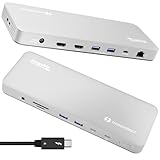
Overview: The Plugable TBT-UDM delivers solid Thunderbolt 4 performance in a sleek space-gray aluminum chassis designed specifically for modern MacBooks. This 13-in-1 dock provides dual 4K 60Hz HDMI outputs, 100W host charging, and driverless plug-and-play operation. It targets M4/M5 MacBook users seeking a hassle-free dual-monitor setup without the premium price tag of Thunderbolt 5 alternatives.
What Makes It Stand Out: True driverless compatibility sets this dock apart—no software installation required for Mac or Windows Thunderbolt 4 systems. The M4/M5 optimization ensures seamless dual-display support where base M1/M2 chips fall short. Its lifetime North American-based support is exceptional in an industry dominated by limited warranties. The streamlined port arrangement includes a downstream Thunderbolt 4 port, SD/microSD UHS-II readers, and multiple USB options, making it ideal for creative workflows.
Value for Money: At $199.95, this dock sits at the sweet spot for Thunderbolt 4 connectivity. It undercuts many competitors while delivering certified performance and robust charging. While it lacks Thunderbolt 5’s future-proofing, most users won’t saturate 40Gbps bandwidth. The lifetime support alone justifies the investment over budget alternatives that cut corners on reliability and customer service.
Strengths and Weaknesses: Strengths: Driverless Mac/Windows compatibility; dedicated M4/M5 dual-display support; premium aluminum build; lifetime support; competitive pricing. Weaknesses: Limited to dual 4K (no 8K); Gigabit Ethernet (not 2.5G); downstream TB4 port provides only 15W charging; base M1/M2 Macs restricted to single display.
Bottom Line: The TBT-UDM is an excellent choice for MacBook users wanting reliable dual-monitor expansion without complexity or cost. It balances performance, build quality, and support in a package that justifies every dollar.
2. Anker Prime TB5 Docking Station, 14-in-1 Thunderbolt 5 Dock with 120Gbps Max Transfer, Thunderbolt Dock with 140W Max Charging, Cooling System, Up to 8K, Dual Display for TBT 5/4 Laptops

Overview: Anker’s Prime TB5 represents the cutting edge of docking technology, leveraging Thunderbolt 5’s 120Gbps bandwidth for unprecedented performance. This 14-in-1 powerhouse supports dual 8K displays, 140W charging, and includes an active cooling system. Designed for power users with massive file transfers and next-generation peripherals, it’s the first true Thunderbolt 5 dock to hit the consumer market at a premium price point.
What Makes It Stand Out: The 120Gbps transfer speed is revolutionary—moving 150GB in just 25 seconds. The intelligent cooling system prevents thermal throttling under sustained loads, a common issue with high-performance docks. Dual Thunderbolt 5 downstream ports future-proof your setup, while the 140W PD 3.1 charging handles power-hungry laptops and peripherals simultaneously. Anker’s robust build quality and 24-month warranty add enterprise-grade reliability.
Value for Money: At $399.99, this is a significant investment, but justifiable for professionals needing tomorrow’s technology today. The performance gains over Thunderbolt 4 are tangible for video editors, 3D artists, and data scientists. For average users, however, the premium is harder to justify when TB4 docks handle most tasks competently at half the price. It’s a forward-looking purchase, not a value play.
Strengths and Weaknesses: Strengths: Thunderbolt 5 future-proofing; blistering 120Gbps speeds; 140W charging; active cooling; dual 8K display support; premium construction. Weaknesses: High price; limited TB5 device ecosystem; overkill for mainstream users; Mac compatibility restrictions on base models.
Bottom Line: Buy the Anker Prime TB5 if you’re a high-end creative professional or IT manager building a future-ready workspace. For everyone else, Thunderbolt 4 docks offer better value until TB5 peripherals become mainstream.
3. Plugable 16-in-1 Thunderbolt 4 Dock – Dual 4K Monitors for M4/M5 MacBook Air/Pro, 100W Charging, 2X HDMI, 2X DisplayPort, 2.5G Ethernet, 7X USB, MicroSD/SD Card Reader, Windows & USB4 Compatible

Overview: Plugable’s 16-in-1 Thunderbolt 4 dock earns its “Dock of the Year” title by maximizing connectivity without sacrificing performance. With dual HDMI/DisplayPort options, 2.5Gbps Ethernet, and seven USB ports, it’s built for power users who need everything connected simultaneously. The 100W charging keeps laptops powered while handling dual 4K displays and multiple peripherals across Mac, Windows, and USB4 platforms.
What Makes It Stand Out: The 2.5G Ethernet is a standout feature, doubling network speeds over Gigabit for professionals working with large files on NAS systems. Seven USB ports (mix of USB-C and USB-A) eliminate the need for additional hubs. The flexible video outputs—two HDMI and two DisplayPort—provide unmatched display compatibility. Its award-winning status reflects rigorous testing and proven reliability in demanding environments.
Value for Money: Priced at $269.95, this dock commands a premium over basic Thunderbolt 4 models but delivers measurable upgrades. The 2.5G Ethernet alone justifies $50-70 for network-intensive workflows. When factoring in the superior port selection and award recognition, it’s competitively priced against enterprise alternatives that cost $100 more. For users needing maximum connectivity, it’s a smart mid-range investment.
Strengths and Weaknesses: Strengths: Extensive 16-port layout; 2.5G Ethernet; flexible dual 4K video outputs; award-winning reliability; broad compatibility. Weaknesses: No 8K support; downstream TB4 port limited to 15W; larger footprint; $70 premium over simpler TB4 docks.
Bottom Line: This is the dock for professionals who refuse to compromise on connectivity. If you need every port imaginable with proven reliability, the extra cost pays for itself in productivity gains.
4. Plugable Thunderbolt 4 Dock with 100W Charging, Thunderbolt Certified, Laptop Docking Station Dual Monitor Single 8K or Dual 4K HDMI for Windows and Mac, 4X USB, Gigabit Ethernet (TBT4-UD5)

Overview: Recognized by Wirecutter as the Best Thunderbolt Dock of 2025, the TBT4-UD5 delivers certified excellence in a compact 13-port package. It uniquely supports both dual 4K and single 8K configurations, making it versatile for different display setups. The Intel Evo certification guarantees seamless compatibility with premium laptops, while the 100W Power Delivery ensures your device stays charged during intensive tasks.
What Makes It Stand Out: Wirecutter’s endorsement signals exceptional reliability and performance validation. The single 8K display option future-proofs your setup for next-generation monitors, while maintaining dual 4K capability for current multi-screen workflows. The downstream Thunderbolt 4 port supports 8K output and 15W charging, enabling daisy-chaining. Intel Evo certification ensures flawless integration with Intel’s premium laptop ecosystem, a rare distinction among docks.
Value for Money: At $199.95, this dock matches the TBT-UDM’s price while adding 8K capability and award-winning pedigree. You’re getting third-party validated performance for the same cost as lesser-certified competitors. The value proposition is exceptional—Wirecutter rarely awards budget-friendly products, indicating this punches above its price class. It’s a no-brainer for discerning buyers who trust expert testing.
Strengths and Weaknesses: Strengths: Wirecutter 2025 award; 8K single display support; Intel Evo certified; competitive pricing; dual 4K flexibility. Weaknesses: Gigabit Ethernet (not 2.5G); only four USB ports; downstream TB4 charging limited to 15W; no SD card reader.
Bottom Line: If you want award-winning performance without the premium price, this is your dock. The TBT4-UD5 combines validation, versatility, and value in a package that’s hard to beat for most users.
5. Dell SD25TB4 Pro Thunderbolt 4 Smart Dock - Supports 8k Display, 3 Years Warranty with 180W Adapter, HDMI, DisplayPort, Thunderbolt Cable, Cloth - USB C Docking Station Hub with Accessories

Overview: Dell’s SD25TB4 Pro targets enterprise environments with modular upgradeability and a massive 180W power adapter. This Thunderbolt 4 dock supports 8K displays and includes a comprehensive three-year warranty, reflecting its business-grade design. The swappable module system allows IT departments to future-proof investments, while the included accessories—cable and cleaning cloth—add professional polish for corporate deployments.
What Makes It Stand Out: The three-year warranty is unmatched in the consumer space, providing peace of mind for business users. Modular design lets you upgrade connectivity modules without replacing the entire dock, reducing long-term TCO. The 180W adapter delivers 130W to the laptop plus reserves power for multiple peripherals, eliminating power contention issues. Dell’s SuperBoost technology optimizes charging and data transfer, while enterprise-focused firmware ensures stable fleet deployment.
Value for Money: At $309.99, this commands a premium over consumer docks, but enterprises aren’t paying for features—they’re paying for reliability and support. The modular architecture and extended warranty justify the cost for IT managers who calculate total cost of ownership, not just purchase price. For home users, the value proposition is weaker unless you specifically need the warranty or Dell ecosystem integration.
Strengths and Weaknesses: Strengths: 3-year warranty; 180W power supply; modular upgradeability; enterprise-grade reliability; 8K support; Dell ecosystem optimization. Weaknesses: Higher price; fewer ports than 16-in-1 alternatives; Gigabit Ethernet; overkill for casual users.
Bottom Line: The SD25TB4 Pro is engineered for corporate fleets, not coffee tables. If you’re managing office deployments or demand maximum warranty coverage, it’s worth every penny. Individual users should consider more cost-effective options unless Dell loyalty runs deep.
6. Anker USB C Hub for MacBook, 7-in-2 with 4K@60Hz HDMI, Compatible with Thunderbolt 4, 1 Type C and 2 USB A Data Ports for MacBookPro 13 Inch, MacBookAir M1 / M2, and More

Overview: The Anker USB C Hub delivers essential connectivity for MacBook users seeking an affordable, compact solution. This 7-in-2 adapter transforms your two MacBook USB-C ports into a versatile workstation with HDMI, USB-A, SD/microSD slots, and pass-through charging. Designed specifically for MacBook Air and Pro models, it integrates seamlessly without blocking the MagSafe port, making it an ideal travel companion or desk accessory for everyday tasks.
What Makes It Stand Out: Its tailored MacBook design ensures perfect alignment and port access, a rarity in universal hubs. The multi-function USB-C port supports 100W power delivery and blazing 40Gb/s data transfer while simultaneously handling 5K display output. The 4K@60Hz HDMI port provides crisp video for presentations or entertainment. Anker’s thoughtful engineering avoids MagSafe obstruction, a common flaw in competing products.
Value for Money: At $54.99, this hub punches above its weight, offering premium features like 40Gb/s speeds typically found in pricier Thunderbolt docks. It’s an excellent middle ground between basic adapters and expensive docking stations, making it ideal for users who need more ports without breaking the bank. The 18-month warranty provides confidence in this budget-friendly investment.
Strengths and Weaknesses: Strengths include MacBook-specific design, high-speed data transfer, and pass-through charging. The compact form factor travels easily. Weaknesses: limited to two USB-C inputs, no Ethernet port, and M1/M2 MacBooks can’t utilize dual external displays. The port selection is modest compared to full docks.
Bottom Line: The Anker 7-in-2 is perfect for MacBook users wanting essential expansion without bulk or budget strain. It excels at everyday tasks and travel, though power users needing Ethernet or multiple displays should look elsewhere.
7. Satechi Thunderbolt 4 Dock 100W Charging, Dual Monitor HDMI 4K/60Hz, 40Gbps Data Transfer, 2 USB-A 3.2, Ethernet, Thunderbolt 4 Dock for MacBook Air/Pro M5, Mac/Windows, DisplayLink Software Required

Overview: The Satechi Thunderbolt 4 Dock positions itself as a premium workstation solution for professionals demanding maximum connectivity. This robust dock delivers 100W charging, 40Gbps data transfer, and support for up to four 4K displays via DisplayLink technology. With dual HDMI ports, multiple Thunderbolt 4 connections, Ethernet, and UHS-II SD card reader, it handles complex workflows effortlessly across Mac and Windows platforms.
What Makes It Stand Out: Its quad-display capability sets it apart, though Mac M1/M2 users are limited to three extended displays. The integration of three Thunderbolt 4 ports allows daisy-chaining up to six devices, while the UHS-II SD reader at 312MB/s caters to content creators. The 100W power delivery charges even demanding laptops, and the 2-year warranty exceeds industry standards.
Value for Money: At $299.99, it’s a significant investment but justified for professionals needing extensive I/O. Comparable Thunderbolt 4 docks hover in this range, and the inclusion of DisplayLink support, UHS-II reader, and robust charging makes it competitive. For users requiring multi-monitor setups, it’s cheaper than buying separate adapters.
Strengths and Weaknesses: Strengths include versatile display options, high-speed data transfer, comprehensive port selection, and strong Mac/PC compatibility. Weaknesses: DisplayLink software requirement adds setup complexity, and the operating temperature can reach 131°F. The price may deter casual users, and base M-chip Macs face display limitations.
Bottom Line: Ideal for creative professionals and power users needing multi-monitor setups and fast data access. The setup complexity is worth the performance gains, though budget-conscious buyers should consider simpler alternatives.
8. CalDigit TS4, 18-in-1 Thunderbolt 4 Docking Station, 98W Charging, 3* TBT4 (40Gb/s), 3* USB-C + 5* USB-A (10Gb/s), 2.5GbE LAN, 18K@30Hz or 26K@60Hz Displays, Mac/Windows/Chrome, 0.8m Certified Cable

Overview: The CalDigit TS4 represents the pinnacle of Thunderbolt 4 docking with an unprecedented 18 ports packed into a sleek chassis. This powerhouse delivers 98W charging, three Thunderbolt 4 ports, five USB-A and three USB-C ports (all 10Gb/s), 2.5GbE Ethernet, and dual card readers. It supports single 8K or dual 6K displays, catering to the most demanding workflows from video editing to software development.
What Makes It Stand Out: The sheer port density is unmatched—eight USB ports at full 10Gb/s speed is exceptional. The 2.5GbE Ethernet provides future-proof networking 2.5x faster than standard Gigabit. Its universal compatibility spans Thunderbolt 3/4, USB4, and USB-C devices across Mac, Windows, and Chrome OS, making it truly platform-agnostic for mixed device environments.
Value for Money: At $379.99, it’s undeniably premium but delivers commensurate value. No competitor offers this port selection and speed combination. For professionals needing maximum connectivity without compromise, it eliminates the need for multiple adapters and hubs, justifying the cost through consolidation and performance.
Strengths and Weaknesses: Strengths include industry-leading port count, full-speed USB ports, 2.5GbE networking, and exceptional build quality. Weaknesses: premium pricing may exceed casual user needs, and the 0.8m cable could be short for some setups. Base M1-M3 Macs remain limited to single display due to Apple hardware constraints.
Bottom Line: The ultimate dock for power users who refuse to compromise. If you need every port imaginable and future-proof networking, the TS4 is unmatched. Budget buyers should look at simpler options, but professionals will find it worth every penny.
9. Satechi Thunderbolt 4 Dock Slim Hub Pro, USB C 100W Charging, Single 8K or Dual 4K Display, 4 Thunderbolt 4 Ports, USB 3.2 Gen2, for Mac/Windows, MacBook Air/Pro M5/M4, Dell, Surface, Lenovo

Overview: The Satechi Thunderbolt 4 Dock Slim Hub Pro balances portability with performance in a compact form factor. This sleek dock provides 100W charging, four Thunderbolt 4 ports, and a USB-A 3.2 Gen 2 port. It supports dual 4K@60Hz or single 8K displays, making it versatile for modern workflows. Designed for Mac and Windows, it emphasizes clean aesthetics and efficient operation while maintaining full Thunderbolt 4 capabilities.
What Makes It Stand Out: Its slim profile distinguishes it from bulkier docks while maintaining full Thunderbolt 4 capabilities. The four Thunderbolt ports offer exceptional flexibility for daisy-chaining devices. Satechi explicitly addresses heat management, with designed thermal dissipation operating at 30-50°C, ensuring reliability during intensive tasks. The 150W GaN power supply is efficiently designed for its class.
Value for Money: At $199.99, it hits a sweet spot between budget hubs and premium docks. You get Thunderbolt 4 speeds and dual display support without paying for excessive ports you might not use. The 2-year warranty and included cable enhance its value proposition for users wanting streamlined expansion.
Strengths and Weaknesses: Strengths include compact design, adequate Thunderbolt 4 ports, strong charging capability, and thoughtful thermal design. Weaknesses: limited USB-A ports (only one), no Ethernet, SD card reader, or audio jacks. DisplayLink is not supported, limiting some display configurations, and the “Slim” name belies its focused port selection.
Bottom Line: Perfect for users prioritizing desk space and Thunderbolt connectivity over maximum port variety. It’s ideal for modern laptop setups with wireless peripherals. If you need Ethernet or card readers, consider alternatives, but for streamlined Thunderbolt expansion, it’s excellent.
10. iVANKY Dual Thunderbolt 4 Chips FusionDock Max 1 for Quad 6K@60Hz Display (20-in-1 Dock for M5/M4/M3/M2/M1 Pro/Max Mac) (6 * 40Gbps TB4, 2.5GbE, SD/TF 4.0) Docking Station Hub, Windows Incompatible

Overview: The iVANKY FusionDock Max 1 targets MacBook Pro power users with M1/M2/M3/M4 Max chips, delivering quad 6K@60Hz display support—a rare feat. This 20-in-1 dock features six Thunderbolt 4 ports, seven USB 3.2 ports, SD/TF 4.0 readers, and 2.5GbE Ethernet. The 180W power adapter provides 96W laptop charging and 30W PD for devices, creating a comprehensive workstation hub exclusively for Mac.
What Makes It Stand Out: Its specialized focus on high-end MacBook Pro models enables quad extended displays for Max chip variants, unmatched by universal docks. The six Thunderbolt 4 ports offer unprecedented expansion for storage arrays, eGPUs, and peripherals. Every port operates at maximum speed, catering to professional video editing and development workflows where bandwidth is critical.
Value for Money: At $299.98, it’s competitively priced for its niche. While expensive for average users, professionals needing quad displays and massive Thunderbolt expansion will find it cheaper than buying multiple docks. The limitation to Mac-only usage restricts its audience but optimizes performance for Apple’s ecosystem.
Strengths and Weaknesses: Strengths include quad-display support for Max chips, six Thunderbolt 4 ports, high-speed card readers, and robust power delivery. Weaknesses: completely incompatible with Windows/Chrome devices, overkill for base M-chip Macs, and the complex display support matrix may confuse buyers. The “FusionDock” branding emphasizes its dual-chip design.
Bottom Line: An exceptional specialized dock for MacBook Pro Max users needing maximum displays and Thunderbolt expansion. If you’re not running a Max-chip Mac, look elsewhere. For the target audience, it’s a game-changing workstation solution that justifies its price.
Understanding Thunderbolt 4 Technology
Thunderbolt 4 represents Intel’s latest iteration of the universal connectivity standard, and it’s a game-changer for MacBook Pro users. While it maintains the same 40Gbps maximum bandwidth as Thunderbolt 3, the real magic lies in the mandatory requirements that eliminate the guesswork from your purchasing decisions. Every Thunderbolt 4 port must support dual 4K displays or a single 8K display, provide at least 15W of power for accessory charging, and include Intel VT-d-based direct memory access (DMA) protection.
For MacBook Pro users, this standardization means you can finally trust that any certified Thunderbolt 4 dock will deliver consistent baseline performance. The protocol also mandates PCIe 32Gb/s speeds, USB4 compliance, and support for wake-from-sleep functionality—features that were optional and inconsistent in the Thunderbolt 3 era. Understanding these non-negotiable specs helps you separate genuine Thunderbolt 4 docks from USB4 devices that might carry similar branding but lack the full feature set your MacBook Pro can exploit.
Why MacBook Pro Users Specifically Need Thunderbolt 4
Apple’s integration of Thunderbolt technology runs deeper than the port shape suggests. Your MacBook Pro’s Thunderbolt controller is directly tied to the system’s PCI Express bus, meaning data flows with minimal latency and maximum throughput. This architectural advantage makes Thunderbolt 4 docks particularly potent for macOS users compared to USB-C alternatives.
The M-series chips in modern MacBook Pros include dedicated Thunderbolt controllers that optimize performance for ProRes video playback, Time Machine backups, and external GPU enclosures. When you connect a Thunderbolt 4 dock, you’re essentially extending your MacBook’s internal bus architecture—something USB hubs simply cannot replicate. This becomes critical when daisy-chaining multiple high-bandwidth devices like NVMe storage arrays and capture cards, where every millisecond of latency impacts your workflow.
Key Features to Prioritize in Your Dock
When evaluating Thunderbolt 4 docks, certain features separate premium solutions from basic port expanders. Power delivery capacity should top your list—look for docks offering 96W or higher to fast-charge 16-inch MacBook Pro models while powering peripherals. Display output capabilities matter equally; verify support for your specific monitor configuration, whether that’s dual 6K Pro Display XDRs or a single ultrawide.
Data transfer speeds across all ports deserve scrutiny. Many docks advertise Thunderbolt 4 speeds but throttle USB-A ports to USB 2.0 rates when multiple devices are active. Check independent specifications for each port type under load, not just theoretical maximums. Additionally, consider downstream Thunderbolt 4 ports that maintain full 40Gbps bandwidth—essential for connecting second-tier high-performance devices without creating bottlenecks.
Port Selection Strategy: Quality Over Quantity
A common mistake is choosing docks based on total port count rather than port utility. For MacBook Pro workflows, prioritize USB-C ports with 10Gbps minimum speeds over numerous slower USB-A connections. Each USB-C port should support both data and DisplayPort Alt Mode, giving you flexibility for modern peripherals and direct monitor connections.
Ethernet connectivity warrants special attention. While many docks include Gigabit Ethernet, creative professionals benefit from 2.5GbE or 5GbE ports that match modern NAS speeds. The Realtek RTL8156 controller found in premium docks delivers these speeds while maintaining rock-solid macOS driver support. For audio work, don’t settle for basic 3.5mm jacks—seek docks with dedicated S/PDIF optical output or USB audio interfaces with built-in DACs that bypass macOS’s sometimes-problematic audio routing.
Power Delivery Deep Dive
Thunderbolt 4’s power delivery specifications are more nuanced than the wattage number suggests. Your dock negotiates power through a complex handshake that considers your MacBook Pro’s battery state, current draw, and thermal conditions. Docks delivering 96W or more use advanced PD 3.0 controllers with programmable power supply (PPS) modes, enabling finer voltage control that reduces heat generation during sustained charging.
Be wary of docks that share power delivery capacity across ports. Some budget options advertise 96W total but split that between the laptop connection and downstream USB-C ports, leaving your MacBook Pro undercharged during intensive tasks. Premium docks feature independent power rails, ensuring your laptop receives full wattage regardless of peripheral load. This becomes crucial during video rendering or compilation tasks when your MacBook Pro’s CPU draws peak power for extended periods.
Display Support: Beyond the Spec Sheet
Thunderbolt 4’s mandatory dual 4K display support is just the starting point for MacBook Pro users. The real consideration is how docks handle varying refresh rates, color depths, and HDR metadata. Your M-series MacBook Pro uses Display Stream Compression (DSC) to push higher resolutions through the bandwidth constraints, but not all docks properly pass DSC signals—resulting in reduced refresh rates or color banding on high-end monitors.
For multi-monitor setups, understand that macOS treats Thunderbolt-connected displays differently than HDMI or DisplayPort directly from the dock. Some docks use MST (Multi-Stream Transport) hubs that macOS doesn’t support, forcing you into mirroring mode instead of extended desktop. Look for docks with independent display controllers per video output, ensuring each monitor receives a dedicated signal that macOS recognizes as a separate display. This technical detail is rarely mentioned in marketing materials but determines whether your triple-monitor ambition becomes reality.
Daisy Chaining and Bandwidth Management
One of Thunderbolt 4’s most powerful features is daisy chaining—connecting up to six devices in series from a single port. However, bandwidth allocation follows strict rules that can bottleneck your workflow if misunderstood. When you daisy chain storage behind a dock, both devices share that single 40Gbps pipeline, but not equally. The first device in the chain reserves bandwidth for its maximum capability, leaving the remainder for downstream devices.
For MacBook Pro users, optimal topology places your dock as the central hub, with high-bandwidth devices like NVMe enclosures connected directly to the dock’s downstream Thunderbolt ports rather than daisy chained. This star configuration prevents a slow device from throttling faster ones. Additionally, understand that PCIe data and display traffic compete for bandwidth—driving two 4K displays at 60Hz consumes approximately 18Gbps, leaving 22Gbps for data. During heavy file transfers, temporarily lowering display refresh rates can boost transfer speeds by 30-40%.
Build Quality and Thermal Design
A dock’s physical construction directly impacts performance and longevity. The Thunderbolt 4 controller and supporting chips generate significant heat—up to 15W under full load. Docks with metal chassis and internal thermal pads dissipate this heat effectively, maintaining consistent performance. Plastic enclosures may cause thermal throttling, where the dock reduces USB speeds or display output to prevent overheating.
Internal component quality matters equally. Premium docks use Intel’s Titan Ridge or Goshen Ridge controllers paired with high-quality retimers that clean and boost signals over longer cable runs. Budget alternatives might use older Alpine Ridge controllers with firmware workarounds that compromise stability. The power supply unit deserves scrutiny too—docks with external 180W or higher adapters run cooler and more efficiently than those with integrated power supplies, reducing the risk of coil whine that can interfere with sensitive audio equipment.
Cable Management and Workspace Integration
The included Thunderbolt 4 cable is not an afterthought—it’s a critical component that affects everything from charging speed to display stability. Many docks ship with passive cables limited to 0.8 meters. For clean desk setups requiring longer runs, you need active cables with built-in signal amplification. These cost significantly more but maintain full 40Gbps speeds at 2-meter lengths.
Consider cable orientation and port placement. Docks with ports on three sides offer cleaner cable routing than those with all connections on the rear. Some models include Kensington lock slots—a crucial security feature for office environments often overlooked until it’s too late. The dock’s footprint matters too; vertical designs save desk space but may have poorer thermal performance, while horizontal models can be mounted under desks using VESA adapters for ultimate cable concealment.
macOS Compatibility Nuances
While Thunderbolt 4 is a universal standard, macOS-specific features require careful verification. Sleep/wake functionality varies dramatically between docks—some cause kernel panics when waking from deep sleep, while others integrate seamlessly with macOS’s power management. Check for firmware update mechanisms; premium docks offer macOS-compatible update utilities that don’t require Windows machines.
The Apple Silicon transition introduced new compatibility considerations. M1 and M2 MacBook Pros handle Thunderbolt differently than Intel models, particularly regarding external display support. Some docks that worked perfectly with Intel Macs exhibit flickering or connection drops with Apple Silicon due to firmware incompatibilities. Look for docks explicitly tested with M-series Macs, and verify support for macOS features like Sidecar and Universal Control, which rely on specific USB and display protocols that some docks inadvertently block.
Security Features Worth Considering
In an era of physical security threats, your dock can be a vulnerability or an asset. Thunderbolt 4 mandates Intel VT-d DMA protection, which prevents malicious devices from accessing system memory directly. However, implementation quality varies. Enterprise-grade docks add physical security features like port control—allowing you to disable specific ports via software—and firmware verification that prevents tampering.
For shared workspaces, consider docks with integrated fingerprint readers that support Touch ID passthrough, maintaining your MacBook Pro’s secure enclave functionality. Some models include TPM modules for BitLocker scenarios when booting Windows via Boot Camp. While these features may seem excessive for personal use, they become invaluable for consultants and freelancers who connect to client networks under strict security policies.
Price-to-Performance Analysis
Thunderbolt 4 docks range from $150 to $400+, with price differences reflecting more than brand prestige. Sub-$200 docks typically make compromises in power delivery (often capping at 60W), use older USB 3.0 controllers for non-Thunderbolt ports, and lack downstream Thunderbolt ports. They suffice for basic setups but falter under professional workloads.
The $250-$300 sweet spot offers 96W power delivery, multiple 10Gbps USB-C ports, and at least one downstream Thunderbolt 4 connection. Premium $350+ docks justify their cost through 2.5GbE networking, dedicated display controllers, superior thermal design, and firmware update support. Calculate cost per usable port and consider longevity—a $300 dock that lasts five years costs less annually than replacing a $150 dock every 18 months when it fails to support new peripherals.
Future-Proofing Your Investment
Technology evolves rapidly, but Thunderbolt 4 docks offer unusual longevity due to forward-looking specifications. Prioritize docks with USB4 compatibility—the protocol ensures your dock will work seamlessly with upcoming USB4v2 devices operating at 80Gbps. While your current MacBook Pro can’t use that speed, your next one likely will.
Consider emerging standards like DisplayPort 2.1 and PCIe 4.0. Docks with firmware-upgradable controllers can gain support for these protocols through software updates. Check the manufacturer’s track record for supporting older products—companies that provide firmware updates three years after release demonstrate commitment to future-proofing. Some docks include vacant internal M.2 slots designed for future expansion modules, allowing you to add 10GbE or video capture capabilities without replacing the entire unit.
Troubleshooting Common Issues
Even premium docks encounter problems, and knowing how to diagnose them saves hours of frustration. If your external displays flicker, first check the cable quality—many issues stem from marginal cables that can’t sustain 40Gbps. Use System Information > Graphics/Displays to verify link speeds and DSC status.
For intermittent disconnections, examine the dock’s power supply. Under-voltage conditions cause USB devices to reset randomly. Measure voltage at the dock’s input with a multimeter; it should remain within 5% of rated voltage under full load. If network speeds are inconsistent, disable Energy Efficient Ethernet in System Preferences > Network > Advanced > Hardware—macOS sometimes misnegotiates link speeds with certain Ethernet controllers. Kernel panics during sleep often require disabling “Put hard disks to sleep when possible” in Energy Saver preferences, as some docks misinterpret the SATA power-down command.
Environmental and Ergonomic Considerations
Your dock’s environmental impact extends beyond electricity consumption. Many budget docks use power supplies with poor power factor correction, creating harmonic distortion on your electrical circuit that can affect other sensitive equipment. Premium docks meet strict efficiency standards (80 Plus Bronze or better) and generate less heat, reducing cooling costs in warm climates.
Ergonomically, consider how the dock’s height and port accessibility affect your daily workflow. Docks with front-facing USB-C ports reduce cable strain and make temporary device connections effortless. The power button location matters too—some docks place it on the rear, requiring awkward reaching. For standing desk users, verify the dock’s weight and rubber feet prevent it from sliding when the desk moves. Some models include integrated cable channels that route wires underneath, preventing them from catching when adjusting desk height.
Warranty and Support Expectations
A dock’s warranty reveals manufacturer confidence. Standard one-year warranties cover defects but not performance degradation. Premium brands offer two-year warranties with advanced replacement programs, shipping you a new unit before you return the faulty one. This matters because dock failures often occur at critical deadlines.
Support quality varies dramatically. Check if the manufacturer provides macOS-specific troubleshooting guides and direct email support from engineers rather than generic call centers. Some companies maintain dedicated forums where users share configurations and solutions. The availability of spare parts—particularly power supplies and cables—indicates long-term support commitment. A dock is only as reliable as its weakest component, and being able to replace a $30 power supply beats buying a whole new $300 dock.
Frequently Asked Questions
1. Will a Thunderbolt 4 dock work with my older Thunderbolt 3 MacBook Pro?
Yes, Thunderbolt 4 is fully backward compatible with Thunderbolt 3. However, you’ll be limited to Thunderbolt 3’s feature set, which may include lower minimum power delivery and optional DMA protection. The connection will operate at Thunderbolt 3’s capabilities, not Thunderbolt 4’s enhanced requirements.
2. Why does my dock get so hot during use?
Thunderbolt controllers and power conversion circuitry generate significant heat. Quality docks use aluminum chassis as heat sinks. If temperatures exceed 50°C (122°F) on the surface, ensure adequate ventilation and check that you’re not exceeding the dock’s power budget with too many bus-powered devices.
3. Can I charge my MacBook Pro and use the dock without connecting the power adapter?
Absolutely. That’s the primary benefit. A proper Thunderbolt 4 dock delivers up to 100W through the same cable handling data and video. Your MacBook Pro will receive power, connect to peripherals, and drive displays through one connection.
4. Why do some USB devices work intermittently on my dock?
This often indicates insufficient power delivery to those ports. Check if your dock has per-port power limits. High-power devices like external SSDs may need direct connection to a Thunderbolt port or a powered USB hub connected to the dock.
5. How many displays can I connect through a Thunderbolt 4 dock?
M1/M2 MacBook Pros support one external display through Thunderbolt (two on M1/M2 Max/Ultra). Intel MacBook Pros support two 4K displays via a single Thunderbolt 4 connection. The dock’s internal display controller determines if it uses MST (which macOS doesn’t support) or separate SST streams for each monitor.
6. What’s the difference between USB4 and Thunderbolt 4?
Thunderbolt 4 is a superset of USB4 with mandatory requirements: minimum 40Gbps speeds, dual 4K display support, 100W power delivery, and DMA protection. USB4 devices may support only 20Gbps and optional features. For MacBook Pro users, Thunderbolt 4 guarantees full capability.
7. Can I use my Thunderbolt 4 dock with a USB-C monitor?
Yes, but with caveats. The monitor will use DisplayPort Alt Mode over USB-C, consuming 10-15Gbps of bandwidth. This reduces available bandwidth for other dock functions. For best performance, connect high-resolution monitors directly to the dock’s dedicated video outputs rather than its USB-C data ports.
8. Why does my network connection drop when the Mac sleeps?
This is a macOS power management feature. Enable “Wake for network access” in System Preferences > Energy Saver. Some docks require disabling “Energy Efficient Ethernet” in the network adapter’s advanced settings to maintain stable connections during sleep/wake cycles.
9. Do I need special cables for full performance?
Yes. Use the included Thunderbolt 4 cable or purchase certified active cables for runs over 0.8 meters. Passive cables longer than 0.8 meters will throttle speeds to 20Gbps. For video, ensure DisplayPort cables support HBR3 for 4K 120Hz or higher resolutions.
10. How do I update my dock’s firmware on a Mac?
Most premium docks offer macOS firmware update utilities. Download from the manufacturer’s support site, connect only the dock (no peripherals), and run the updater. Never interrupt the process. Some docks update automatically when connected to a Mac with internet access—check the manual for your specific model’s procedure.