Themodern smart home ecosystem has evolved far beyond simple light bulbs and thermostats. As we move deeper into 2026, intelligent power management has become the unsung hero of home automation, with smart power strips emerging as essential command centers for our increasingly connected lives. These aren’t your father’s surge protectors—they’re sophisticated devices that put precise control over every plugged-in gadget at your fingertips, or more accurately, at the tip of your tongue.
Voice control integration with Alexa and Google Assistant has transformed these once-humble accessories into proactive energy managers that respond to your natural speech patterns. Whether you’re orchestrating your morning routine while still half-asleep or shutting down your entire entertainment system without leaving the couch, the right smart power strip becomes an invisible but indispensable member of your household. But with dozens of models flooding the market, each promising revolutionary features, how do you separate genuine innovation from marketing fluff? This comprehensive guide cuts through the noise to arm you with everything you need to make an informed decision.
Top 10 Smart Power Strips with Voice Control
Detailed Product Reviews
1. Kasa Smart Plug Power Strip HS300, Surge Protector with 6 Individually Controlled Smart Outlets and 3 USB Ports, Works with Alexa & Google Home, No Hub Required , White
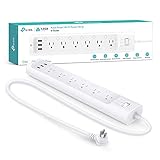
Overview: The Kasa HS300 transforms traditional power strips into an intelligent energy management hub. With six independently controllable smart outlets and three USB ports, this ETL-certified surge protector offers comprehensive control over your home or office electronics through the Kasa Smart app. It eliminates the need for a hub and integrates seamlessly with major voice assistants.
What Makes It Stand Out: The standout feature is real-time energy monitoring for each outlet, allowing you to track power consumption and identify energy-hogging devices. Unlike many competitors, you can monitor usage patterns and remotely cut power to wasteful appliances. The six individually controlled outlets provide granular automation that simpler strips can’t match, making it ideal for complex setups like entertainment centers or workstations.
Value for Money: At $39.98, the HS300 delivers exceptional value. You’re getting six smart outlets (equivalent to six individual smart plugs costing $8-12 each), three USB ports, surge protection, and energy monitoring in one device. Non-smart surge protectors with similar outlet counts cost $25-35, making the smart features essentially a $5-15 upgrade.
Strengths and Weaknesses: Strengths include individual outlet control, energy monitoring, robust surge protection, USB charging ports, and excellent app integration. Weaknesses are limited to three USB ports (no USB-C), 2.4GHz WiFi only, and a bulkier design. The energy monitoring feature may be unnecessary for users seeking basic automation.
Bottom Line: The Kasa HS300 is the best choice for users wanting detailed energy insights and comprehensive control. Its monitoring capabilities and six smart outlets justify the price premium, making it perfect for tech enthusiasts and energy-conscious households.
2. Kasa Smart Plug Power Strip KP303, Surge Protector with 3 Individually Controlled Smart Outlets and 2 USB Ports, Works with Alexa & Google Home, No Hub Required , White
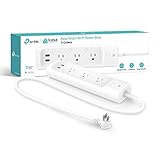
Overview: The Kasa KP303 offers an affordable entry point into smart power management. This compact surge protector features three independently controlled smart outlets and two always-on USB ports, making it perfect for smaller spaces like nightstands, desks, or kitchen counters. It delivers Kasa’s reliable smart home experience without the complexity of advanced features.
What Makes It Stand Out: Its primary distinction is value-focused simplicity. While competitors pack in features that inflate costs, the KP303 focuses on core functionality: reliable voice control, scheduling, and remote access. The always-on USB ports are a thoughtful touch, ensuring your essential devices stay charged regardless of smart outlet status. Its compact footprint fits where bulkier strips can’t.
Value for Money: At $23.38, this is the most budget-friendly option in the Kasa lineup. Three individual smart plugs would cost $24-30 separately, making this strip essentially free. You’re getting ETL-certified surge protection, USB charging, and smart scheduling for less than the price of a basic non-smart surge protector with USB ports.
Strengths and Weaknesses: Strengths include unbeatable price, trusted Kasa ecosystem, simple setup, scheduling capabilities, and space-saving design. Weaknesses are limited to three smart outlets, lack of energy monitoring, no USB-C ports, and 2.4GHz WiFi restriction. It’s less suitable for complex entertainment centers or whole-room automation.
Bottom Line: The KP303 is the ideal starter smart strip for budget-conscious buyers or those with modest needs. It delivers essential smart features without unnecessary frills, making it perfect for controlling a lamp, fan, and charger simultaneously.
3. GHome Smart Power Strip Surge Protector 10A, Smart Plug That Works with Alexa & Google Home, 6 in 1 WiFi Outlets with APP Control, White Extension Cord 2.4G WiFi Only, ETL FCC Listed, No Hub Needed
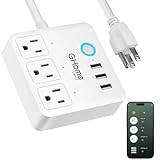
Overview: The GHome Smart Power Strip positions itself as a feature-rich alternative to mainstream brands. With three smart outlets and three USB 3.0 ports, this ETL and FCC-certified strip offers flexible control options through its proprietary app and voice assistants. It’s designed for users who prioritize USB charging speed and advanced scheduling capabilities.
What Makes It Stand Out: The three USB 3.0 ports deliver faster charging than standard USB-A, a notable advantage for device-heavy households. Its advanced timer functions include countdown, cycle, and random modes—perfect for security simulation when traveling. The ability to control outlets individually or as groups provides automation flexibility that exceeds basic smart strips.
Value for Money: Priced at $26.99, it slots between Kasa’s entry-level and premium models. While it lacks energy monitoring, the USB 3.0 ports and sophisticated scheduling justify the cost. Comparable non-smart USB 3.0 strips cost $20-25, making the smart features a modest $2-7 premium—excellent value for tech-forward users.
Strengths and Weaknesses: Strengths include USB 3.0 charging, comprehensive safety certifications, versatile timer functions, individual/group control, and competitive pricing. Weaknesses are limited to three smart outlets, a lesser-known brand ecosystem, 2.4GHz WiFi only, and no energy monitoring. App reliability may not match established competitors.
Bottom Line: The GHome strip excels for users needing fast USB charging and advanced scheduling. It’s a strong value proposition despite the brand recognition gap, making it ideal for bedrooms or offices where USB-C isn’t critical but charging speed matters.
4. Amazon Basics Smart Plug Power Strip with 6 Individually Controlled Outlets and 3 USB Ports (2 USB-A and 1 USB-C), Works with Alexa Only, 2.4 GHz Wi-Fi, No Hub Required, White

Overview: Amazon Basics enters the smart strip market with an Alexa-exclusive offering. Featuring six smart outlets and three USB ports—including a USB-C port—this surge protector is engineered for seamless integration within the Amazon ecosystem. Setup is remarkably simple through the Alexa app, making it accessible for smart home beginners.
What Makes It Stand Out: The inclusion of a USB-C port sets it apart from most competitors, future-proofing it for newer devices. Its deep Alexa integration enables sophisticated routines and automation without third-party apps. The “frustration-free setup” process is genuinely streamlined—plug in, open Alexa app, and you’re operational within minutes.
Value for Money: At $39.99, it matches the Kasa HS300’s price but trades energy monitoring for USB-C. For pure Alexa households, this is perfect value. However, the lack of Google Assistant support limits its appeal. You’re paying a premium for Amazon ecosystem lock-in, which benefits heavy Alexa users but alienates others.
Strengths and Weaknesses: Strengths include USB-C charging, effortless Alexa setup, six individually controlled outlets, and reliable performance. Weaknesses are Alexa-only compatibility (no Google/Cortana), lack of energy monitoring, limited scheduling compared to dedicated apps, and 2.4GHz WiFi restriction. It’s a non-starter for multi-platform homes.
Bottom Line: This strip is exclusively for dedicated Alexa users. If you live in the Amazon ecosystem, the USB-C port and seamless integration justify the price. For everyone else, the platform limitation makes it a poor choice despite solid hardware.
5. Geeni Surge Ultra Smart 8-Outlet Surge Protector – 6 Smart Outlets, 2 Always-On Outlets, 6 ft Cord, WiFi & Voice Control with Alexa/Google, 1200 Joules Protection, No Hub, Black

Overview: The Geeni Surge Ultra maximizes outlet density with eight total sockets, including six smart outlets and two always-on ports. This 1200-joule surge protector features a generous six-foot cord, making it ideal for hard-to-reach outlets. It balances capacity with smart functionality for users needing to control multiple devices simultaneously.
What Makes It Stand Out: No competitor offers this many outlets at the price point. The two always-on outlets are strategically valuable for devices requiring continuous power like routers or clocks. The 1200-joule surge rating exceeds many competitors, providing superior protection for expensive electronics. The lengthy cord solves placement challenges in larger rooms.
Value for Money: At $39.99, it undercuts the Kasa HS300 while offering two additional outlets. The always-on ports effectively provide free “dumb” outlets that don’t count against your smart device limit. For high-density setups like entertainment centers or workstations, this represents unmatched outlet-per-dollar value.
Strengths and Weaknesses: Strengths include maximum outlet count, always-on ports, superior surge protection, long power cord, and competitive pricing. Weaknesses are lack of USB ports, no energy monitoring, lesser brand recognition, potentially less polished app experience, and 2.4GHz WiFi only. The absence of USB charging is a notable omission.
Bottom Line: Choose the Geeni for maximum outlet capacity and superior surge protection. It’s perfect for entertainment centers or offices with numerous devices. The lack of USB ports is the main compromise, but for pure AC outlet expansion, it’s the capacity leader.
6. Smart Power Strip, Yozisital Surge Protector with 6 Smart Outlets and 4 USB Ports, 5FT Flat Plug Extension Cord for Home Office

Overview: The Yozisital smart power strip delivers a versatile 12-in-1 solution for modern homes and offices, combining six individually controlled smart outlets, two standard always-on outlets, and four USB charging ports (two USB-A and two USB-C). The 5-foot flat plug extension cord makes it ideal for tight spaces behind furniture, while the Smart Life app enables remote scheduling and management of connected devices from anywhere.
What Makes It Stand Out: This power strip’s hybrid design sets it apart—six smart outlets for automated control plus two traditional outlets for devices requiring constant power. The flat plug profile solves a common pain point in space-constrained installations. With four USB ports including modern USB-C connections, it eliminates the need for separate wall adapters. The detailed three-step setup process in the product description suggests a more guided onboarding experience than competitors.
Value for Money: At $43.99, this strip sits in the mid-range category. The value proposition is strong when you consider that six individual smart plugs would cost significantly more. The inclusion of USB-C ports and a space-saving flat plug design adds premium features that justify the price point over basic smart strips. It’s particularly cost-effective for aquarium enthusiasts and plant growers who need precise scheduling.
Strengths and Weaknesses: Strengths include the smart/always-on outlet hybrid configuration, flat plug for furniture clearance, comprehensive USB charging options, and robust scheduling capabilities. The dedicated Wi-Fi pairing button simplifies setup. Weaknesses are the 2.4GHz-only limitation (no 5GHz support), lack of explicit voice assistant compatibility in the listing, and potential app dependency that may overwhelm less tech-savvy users.
Bottom Line: This Yozisital power strip excels for users needing both automated and continuous power in one unit. The flat plug and USB-C ports make it ideal for modern home offices and aquarium setups. If you can work within the 2.4GHz limitation and primarily use the Smart Life app, it’s a smart investment that consolidates multiple functions into one sleek package.
7. BN LINK Smart Plug Power Strip,Surge Protector with 6 Individually Controlled Smart Outlets, 4 USBs (incl. 20W USB-C), Compatible with Alexa and Google Home

Overview: The BN LINK smart power strip offers comprehensive home automation with six individually controlled outlets, four USB charging ports (including a 20W USB-C fast charging port), and robust 1200-joule surge protection. Designed for seamless integration with Alexa and Google Assistant, this ETL-certified strip allows voice-activated control and remote management through the BN-LINK Smart app over 2.4GHz WiFi.
What Makes It Stand Out: The 20W USB-C fast charging port delivers true quick-charging capabilities rarely found in power strips at this price point. Each of the six outlets can be controlled independently or grouped together for unified commands, providing exceptional flexibility. The direct voice assistant compatibility without requiring additional hubs or bridges makes it immediately accessible for existing smart home ecosystems. The comprehensive protection indicators for safety, grounding, and WiFi status add professional-grade monitoring.
Value for Money: Priced at $39.99, this strip offers compelling value. The 20W USB-C port alone saves you from buying a separate fast charger (typically $15-20). When you factor in six smart outlets that would cost $30-40 individually, plus surge protection and USB ports, the package delivers significant savings. It’s competitively positioned against similar products while offering superior charging speed.
Strengths and Weaknesses: Strengths include powerful 20W USB-C charging, individual outlet control with grouping, robust 1200J surge protection, ETL certification, and 24/7 customer support. Voice integration works flawlessly with major platforms. Weaknesses are the 2.4GHz-only WiFi limitation and lack of always-on outlets for devices requiring constant power. The five-foot cord length is standard but not exceptional.
Bottom Line: This BN LINK strip is an excellent choice for smart home enthusiasts prioritizing fast charging and voice control. The 20W USB-C port and individual outlet management make it ideal for home offices and entertainment centers. If your router supports 2.4GHz and you want maximum voice integration without breaking the bank, this is a top contender that delivers premium features at a mid-range price.
8. Feit Electric Smart Power Strip, 4 Outlets + 4 USB Ports, Voice Control with Alexa & Google Assistant, App Control & Scheduling from Anywhere, 15 Amp, Indoor 4-Outlet Powerstrip, POWERSTRIP/WiFi

Overview: The Feit Electric smart power strip provides a streamlined solution with four smart outlets and four USB ports delivering 4.8A total charging capacity. This 15-amp indoor strip supports voice control through Alexa, Google Assistant, and notably includes Siri shortcuts for Apple users. With no hub required and a simple 5-foot cord, it converts traditional appliances into smart devices without complex wiring.
What Makes It Stand Out: Siri shortcuts integration distinguishes this from most competitors that only support Alexa and Google Assistant, making it particularly attractive for Apple household ecosystems. The convenient night light feature adds practical value for bedrooms or dark office corners. Its straightforward 4-outlet design simplifies setup and management for users who don’t need six or more smart outlets, focusing on quality over quantity.
Value for Money: At $37.16, this is the most budget-friendly option in the lineup. For Apple-centric homes, the Siri support alone justifies the price compared to alternatives requiring additional hubs or software workarounds. While it offers fewer outlets than competitors, the cost per smart outlet remains competitive. It’s ideal for smaller setups like bedside tables or single-device entertainment centers where four controllable outlets suffice.
Strengths and Weaknesses: Strengths include Siri shortcuts compatibility, built-in night light, ETL safety rating, and straightforward app control. The 15-amp capacity handles most small appliances adequately. Weaknesses are the limited four-outlet configuration, shared 4.8A USB power without dedicated USB-C fast charging, and potentially less granular control compared to six-outlet alternatives. The product description lacks mention of individual outlet control.
Bottom Line: This Feit Electric strip is perfect for Apple users seeking basic smart power control without complexity. The Siri integration and night light make it ideal for bedrooms and small office setups. However, if you need more than four smart outlets or fast USB-C charging, consider alternatives. For targeted applications and iOS households, it delivers solid performance at an entry-level price point.
9. Geeni Smart Plug Power Strip, 6 Outlets and 2 USB Ports, 6 ft. Cord, Surge Protector with Voice Control, WiFi Control, Compatible with Alexa & Google Home, No Hub Required, Black

Overview: The Geeni smart power strip balances capacity and convenience with six individually controlled smart outlets, two USB charging ports (USB-A and USB-C), and robust 1200-joule surge protection. Its standout feature is the extended 6-foot power cord, providing greater placement flexibility than standard 5-foot models. Direct WiFi connectivity eliminates hub requirements, while Alexa and Google Home integration enables seamless voice control.
What Makes It Stand Out: The six-foot cord length offers meaningful extra reach for challenging room layouts and distant wall outlets—a practical advantage often overlooked until installation. The combination of individual outlet control, strong surge protection, and USB-C charging creates a well-rounded feature set. The Geeni app’s reputation for reliability and the brand’s established presence in the smart home market inspire confidence. The sleek black finish provides a modern aesthetic that blends with contemporary electronics.
Value for Money: At $37.99, this strip hits the sweet spot between features and affordability. You get six smart outlets, USB-C charging, and superior surge protection for less than the Yozisital model. The longer cord adds tangible value without a price premium. While it has fewer USB ports than some competitors, the quality-over-quantity approach makes sense for users who primarily need smart outlet control with occasional USB charging.
Strengths and Weaknesses: Strengths include the extended 6-foot cord, robust 1200-joule surge protection, individual outlet management, USB-C support, and no-hub-required design. The established Geeni ecosystem ensures reliable app performance. Weaknesses are the limited two USB ports versus four on competing models, 2.4GHz-only connectivity, and lack of always-on outlets for critical devices. The black color may not suit all décor preferences.
Bottom Line: The Geeni strip is an excellent all-around choice for users needing flexible placement and reliable smart control. The longer cord makes it ideal for entertainment centers and workstations where outlets are scarce. If you value surge protection and individual outlet control over numerous USB ports, this offers outstanding value. It’s a practical, no-nonsense solution for expanding smart home capabilities without breaking the bank.
10. BN LINK Smart Plug Power Strip,Surge Protector with 4 Individually Controlled Smart Outlets, 4 USBs (incl. 20W USB-C), Compatible with Alexa and Google Home

Overview: This compact BN LINK smart power strip delivers premium features in a smaller footprint, offering four individually controlled smart outlets, four USB charging ports, and a powerful 20W USB-C fast charging port. With 1200-joule surge protection, ETL certification, and full compatibility with Alexa and Google Assistant, it provides robust smart home control for users who don’t require six outlets. The 2.4GHz WiFi connectivity ensures stable remote management through the BN-LINK Smart app.
What Makes It Stand Out: The 20W USB-C fast charging port stands out as a premium feature rarely found in sub-$35 smart power strips, making it ideal for quickly charging modern smartphones, tablets, and Kindles. The four-outlet design targets users with modest needs, preventing the cost and complexity of underutilized outlets. It maintains the same surge protection and voice integration as its larger sibling while trimming size and price. The ETL certification and 24/7 support provide enterprise-level confidence in a budget package.
Value for Money: At $31.99, this represents exceptional value—the lowest price in the comparison while retaining flagship features like 20W USB-C and individual outlet control. You’re getting fast charging capability that typically costs $15-20 standalone, plus four smart outlets and surge protection. For apartment dwellers, single-room setups, or as a supplementary strip, the cost-per-feature ratio is outstanding. It eliminates the premium paid for unused outlets in larger models.
Strengths and Weaknesses: Strengths include the 20W USB-C fast charging, individual outlet control with grouping, robust surge protection, ETL certification, and unbeatable price point. Voice integration is seamless with major platforms. Weaknesses are the limited four-outlet capacity, 2.4GHz-only WiFi, and absence of always-on outlets. The five-foot cord is adequate but not class-leading.
Bottom Line: This BN LINK strip is the budget champion for smart home newcomers and minimalists. If you need four or fewer smart outlets but refuse to compromise on fast charging and voice control, this is your best value option. It’s perfect for nightstands, small desks, or secondary rooms where premium features are desired without the premium price. The 20W USB-C alone makes it worth considering over cheaper alternatives lacking fast charging.
Understanding Smart Power Strips in 2026
The Evolution from Traditional to Intelligent
Remember when power strips were just plastic bars with a basic on/off switch? Those days feel like ancient history. Today’s smart power strips house miniature computers capable of processing complex commands, monitoring energy consumption in real-time, and communicating with cloud services across the globe. The transformation began with simple timer functions but has exploded into sophisticated systems that learn your habits, predict your needs, and integrate seamlessly with broader smart home architectures. In 2026, we’re seeing the integration of AI-driven power management that can distinguish between standby power waste and legitimate device needs—a quantum leap from the crude “all on or all off” approach of early models.
Why Voice Control Changes Everything
The addition of voice control hasn’t just added convenience; it’s fundamentally changed how we interact with our devices. Instead of fumbling for apps on your phone or manually pressing buttons, you can now issue natural commands like “Alexa, turn off the gaming setup” or “Hey Google, activate my work-from-home station.” This shift matters because it removes friction from power management. When controlling outlets requires zero physical effort, you’re far more likely to actively manage energy consumption. Studies show that households using voice-controlled power strips reduce phantom load by up to 40% compared to those using traditional strips—simply because the barrier to action has been eliminated.
Key Features That Define Premium Smart Power Strips
Individual Outlet Control vs. Master Switch
The most critical feature distinguishing premium models from budget alternatives is individual outlet control. While basic strips might only offer master on/off functionality, sophisticated units let you name and control each socket independently. This granularity transforms your power strip from a simple switch into a versatile control hub. Imagine being able to say “turn off the TV but keep the streaming box on” or “power cycle just the router” without affecting other connected devices. For home offices, this means your monitor, printer, and desk lamp can operate as separate entities, each responding to different voice commands or automation triggers.
USB-C Power Delivery Standards
In 2026, USB-C Power Delivery (PD) has become non-negotiable for any serious smart power strip. But not all PD implementations are equal. Look for strips offering at least 65W per USB-C port, with some premium models pushing 100W or more. This matters because modern laptops, tablets, and phones demand serious power to charge at full speed. More importantly, intelligent power strips can now negotiate power delivery dynamically, ramping down wattage when devices near full charge and cutting power entirely when batteries reach 100%. This smart charging extends battery lifespan while eliminating vampire drain from idle chargers—a feature that pays for itself over time.
Energy Monitoring Capabilities
True energy monitoring goes beyond displaying a simple wattage readout. Advanced strips now provide granular per-outlet consumption data, historical trend analysis, and cost projections based on your utility rates. The best implementations use machine learning to identify devices by their power signatures—automatically recognizing when your coffee maker kicks on versus your space heater. This data becomes actionable when integrated with voice assistants, allowing queries like “Alexa, how much did my office equipment cost to run today?” or “Hey Google, which device is using the most power right now?” Look for models that export data to spreadsheets or integrate with home energy management platforms for serious power budgeting.
Surge Protection Ratings
Don’t let smart features distract from the core purpose: protecting your expensive electronics. In 2026, respectable surge protection starts at 2,000 joules for basic setups, but home theater or gaming rig applications demand 3,000+ joules. Pay attention to clamping voltage (lower is better—look for 400V or less) and response time (under 1 nanosecond). Premium strips also include EMI/RFI noise filtering, which cleans up power line interference that can affect audio/video quality. Some advanced models even monitor surge protection status actively, alerting you via voice notification when the protective components have degraded and need replacement—a far cry from the passive indicator lights of yesteryear.
Voice Control Integration Deep Dive
Alexa vs. Google Assistant: Key Differences
While both platforms offer robust voice control, their integration approaches differ subtly. Alexa excels at creating complex routines involving multiple device types, making it ideal for elaborate “good night” sequences that control power strips alongside lights, locks, and thermostats. Google Assistant, meanwhile, offers superior natural language processing—you can speak more conversationally without memorizing exact device names. For power strips specifically, Alexa’s “smart home groups” allow you to control multiple strips in a room as a single entity, while Google’s “home view” provides a more intuitive visual interface for manual control. Consider your existing ecosystem and which assistant you already use for other tasks, as mixing platforms can create friction.
Setting Up Voice Commands
The setup process determines your long-term satisfaction. Quality strips integrate directly through the Alexa or Google Home apps without requiring a proprietary hub. During setup, you’ll name each outlet descriptively—think “bedside lamp” rather than “outlet 3.” Pro tip: use consistent naming conventions across your home. If you have multiple strips, append location descriptors like “bedroom TV” and “living room TV” to avoid confusion. Advanced users should explore custom routines that combine power control with other actions. For example, a “movie time” routine could dim lights, power on the TV and soundbar, and turn off distracting devices like gaming consoles—all with a single phrase.
Creating Routines and Automation
The real magic happens when you move beyond simple on/off commands. Modern smart power strips shine as automation endpoints triggered by sensors, schedules, or other devices. Configure your office strip to power on when your smart door lock detects you’ve arrived home, or set the kitchen strip to disable high-draw appliances during peak electricity rate hours. The most sophisticated implementations use geofencing—your devices automatically power down when you leave home and wake up as you approach. When designing routines, always include fail-safes: what happens if your Wi-Fi drops? Quality strips offer local fallback modes that maintain critical schedules even when cloud connectivity fails.
Technical Specifications to Evaluate
Wi-Fi Standards and Connectivity
In 2026, dual-band Wi-Fi 6 support has become the baseline expectation. This isn’t just about faster speeds—Wi-Fi 6 handles crowded network environments far better, crucial when your strip sits in a utility closet surrounded by metal appliances. Some cutting-edge models now offer Wi-Fi 6E, utilizing the 6 GHz band for even less interference. However, don’t overlook mesh network compatibility; if you use a mesh system, ensure the strip can seamlessly roam between nodes without dropping connections. For larger homes, consider strips with external antennas or mesh repeater functionality that extends coverage to Wi-Fi dead zones.
Amperage and Wattage Limits
Understanding electrical limits prevents dangerous overloads. Most residential smart strips max out at 15 amps (1,800 watts at 120V), but individual outlet limits vary. Check the fine print—some models restrict high-draw outlets to 10 amps while limiting USB ports to shared 2.4A total. For workshops or home theaters with power-hungry equipment, commercial-grade strips offering 20-amp capacity exist, though they require compatible wall outlets. Calculate your connected devices’ total draw, then add a 20% safety margin. Remember that motors and compressors (like in fridges or AC units) have startup surges 2-3 times their rated wattage—smart strips should handle brief 3,000+ watt spikes without tripping.
Response Time and Latency
Nobody wants to wait five seconds after a voice command for a light to turn on. Premium smart power strips achieve sub-200ms response times from command to action. This speed depends on multiple factors: cloud processing time, local network latency, and the strip’s internal relay switching speed. Look for models boasting “local control” capabilities that process simple commands directly on your network without round-tripping to cloud servers. During evaluation, test response consistency—does the strip react instantly sometimes but lag other times? Inconsistent performance often indicates poor antenna design or overloaded internal processors.
Safety and Certification Standards
UL Certification and What It Means
In the unregulated Wild West of smart home gadgets, UL (Underwriters Laboratories) certification remains your most reliable safety indicator. For smart power strips, look specifically for UL 1363 (relocation taps) and UL 1449 (surge protective devices) listings. These certifications mean the product has undergone rigorous testing for fire hazards, electrical shock risks, and component durability. Be wary of vague “meets UL standards” claims—genuine certification includes a file number you can verify on UL’s database. In 2026, we’re also seeing strips certified to UL 62368-1, the newer standard for audio/video and ICT equipment, which covers the smart components themselves.
Overload Protection Mechanisms
Smart overload protection goes beyond simple circuit breakers. Advanced strips continuously monitor current draw per outlet and across the entire device, cutting power before dangerous heat builds up. The best implementations provide graduated responses: first alerting you via voice notification of rising consumption, then automatically shutting down non-critical outlets if overload threatens. Some models even learn your usage patterns, predicting when you’re likely to exceed limits and proactively suggesting load redistribution. This predictive approach prevents nuisance trips while maintaining safety—a delicate balance that separates quality engineering from cheap alternatives.
Fire-Resistant Housing Materials
When electronics fail, they can fail catastrophically. Premium smart power strips use V-0 rated flame-retardant polycarbonate housings that self-extinguish within 10 seconds if ignited. Avoid strips using ABS plastic, which burns readily and releases toxic fumes. Internal component layout matters too—quality designs separate high-voltage and low-voltage sections, preventing arcing faults that can start fires. Some manufacturers now embed thermal sensors throughout the strip, shutting down immediately if any internal component exceeds safe temperatures. This multi-layered approach to fire safety is non-negotiable for devices that operate 24/7, often in concealed locations.
Installation and Setup Best Practices
Optimal Placement Strategies
Location affects both performance and safety. Install smart power strips in well-ventilated areas away from heat sources—each transformer plugged in generates warmth, and enclosed spaces can create dangerous heat buildup. For voice control reliability, position strips where they can “hear” your commands, either through built-in microphones or via proximity to smart speakers. Avoid plugging strips into other strips (daisy-chaining), which violates electrical codes and creates fire hazards. In home offices, mount strips under desks using included brackets to keep floors clear while positioning them for easy manual access if voice control fails.
Network Configuration Tips
Segregate your smart home devices onto a dedicated 2.4 GHz guest network for maximum stability, even if the strip supports 5 GHz. This isolation prevents bandwidth-hungry activities like 4K streaming from interfering with device commands. Assign static IP addresses to your power strips through your router’s DHCP reservation system—this prevents connection drops when IP leases renew. For larger installations, create a separate VLAN for IoT devices, adding firewall rules that block internet access while allowing local control. This “local-only” configuration dramatically improves security and often reduces latency since commands don’t leave your network.
Firmware Update Protocols
Smart devices require regular updates, but automatic updates can cause frustrating downtime. Quality strips let you schedule updates during predetermined maintenance windows—say, 3 AM on Sundays. Before purchasing, research the manufacturer’s update history; frequent updates suggest active development, but forced updates without user consent indicate poor design. The best strips maintain basic functionality during updates, ensuring critical devices stay powered. Post-update, verify that your custom device names and routines remain intact—some cheap models factory reset after updates, erasing your carefully configured settings.
Advanced Features for Power Users
Away Mode Simulation
Sophisticated security features now go beyond simple scheduling. Away mode simulation randomly powers devices on and off throughout the evening to mimic occupancy, but the best implementations are far more nuanced. They learn your typical usage patterns over weeks, then replicate those patterns with realistic variations when you’re traveling. Some strips even integrate with smart blinds and lighting, coordinating power cycling with light changes for convincing simulation. For voice control, you can trigger away mode with a simple “Alexa, we’re leaving” command, instantly activating weeks of learned behavior patterns.
IFTTT and Third-Party Integration
While native Alexa and Google integration covers most needs, IFTTT (If This Then That) support unlocks infinite possibilities. Connect your power strip to weather services to automatically turn off outdoor equipment during storms, or link to your email to power on a notification lamp when important messages arrive. In 2026, we’re seeing direct integration with energy providers—some strips automatically cut non-essential loads when the grid is under strain, earning you utility bill credits. Check for open API documentation if you’re technically inclined; well-documented APIs indicate manufacturer confidence and enable custom integrations that future-proof your investment.
Power Scheduling and Timers
Basic scheduling is table stakes, but advanced time-of-use management sets premium strips apart. Program different behaviors for weekdays, weekends, and holidays. Link schedules to local sunrise/sunset times rather than fixed clock times. The most sophisticated models integrate with utility rate data, automatically avoiding high-cost peak hours. For parents, look for “allowance” features that limit total daily usage of gaming consoles or TVs, with voice notifications warning kids when time is running low. These granular controls transform the power strip from a simple switch into a behavioral tool.
Common Use Cases and Applications
Home Office Optimization
The work-from-home revolution has made smart power strips indispensable productivity tools. Create a “focus mode” routine that powers down distracting devices (phone chargers, secondary monitors) while ensuring your primary workstation stays active. Link your calendar to automatically power on equipment five minutes before scheduled video calls, preventing the dreaded “sorry, my camera isn’t working” moments. Energy monitoring helps justify home office tax deductions, providing detailed logs of business-related electricity consumption. For sensitive equipment, look for strips with pure sine wave output—critical for preventing data corruption on external drives and maintaining stable network connections.
Entertainment Center Management
Home theaters present unique challenges with their mix of always-on, standby, and high-draw devices. Smart strips solve the “vampire power” problem by completely cutting power to devices that claim to be “off” but still draw watts. Create a “movie night” routine that sequences power-on delays—turn on the TV first, wait 30 seconds for it to boot, then power the soundbar and streaming device, preventing HDMI handshake issues. Use energy monitoring to identify which components draw power in standby; you might be shocked to learn your “off” cable box consumes 15 watts 24/7. For gaming setups, configure a “cooldown” mode that keeps fans running for 10 minutes after shutdown before cutting power entirely.
Kitchen Appliance Control
Kitchens demand special consideration due to heat, moisture, and high-power appliances. Only use smart strips rated for kitchen environments with appropriate IP (Ingress Protection) ratings against moisture. Control small appliances like coffee makers, toasters, and stand mixers—never plug refrigerators or stoves into smart strips, as safety overrides and warranties may be compromised. Create morning routines that start your coffee maker and toaster simultaneously when your bedroom alarm is dismissed. Use energy monitoring to identify inefficient appliances; that old microwave might be costing you more than a replacement. For safety, configure automatic shutoff if power draw exceeds safe levels for extended periods, preventing forgotten appliances from becoming fire hazards.
Troubleshooting Common Issues
Connectivity Dropouts
Intermittent connectivity is the bane of smart home devices. When your strip drops off the network, first check for IP address conflicts—many routers poorly handle the flood of IoT devices. If problems persist, investigate your Wi-Fi channel congestion; use a Wi-Fi analyzer app to find the least crowded channel. Some strips include diagnostic modes accessible through voice commands like “run connectivity test.” Firmware bugs often cause dropouts; check manufacturer forums for patterns. As a last resort, install a dedicated Wi-Fi access point near problematic strips—sometimes the cheapest solution is a $30 range extender rather than replacing a $100 strip.
Voice Command Misunderstandings
When Alexa or Google consistently mishears commands, the issue is usually naming conflicts. Avoid homophones (“fan” vs. “van”) and overly generic names. Use the voice assistant’s activity log to see exactly what it heard—you might discover background noise is corrupting commands. Create custom routines with unique activation phrases that won’t conflict with other devices. For households with multiple voice assistants, ensure each strip is only linked to one platform to prevent command duplication. If accents or speech patterns cause issues, enable voice training features that help assistants learn your specific pronunciation.
Overload Tripping
Frequent tripping indicates either genuine overload or overly sensitive protection circuits. Calculate your actual load using a kill-a-watt meter to verify the strip isn’t being pushed beyond 80% of its rated capacity. If loads are reasonable, the strip’s internal current sensor may be miscalibrated—contact support for a replacement. Check for device startup surges; some strips allow brief “inrush current” exceeding normal limits. Consider redistributing high-draw devices across multiple circuits. For mission-critical setups, use two strips with a failover configuration: if one trips, the other maintains essential devices until you can reset manually.
The Economics of Smart Power Strips
Calculating Energy Savings
The payback period for a smart power strip depends on your usage patterns and local electricity rates. Start by measuring baseline phantom load—plug all devices into a traditional strip, wait 30 minutes, then measure wattage with everything “off.” Multiply this by your cost per kWh and hours of inactivity. A typical entertainment center might waste $50-100 annually in standby power. Factor in convenience value: how much is it worth to never crawl behind furniture to flip switches? For home offices, calculate productivity gains from automated setups. Most households break even within 12-18 months, with strips lasting 5+ years, making them excellent long-term investments.
Understanding Price Tiers
Smart power strips fall into three distinct categories. Budget models ($25-40) offer basic voice control and master switching but lack individual outlet control or energy monitoring. Mid-range options ($45-70) add per-outlet control, decent energy monitoring, and reliable connectivity. Premium strips ($75-150) deliver industrial-grade surge protection, advanced automation, local processing, and robust third-party integrations. Ultra-premium commercial units ($200+) offer 20-amp capacity, pure sine wave output, and enterprise management features. For most homes, the $60-90 sweet spot provides the best feature-to-value ratio, offering genuine utility without diminishing returns.
Warranty Considerations
Warranty terms reveal manufacturer confidence. Basic strips offer 1-year warranties covering manufacturing defects. Better models provide 2-3 years plus connected equipment protection—if the strip fails and damages plugged-in devices, they’ll cover repair costs up to a specified limit (typically $50,000-300,000). Read the fine print: many warranties require registration within 30 days of purchase and exclude damage from power company errors. Premium strips often include lifetime warranties on surge protection components, though the smart features may only be covered for 2-3 years. Save your receipt and document your setup with photos—claims adjusters appreciate proof of proper usage.
Future-Proofing Your Purchase
Matter Protocol Support
Matter, the new universal smart home standard, is revolutionizing device interoperability in 2026. Strips with Matter certification work seamlessly across Alexa, Google, Apple HomeKit, and Samsung SmartThings without platform-specific limitations. This matters because it prevents ecosystem lock-in; if you switch from Alexa to Google, your strip transitions effortlessly. Matter also enables local control even when internet is down, with faster response times and enhanced privacy. When shopping, look for the Matter logo and verify certification on the CSA Alliance website—some manufacturers claim compatibility without official certification, which may result in limited functionality.
Thread Network Compatibility
Thread is the low-power mesh networking protocol that makes Matter devices truly magical. Thread-enabled smart power strips act as network extenders, strengthening your smart home mesh with each device added. Unlike Wi-Fi, Thread devices create a self-healing network that routes commands through the most efficient path, eliminating single points of failure. If one device goes offline, others automatically reroute around it. This redundancy is crucial for power strips controlling critical devices. Thread also uses significantly less power than Wi-Fi, reducing the strip’s own energy consumption—a nice meta-benefit for an energy-saving device.
Over-the-Air Update Policies
A device’s longevity depends on manufacturer support. Research the company’s track record: do they provide updates for products 3+ years old? Check their end-of-life policy—some manufacturers explicitly commit to 5 years of security updates. Avoid brands that haven’t updated firmware in over a year, indicating abandoned products. The best manufacturers publish detailed changelogs explaining what each update fixes or adds, demonstrating transparency. Consider purchasing from companies with public bug bounty programs; this shows they take security seriously and actively encourage vulnerability reporting. Your smart power strip should improve over time, not become obsolete when the next model releases.
Environmental Impact and Sustainability
Vampire Power Reduction
The environmental case for smart power strips is compelling. The average US home wastes 200-400 kWh annually to phantom loads—equivalent to leaving a 60-watt bulb on 24/7 for an entire year. By completely disconnecting devices from power, smart strips eliminate this waste entirely. Advanced models take it further by analyzing usage patterns and suggesting which devices to unplug permanently. For example, if your strip detects that your printer is only used twice a month, it might recommend storing it unplugged and only powering it on via voice command when needed. This behavioral nudging amplifies environmental benefits beyond pure automation.
Recycling and Disposal
Smart power strips contain valuable metals and hazardous components requiring proper disposal. Responsible manufacturers participate in e-waste recycling programs, offering free mail-back labels for end-of-life devices. Some even provide trade-in credits toward new purchases, creating circular economy incentives. Before buying, check if the company publishes a materials list—premium strips use lead-free solder and halogen-free plastics. Avoid models with glued-shut cases that can’t be repaired; opt for screw-assembled units that extend lifespan through component replacement. When disposal becomes necessary, remove the smart module (often a separate board) and recycle it with electronics, while the power cord and metal contacts go to metal recycling.
Manufacturer Sustainability Programs
Forward-thinking companies now embed sustainability throughout their supply chain. Look for manufacturers using renewable energy in production, carbon-neutral shipping, and minimal packaging. Some publish annual sustainability reports detailing water usage, emissions, and recycling rates. Cradle-to-cradle certifications indicate products designed for disassembly and material recovery. A few innovative brands even offset the estimated lifetime energy consumption of their strips through renewable energy credits—effectively making your device carbon-negative. These programs might seem like greenwashing, but independently verified certifications like B Corp or ISO 14001 signal genuine commitment.
Security and Privacy Considerations
Data Transmission Encryption
Your power strip knows when you’re home, when you sleep, and which devices you use—a treasure trove for data brokers. Ensure any strip you consider uses TLS 1.3 encryption for all cloud communications, with end-to-end encryption for sensitive data like energy usage patterns. Some privacy-focused models process all data locally, only transmitting anonymized usage statistics to the manufacturer. Read the privacy policy: does the company sell your data to third parties? Do they retain voice recordings? The best manufacturers publish transparency reports detailing government data requests and their responses. For maximum privacy, choose strips that work entirely locally without cloud accounts—though this sacrifices some convenience features.
Guest Network Recommendations
Never connect smart home devices to your primary Wi-Fi network. Create a separate IoT guest network with a strong password and no access to your main network’s resources. This isolation prevents a compromised power strip from becoming a gateway for hackers to access your computers or NAS drives. Configure your router’s firewall to block this guest network from initiating outbound connections except to known manufacturer servers, reducing the attack surface. Some routers offer “IoT network” presets that automatically apply these security settings. Remember to update this network’s password every 6-12 months, especially after guests who’ve connected devices leave your home.
Account Security Best Practices
Your smart strip’s app account is a potential vulnerability. Always enable two-factor authentication (2FA) using an authenticator app, not SMS, which is vulnerable to SIM-swapping attacks. Use a unique, complex password generated by a password manager—never reuse passwords across services. Review connected device lists monthly, revoking access for any unknown devices. If the manufacturer offers it, enable login notifications to alert you of unauthorized access attempts. For voice assistants, regularly audit and delete voice recordings to minimize stored data. Consider creating a separate email address exclusively for smart home accounts, so breaches don’t compromise your primary email.
Frequently Asked Questions
1. Can I control a smart power strip when I’m away from home? Yes, through the Alexa or Google Home apps, you can control outlets remotely as long as the strip maintains an internet connection. Some models also support direct VPN access for local control without cloud dependency, offering faster response and enhanced privacy when you’re traveling.
2. Will smart power strips work during a power outage? No, they require electricity to operate their internal electronics and maintain Wi-Fi connectivity. However, premium models include non-volatile memory that retains your schedules and settings, automatically resuming normal operation when power returns without requiring manual reconfiguration.
3. How many devices can I plug into a smart power strip before overloading it? It depends on total wattage, not device count. Most residential strips support 1,800 watts (15 amps) total. Add up the wattage of all devices, staying under 1,440 watts for continuous safe operation. High-draw appliances like space heaters or air conditioners should never share a strip with other devices.
4. Do I need a hub to use voice control with these power strips? No, modern smart power strips connect directly to your Wi-Fi network and communicate with Alexa or Google servers independently. However, Thread-enabled strips benefit from a Thread border router (found in newer smart speakers and displays) to enable local control and mesh networking capabilities.
5. Can I use smart power strips outdoors or in garages? Only if specifically rated for outdoor use with appropriate IP codes (typically IP65 or higher). Standard indoor strips will fail in humidity, temperature extremes, and dust. Outdoor models include weatherproof housings and sealed outlets but command a 30-50% price premium.
6. What happens if my Wi-Fi goes down? Basic functionality is lost without Wi-Fi, but premium strips offer local fallback modes. Thread/Matter devices continue working via local mesh networks. Some models store the last known schedule and execute it blindly without feedback. For critical applications, maintain a backup traditional strip for manual control during extended outages.
7. Are there monthly fees or subscriptions required? Reputable manufacturers charge no ongoing fees for basic control and monitoring. Some offer optional premium features like advanced analytics or extended cloud storage for energy data, but these are unnecessary for most users. Always verify “no subscription required” in product specifications to avoid unpleasant surprises.
8. How do I reset a smart power strip if it stops responding? Most include a physical reset button—hold it for 10-15 seconds to restore factory settings. For unresponsive units, unplug for 60 seconds to discharge capacitors, then reconnect. If voice control fails but the app works, try unlinking and relinking the skill in your voice assistant’s app to refresh authentication tokens.
9. Can smart power strips damage sensitive electronics like computers or TVs? Quality strips with proper surge protection and EMI filtering actually protect sensitive gear. However, avoid abruptly cutting power to computers without proper shutdown—use strips to control peripherals, not the computer itself, unless you’ve configured OS-level shutdown commands. For AV equipment, enable “sequenced power” options that add delays between outlets.
10. How long do smart power strips typically last before needing replacement? The surge protection components degrade with each power spike and typically last 3-5 years in areas with stable power, or 2-3 years in lightning-prone regions. The smart features often outlast the surge protection—some manufacturers offer replacement surge modules while reusing the smart components. Expect 5-7 years of total lifespan with proper care and firmware updates.