Finding a chair that genuinely supports over 500 pounds while providing proper lumbar support isn’t just about comfort—it’s about safety, health, and dignity. For too long, the big and tall community has been forced to choose between flimsy seating that buckles under pressure or industrial-looking options that belong in a warehouse, not a modern office. The truth is, your spine doesn’t care about weight capacity ratings; it needs consistent, ergonomic support that moves with you through eight-hour workdays and beyond.
This guide cuts through the marketing fluff and hollow weight claims to reveal what actually matters when investing in a heavy-duty lumbar support chair. We’re diving deep into engineering principles, materials science, and ergonomic design specifically scaled for larger bodies. Whether you’re outfitting a home office or sourcing furniture for a diverse workplace, understanding these critical factors will save you money, prevent injury, and finally deliver the seating experience you deserve.
Top 10 Big & Tall Lumbar Support Chairs over 500 lbs
Detailed Product Reviews
1. Sweetcrispy Big and Tall Office Desk Chair with Lumbar Support, 500lbs Heavy Duty Mesh Ergonomic Computer Chair with 4D Armrest and Wide Comfy Seat, Wheels for Adult

Overview: The Sweetcrispy heavy-duty office chair delivers robust support for larger users up to 500 pounds. Featuring an extra-large 22" x 26.77" seat cushion with 4.33 inches of thickness, this chair prioritizes spacious comfort. The mesh construction promotes airflow while the adjustable lumbar system targets spinal pressure relief.
What Makes It Stand Out: The 4D metal armrests offer exceptional customization rarely found at this price point, allowing precise positioning for optimal shoulder support. The three-stage SGS-certified cylinder provides superior stability compared to standard gas lifts. Its waterfall seat edge design actively improves circulation by reducing calf pressure during extended sitting sessions.
Value for Money: At $150.77, this chair undercuts many competitors while offering premium features like 4D armrests and a true 500-pound capacity. Similar mesh chairs with such adjustability typically retail above $200, making this an excellent budget-conscious choice for big and tall users seeking ergonomic precision without premium pricing.
Strengths and Weaknesses: Strengths include genuine 500lb capacity certification, breathable mesh material, highly adjustable components, and thoughtful ergonomic design. The 4D armrests and thick cushioning provide exceptional comfort. Weaknesses: Mesh may lack the plush feel of leather for some users, and the aesthetic is more functional than executive. Assembly may require more time than advertised due to weight.
Bottom Line: An outstanding choice for big and tall users wanting maximum adjustability and proven weight capacity at a mid-range price. The 4D armrests and ergonomic features make it ideal for all-day productivity.
2. Vogue Furniture Direct Big and Tall Office Chair 500lbs, Heavy Duty High Back PU Leather Desk Chair, Adjustable Height Rolling Wheels Computer Chair for Home Office Work (Black)
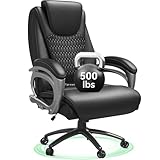
Overview: This executive-style chair combines 500-pound capacity with sophisticated PU leather upholstery. Designed for big and tall professionals, it features an extra-wide seat and reinforced SGS-certified components tested over 100,000 cycles. The reclining mechanism adjusts from 90° to 120°, accommodating both focused work and brief relaxation.
What Makes It Stand Out: The “air leather” upholstery attempts to bridge breathability and traditional leather aesthetics, staying cooler than standard PU while maintaining an executive appearance. The 10-minute assembly claim is notably ambitious for a chair of this capacity. Bilingual customer support demonstrates commitment to accessibility.
Value for Money: Priced at $154.99, it competes directly with mesh alternatives while offering a more traditional office aesthetic. The SGS certification and durability testing provide confidence in longevity. However, the limited 3-inch height adjustment range may not suit all desk configurations, slightly diminishing versatility compared to similarly priced competitors.
Strengths and Weaknesses: Strengths include easy-clean leather surface, quick assembly, robust weight capacity, and professional appearance. The breathable leather performs better than standard PU. Weaknesses: Narrower height adjustment range, less armrest customization than mesh counterparts, and leather may still trap more heat than mesh in warm environments.
Bottom Line: Ideal for users prioritizing executive aesthetics and easy maintenance over maximum ventilation. A solid mid-range option for leather lovers needing genuine heavy-duty support.
3. Big and Tall 700lbs Office Chair - Adjustable Lumbar Support 3D Flip Arms Heavy Duty Metal Base&Wheels, High Back Large Executive Computer Desk Chair, Thick Padded Ergonomic Design for Back Pain

Overview: The FAMIC executive chair raises the bar with an impressive 700-pound capacity, targeting users who need maximum weight support. This premium chair features innovative inflatable lumbar support, allowing personalized back pressure adjustment via an integrated airbag system. The bonded leather upholstery with diamond-patterned ventilation holes aims to combine luxury with breathability.
What Makes It Stand Out: The inflatable lumbar support is a unique feature providing unprecedented customization for spinal alignment. The 3D flip-arm design cleverly saves space by tucking completely away, perfect for compact workspaces. Premium rubber casters protect floors without requiring mats, a thoughtful detail for hardwood or tile surfaces.
Value for Money: At $265.99, this is a significant investment. The 700lb capacity, inflatable lumbar system, and floor-protecting wheels justify the premium over 500lb models. For users exceeding standard heavy-duty limits, the extra cost translates to essential safety and comfort. However, budget-conscious buyers may find comparable 500lb chairs sufficient.
Strengths and Weaknesses: Strengths: Highest weight capacity (700lbs), innovative inflatable lumbar support, space-saving flip arms, floor-protecting wheels, and premium materials. Weaknesses: Highest price point, bonded leather may not match genuine leather durability, and complex features may overwhelm users wanting simplicity.
Bottom Line: The ultimate choice for users requiring maximum weight capacity and customizable lumbar support. Worth the investment for those who’ve struggled to find adequate support elsewhere.
4. 500LBS Big and Tall Office Chair, Heavy Duty Office Desk Chair with Padded Flip-Up Arms, Adjustable Lumbar Support & Tilt Lock, High Back Ergonomic Executive Computer Chair for Work & Study

Overview: The CHAIRKER executive chair offers a budget-friendly entry into heavy-duty seating with a 500-pound capacity rating. It features airbag-based lumbar support, padded flip-up arms, and a curved high-back design. The chair reclines and locks at various angles, while the premium leather upholstery provides a classic executive aesthetic suitable for home or office environments.
What Makes It Stand Out: The air lumbar inflation system allows real-time adjustment without mechanical components. The 90° flip-up arms enable complete clearance for tucking under desks, maximizing floor space. BIFMA 5.1 compliance testing ensures structural integrity, though the recommended load rating of 275lbs creates confusion about actual safe capacity.
Value for Money: At $119.99, this is the most affordable true heavy-duty option. The price makes it accessible for budget-conscious buyers. However, the discrepancy between marketed 500lb capacity and BIFMA’s 275lb recommended load raises durability concerns. For users under 275 pounds, it represents exceptional value; those approaching 500 pounds should verify specifications directly with the manufacturer.
Strengths and Weaknesses: Strengths: Unbeatable price, adjustable air lumbar support, space-saving flip arms, easy tilt lock mechanism, and professional appearance. Weaknesses: Conflicting weight capacity information, potentially less durable materials at this price point, and limited adjustability compared to premium models.
Bottom Line: Best for users under 275 pounds seeking executive style on a tight budget. Those needing true 500-pound support should seek clarification before purchasing.
5. Waleaf 500lbs Big and Tall Office Chair, Heavy Duty Chair for Heavy People, Adjustable Ergonomic Lumbar Support Executive Chair, Large High Back and Quiet Rubber Wheels

Overview: The Waleaf executive chair targets big and tall users with a 500-pound capacity and emphasis on floor protection. It features a double-layer high-density foam cushion wrapped in breathable PU leather, plus adjustable lumbar support. The recline function spans 90° to 120°, while the class-4 gas lift and alloy steel frame provide structural confidence.
What Makes It Stand Out: The premium rubber casters are specifically designed to protect hardwood, laminate, and tile floors without sacrificing mobility. The double-layer foam construction aims to prevent bottoming out while maintaining breathability. The reinforced metal base uses alloy steel rather than standard steel, potentially offering better strength-to-weight ratio.
Value for Money: At $189.90, it sits in the upper mid-range category. The floor-protecting wheels and reinforced construction justify the premium over budget options. However, it lacks the 4D armrests of competitors at similar prices, and the PU leather may not satisfy users wanting mesh ventilation. Comparable chairs with more adjustability exist for less.
Strengths and Weaknesses: Strengths: Excellent floor protection, sturdy alloy steel frame, adjustable lumbar support, breathable leather, and quiet operation. Weaknesses: Limited armrest adjustability, leather may retain heat, and price point faces stiff competition from more adjustable mesh models.
Bottom Line: Perfect for users with delicate flooring who need heavy-duty support. Choose this chair if wheel protection is a priority, but consider alternatives if maximum ventilation or armrest customization matters more.
6. Big and Tall Office Chair 500lbs, Ergonomic Oversize Mesh Desk Chair, Heavy Duty High Back Computer Chair with Wide Thick Seat Cushion, Adjustable Lumbar Support, 4D Armrests

Overview: The Big and Tall Office Chair delivers exceptional heavy-duty support for users up to 500 pounds at a surprisingly accessible price point. This ergonomic mesh chair combines thoughtful engineering with practical adjustability, featuring an oversized W-shaped seat cushion measuring 5.1 inches thick and packed with 28 built-in spring pockets for mattress-like comfort. The S-shaped backrest with fully adjustable lumbar support and 4D armrests provides comprehensive customization for all-day productivity.
What Makes It Stand Out: The four-directional lumbar support system sets this chair apart, allowing manual adjustment up, down, forward, and backward to target precise pressure points. Unlike competitors at this price tier, the spring-pocket seat construction delivers sofa-like resilience rather than basic foam. The 135-degree rocking mechanism with tension control offers genuine recline capability, while BIFIMA and SGS certifications ensure structural integrity exceeds industry standards.
Value for Money: At $139.96, this chair dramatically undercuts market alternatives with similar weight capacities and adjustability features. Comparable models with 4D armrests and multi-directional lumbar support typically retail above $200, making this an outstanding investment for budget-conscious buyers prioritizing ergonomic customization.
Strengths and Weaknesses: Strengths include unbeatable pricing, superior seat cushioning with springs, comprehensive adjustability, and robust safety certifications. The breathable mesh back promotes airflow during extended sessions. Weaknesses involve potentially complex assembly and 4D armrests that may overwhelm users preferring simplicity. The mesh material, while cooling, might feel less premium than leather alternatives.
Bottom Line: This chair represents remarkable value for heavy users seeking extensive ergonomic adjustments without breaking the bank. The combination of spring-pocket comfort, 4D customization, and certified durability makes it a top contender in the sub-$150 category.
7. BOSMILLER 650lbs Large Big and Tall Office Chair for Heavy People with Adjustment Lumbar Support, Comfy Padded Heavy Duty Leather Executive Office Chair with Quiet Rubber for Adults 8 Hours Daliy Work

Overview: The BOSMILLER Office Chair stands as a fortress of support with an industry-leading 650-pound weight capacity, engineered specifically for the heaviest users seeking executive-level comfort. This heavy-duty chair swaps mesh for padded leather upholstery and utilizes high-density elastic sponge padding instead of springs, creating a firm yet supportive seating platform. Designed for eight-hour workdays, it prioritizes stability and simplicity over flashy features.
What Makes It Stand Out: The 650-pound rating surpasses nearly all competitors, including those costing twice as much. The reinforced metal base and upgraded class lift provide unmatched structural confidence. Quiet rubber casters deliver smooth, floor-protecting mobility that remains silent during video calls, while the integrated flip armrests offer basic adjustability without mechanical complexity.
Value for Money: Priced at $169.99, this chair offers extraordinary capacity-per-dollar value. While lacking some premium adjustments, the focus on core strength and leather comfort at under $170 makes it ideal for users whose primary concern is maximum weight support rather than ergonomic fine-tuning.
Strengths and Weaknesses: Strengths include the highest weight capacity in its class, durable leather upholstery, whisper-quiet casters, and straightforward functionality. The absence of springs appeals to users preferring consistent foam support. Weaknesses include limited adjustability—no headrest, basic armrests, and single-direction lumbar support. The executive aesthetic may not suit modern office environments.
Bottom Line: For users exceeding 500 pounds who need proven structural integrity above all else, this chair delivers exceptional reliability. It sacrifices some ergonomic refinement for brute strength, making it the practical choice for maximum load requirements on a moderate budget.
8. Indulgear 500lbs Big and Tall Office Chair, Heavy Duty Office Chair for Heavy People, High Back Executive Desk Chair with Adjustable Lumbar Support,Quiet Rubber Wheel,Pocket Spring Cushion

Overview: Indulgear’s 500-pound capacity chair bridges the gap between budget mesh models and premium leather executive chairs, offering breathable leather upholstery with hidden pocket spring technology. This executive-style desk chair emphasizes cooling comfort through its proprietary “breathing leather” while maintaining the resilient support of traditional spring cushions. The heavy-duty construction meets rigorous SGS and BIFMA standards with a 4-level gas lift system, ensuring reliable height adjustment for years.
What Makes It Stand Out: The breathable leather surface solves the heat retention issues common in bonded leather chairs while resisting fading and flaking. Pocket spring cushioning provides mattress-like comfort without the full depth of foam-only designs. The soft rubber wheels have passed a 100,000-cycle rolling test, ensuring long-term floor protection across hardwood, tile, and carpeted surfaces without leaving marks.
Value for Money: At $199.98, this chair sits in the mid-range sweet spot, offering genuine leather construction and spring cushioning typically found in $250+ models. The durability testing and quality materials justify the investment for users wanting executive aesthetics without premium pricing, delivering excellent cost-per-feature value.
Strengths and Weaknesses: Strengths include superior leather breathability, proven wheel durability, double-layer sponge cushioning, and robust stability testing that exceeds standards by 1.5 times. The chair maintains a professional appearance suitable for executive offices. Weaknesses include vague armrest adjustability details and absence of a headrest. The leather, while breathable, may still feel warmer than mesh alternatives in hot climates.
Bottom Line: This chair excels for users wanting leather luxury with enhanced cooling and spring-supported comfort. The meticulous durability testing and mid-range pricing make it a smart upgrade from basic mesh models, particularly for traditional office settings.
9. 600lbs Big and Tall Office Chair- Heavy Duty Executive Computer Chair with 3D Flip Arms Large Wheels, Ergonomic Mesh High Back Desk Chair, Extra Wide Seat Adjustable Lumbar Support&Headrest

Overview: This 600-pound capacity chair represents the pinnacle of hybrid design, combining a ventilated mesh backrest with a generously padded leather seat cushion for optimal temperature regulation and support. The oversized dimensions—22.4-inch deep by 26-inch wide seat with 6.3-inch thickness—accommodate larger body types comfortably. Adjustable lumbar support, headrest, and 3D flip-up armrests provide comprehensive ergonomic customization for marathon work sessions.
What Makes It Stand Out: The ingenious mesh-and-leather combination delivers cooling airflow to the back while maintaining plush leather support beneath. The L-shaped backrest conforms to natural spinal curvature, while 3D armrests adjust in multiple directions and flip up for space-saving versatility. Large, soft rubber casters ensure silent mobility and floor protection across all surfaces.
Value for Money: At $246.99, this chair commands a premium price but justifies it through exceptional dimensions, hybrid materials, and full-spectrum adjustability. Comparable executive chairs with similar specifications typically exceed $300, making this a worthwhile investment for users prioritizing comprehensive ergonomic features.
Strengths and Weaknesses: Strengths include massive seat proportions, hybrid cooling design, 3D armrests, adjustable headrest, and whisper-quiet wheels. The 600-pound rating provides ample safety margin. Weaknesses include the highest price point in this comparison and potentially overwhelming assembly complexity. The chair’s substantial footprint may overwhelm compact workspaces.
Bottom Line: For heavy users wanting every premium feature without compromise, this chair delivers unparalleled comfort and customization. The hybrid design solves the mesh-vs-leather dilemma while providing executive-level space and support.
10. Big and Tall Office Chair 600lbs with 3D Flip Arms Adjustable Headrest - Heavy Duty Large Wheels Executive Computer Desk Chair, Ergonomic Lumbar Support Mesh High Back Plus Size Chair for Adults

Overview: Nearly identical to Product 9, this 600-pound capacity chair features the same hybrid mesh back and leather seat construction with executive-grade dimensions. The 22.4-inch deep by 26-inch wide seat with 6.3-inch thickness provides generous accommodation, while the L-shaped backrest and adjustable headrest ensure proper spinal alignment. 3D flip-up armrests and quiet rubber wheels complete the premium feature set for demanding users.
What Makes It Stand Out: This chair mirrors Product 9’s best attributes—the cooling mesh backrest, supportive leather seat, and comprehensive adjustability—while offering a slight price advantage. The space-saving 3D armrests flip up to accommodate various desk configurations, making it versatile for both dedicated offices and multi-use spaces. The waterfall-edge seat design promotes healthy circulation during extended sitting.
Value for Money: At $237.49, this represents a marginally better value than its near-twin, saving approximately $10 while delivering identical specifications. The price remains premium but competitive for a 600-pound chair with hybrid materials and full adjustability.
Strengths and Weaknesses: Strengths mirror Product 9: exceptional dimensions, hybrid cooling design, multi-directional armrests, adjustable headrest, and floor-protecting wheels. The 600-pound capacity ensures robust support. Weaknesses include the still-high price point and redundancy with similar models. The substantial size may prove cumbersome in tight quarters, and assembly requires patience.
Bottom Line: Choose this chair if you desire Product 9’s comprehensive features at a slightly reduced cost. The minimal savings don’t compromise quality, making it an equally excellent choice for heavy users seeking premium hybrid construction and extensive ergonomic adjustments.
Understanding the 500+ lbs Weight Capacity Standard
The 500-pound threshold represents more than just a number—it signals a fundamental shift in chair engineering. Standard office chairs typically cap out at 250-300 lbs, designed around average body weights from decades-old anthropometric data. When manufacturers commit to a 500+ lb capacity, they’re essentially redesigning every component from the ground up, not just reinforcing a standard frame.
This rating requires robust testing protocols that simulate years of use under significantly higher loads. The base, cylinder, mechanism, and even the screws must be upgraded to handle not just static weight, but dynamic forces created when you sit down, shift, lean, and stand. Understanding this baseline helps you spot chairs that are truly engineered versus those simply slapped with a higher rating for marketing appeal.
Why Standard Office Chairs Fail for Big & Tall Users
The Engineering Reality of Weight Ratings
Most office chair failures don’t happen dramatically—they begin with subtle compromises. The pneumatic cylinder slowly loses pressure, the casters flatten and crack, or the tilt mechanism develops a disconcerting squeak. For users over 300 lbs, these failures accelerate exponentially because every component operates beyond its engineered stress tolerance.
The mathematics are sobering: a 350-pound user dropping into a seat creates momentary forces exceeding 500 pounds. Standard Class 3 gas cylinders, rated for 300 lbs, experience metal fatigue within months. The five-star nylon base, fine for average users, develops microfractures that eventually lead to catastrophic failure. True big and tall chairs use Class 4 cylinders and reinforced bases specifically because they account for these real-world physics.
Common Failure Points in Conventional Chairs
Beyond the obvious cylinder and base issues, subtle design flaws plague standard chairs under heavy use. The seat pan attachment points, typically secured with thin bolts into pressed wood, begin to loosen and wobble. Lumbar support systems, calibrated for average body mass, bottom out completely when substantial weight applies pressure. Even the foam density—usually 1.5-2.0 lbs per cubic foot—compresses permanently within weeks, creating a “hammock” effect that eliminates any ergonomic benefit.
Critical Lumbar Support Features for Larger Bodies
Adjustable Lumbar Depth and Height
For big and tall users, lumbar support isn’t one-size-fits-all—it’s highly dependent on torso length, spinal curvature, and weight distribution. A proper system offers independent height adjustment of 4-6 inches to position the support at your L4-L5 vertebrae, regardless of your back height. Depth adjustment matters even more; you need 1.5-3 inches of in-and-out movement to achieve proper support without forcing your spine into an unnatural arch.
Chairs that skimp on depth adjustment often create the painful “pressure point” sensation where the lumbar support feels like a hard ball pushing into your lower back. This happens because the fixed depth was designed for an average-weight user whose body would compress the foam and flex the frame slightly. At 400+ lbs, that same support becomes a rigid obstacle rather than a supportive guide.
Dynamic vs. Static Lumbar Systems
Static lumbar supports are essentially sculpted foam or plastic that stays fixed in one position. While adequate for short periods, they don’t accommodate the constant micro-movements healthy spines need throughout the day. Dynamic systems, often using spring-loaded or pivoting mechanisms, respond to your movements, providing consistent support whether you’re leaning forward to type or reclining to think.
For heavier users, dynamic systems must be specifically calibrated. A mechanism too soft will collapse and offer no support; too stiff and it becomes immovable. Look for chairs advertising “variable tension” or “weight-responsive” lumbar systems that explicitly mention accommodating higher body masses.
Seat Dimensions: The Make-or-Break Factor
Seat Width and Depth Requirements
The seat pan is where theory meets reality. For users requiring 500+ lb capacity, a seat width of at least 22 inches between armrests is non-negotiable—23-24 inches is preferable. But width alone doesn’t guarantee comfort; the depth matters equally. A 20-22 inch seat depth accommodates longer femurs while ensuring you can sit back fully against the lumbar support without the front edge digging into your thighs.
Many “big and tall” chairs increase width but keep standard depth, creating a perch-like sensation where you feel perched on the edge rather than properly seated. Conversely, excessive depth without proper tilt tension forces you to slouch forward, eliminating lumbar benefits entirely.
The Importance of Seat Edge Design
The waterfall edge—a gentle downward curve at the front of the seat—isn’t just aesthetic; it’s crucial for circulation. For larger users, a poorly designed seat edge compresses the femoral arteries and nerves, causing leg numbness within minutes. The curve should begin 3-4 inches from the front and descend at a 30-45 degree angle.
Some premium designs incorporate adjustable seat depth with a sliding mechanism, allowing you to customize the edge position relative to your knee pit. This feature alone can transform a chair from torturous to comfortable, yet it’s rarely mentioned in standard product descriptions.
Frame and Base Construction: The Foundation of Safety
Materials That Matter: Steel vs. Aluminum vs. Reinforced Nylon
The frame is your chair’s skeleton, and material choice determines longevity. Solid steel frames, typically 12-14 gauge, provide the highest strength-to-weight ratio but add significant heft. Aircraft-grade aluminum offers 70% of steel’s strength at 30% less weight, making it ideal for chairs that need to remain somewhat mobile. Reinforced nylon composites, when properly engineered with glass fiber fill, can achieve remarkable strength while providing flex that metal frames lack.
The key is integration. A steel frame with cheap plastic connection points fails at the weakest link. Look for chairs where the base, mechanism, and frame are either single-piece construction or joined with Grade 8 bolts and steel reinforcement plates—not wood screws into particle board.
Base Design and Stability Principles
The five-star base is standard, but its geometry matters immensely. The radius from center to caster should be at least 12 inches for 500+ lb chairs, creating a wider stability footprint. The angle of the arms should be 90-110 degrees from vertical; more acute angles create tipping hazards when leaning.
Base thickness is another overlooked factor. A 1.5-inch thick steel base provides dramatically more torsional rigidity than a 1-inch base, preventing that unsettling flex you feel when shifting weight. Some manufacturers now use hexagonal or octagonal tube designs rather than round, increasing strength without adding weight.
Weight Capacity Ratings: What They Really Mean
BIFMA Standards vs. Manufacturer Claims
The Business and Institutional Furniture Manufacturers Association (BIFMA) sets the industry standard for testing, but it’s often misunderstood. BIFMA’s general duty rating tests chairs to 275 lbs, while their “Heavy Duty” classification tests to 400 lbs. Anything beyond that falls into custom testing territory, where manufacturers create their own protocols.
Savvy buyers should ask for dynamic load testing results, not just static weight claims. A chair rated for 500 lbs static weight might only handle 350 lbs of dynamic load—the kind created by sitting down. Reputable manufacturers will provide both figures and explain their testing methodology.
The Safety Margin You Should Demand
Engineering best practices demand a safety factor of 1.5x to 2x the rated capacity. This means a chair rated for 500 lbs should be tested to withstand 750-1,000 lbs without permanent deformation. Unfortunately, some manufacturers rate chairs at their absolute failure point, leaving zero margin for real-world use.
Ask about the chair’s “duty cycle” rating—how many sit-stand cycles it’s tested for. A quality 500+ lb chair should be rated for at least 100,000 cycles, simulating 10 years of daily use. Anything less suggests the rating is theoretical, not practical.
Adjustability: Beyond Basic Height and Tilt
Armrest Adjustments for Proper Ergonomics
Armrests on standard chairs fail big and tall users in three ways: they don’t adjust high enough, they collapse under weight, and they’re positioned too narrowly. Proper heavy-duty armrests should adjust 8-10 inches vertically, positioning your elbows at 90-110 degrees with shoulders relaxed.
Width adjustment is equally critical. Look for armrests that pivot outward and slide horizontally, achieving a minimum separation of 24-26 inches. Some advanced designs offer “swivel-in” adjustments that allow the armrests to angle slightly inward for keyboard work, then swing out for relaxed sitting.
Tilt Mechanisms and Recline Tension
The synchro-tilt mechanism, where the seat and back recline at different ratios, must be specifically calibrated for heavier users. Standard mechanisms use lighter springs that bottom out immediately under 300+ lbs, creating either no recline or a dangerous free-fall sensation.
Quality big and tall chairs use heavy-duty tilt mechanisms with adjustable tension knobs that actually function across the weight range. The mechanism should lock securely in multiple positions and provide a smooth, controlled return when you shift forward. Test this in person if possible—sit down quickly and feel whether the mechanism absorbs your weight smoothly or slams to its limit.
Upholstery Options for Durability and Comfort
Leather, Mesh, or Fabric: Pros and Cons
Genuine leather offers unmatched durability and a premium feel but requires maintenance and can become sticky in warm environments. For 500+ lb capacity, the leather must be at least 1.2mm thick (top-grain) with reinforced stitching at stress points. Bonded leather or polyurethane “leather” will delaminate within months under heavy use—avoid these entirely.
Mesh presents a paradox: high-end mesh provides excellent breathability and weight distribution, but cheap mesh stretches permanently under heavy loads, creating a sagging hammock effect. Look for “high-tensile” or “heavy-duty” mesh rated specifically for high weight capacities, typically with woven-in reinforcement threads.
Commercial-grade fabric (50,000+ double rub count) offers the best middle ground, providing breathability without the stretch issues of mesh. Crypton or similar engineered fabrics add stain resistance crucial for long-term appearance.
Breathability and Heat Management
Excessive heat buildup isn’t just uncomfortable—it accelerates foam degradation and causes you to shift constantly, reducing ergonomic benefits. Chairs designed for larger users should incorporate ventilation channels in the foam, perforated upholstery layers, or mesh zones in high-contact areas.
Some premium designs use phase-change materials (PCMs) in the upholstery, similar to cooling mattress technology. These materials absorb and dissipate heat actively, maintaining a consistent surface temperature. While adding cost, this feature dramatically improves comfort during extended sitting sessions.
Casters, Glides, and Flooring Considerations
The humble caster becomes critical under 500+ lbs. Standard casters use 2-inch diameter wheels with plastic treads that flatten and crack. Heavy-duty chairs require 3-inch dual-wheel casters with polyurethane treads rated for industrial use. These distribute weight over a larger surface area and roll smoothly even under maximum load.
For hardwood or tile floors, specify soft-tread casters to prevent damage. Carpeted offices need hard-tread versions that won’t sink into the pile. Some users prefer glides (fixed feet) for maximum stability, especially on thick carpet where casters create unwanted movement.
Check the caster stem size—most heavy-duty chairs use 7/16" diameter stems rather than the standard 3/8". This seemingly small difference prevents the stem from bending or snapping under load, a surprisingly common failure point.
Warranty and Longevity Indicators
What a Strong Warranty Tells You
A manufacturer’s warranty reveals their confidence in engineering. For 500+ lb chairs, look for lifetime warranties on the frame and base, 5-10 years on mechanisms, and at least 3 years on upholstery and foam. Be wary of “limited lifetime” warranties that exclude commercial use or require registration within 30 days.
Read the fine print for weight-specific exclusions. Some warranties void coverage if the user exceeds 350 lbs, even on chairs marketed as “heavy duty.” A true 500+ lb chair should have explicit warranty coverage for the full rated capacity, with no weight-based exclusions.
Red Flags in Warranty Language
Phrases like “normal wear and tear not covered” or “foam compression considered normal” are red flags. For heavy-duty chairs, foam should maintain its loft for years, not months. Similarly, “dynamic load not covered” suggests the manufacturer knows their static rating is misleading.
The best warranties offer “no questions asked” replacement for the first year, then prorated coverage thereafter. This indicates they’ve stress-tested extensively and stand behind their engineering. Companies offering white-glove delivery and setup often have better warranty support because they control the assembly quality.
Price vs. Value: Investing in Your Health
Budget chairs claiming 500+ lb capacity for under $300 should raise immediate skepticism. Quality materials and engineering simply cost more. A realistic entry point for a legitimate 500 lb capacity chair with proper lumbar support is $600-800, with premium models ranging from $1,200-2,500.
Consider the cost per use: a $1,500 chair used 2,000 hours annually for five years costs 15 cents per hour. Compare that to medical bills from back injury, lost productivity from discomfort, or replacing a $300 chair every six months when it fails. The math becomes clear.
Financing options from manufacturers or retailers can make premium chairs accessible. Some companies offer HSA/FSA reimbursement for chairs prescribed for back conditions—worth exploring with your healthcare provider.
Where to Test and Purchase Big & Tall Chairs
Never buy a heavy-duty chair without sitting in it first. Online reviews from average-sized users provide zero relevant data for your needs. Specialty office furniture dealers often have showroom models specifically for big and tall testing. Call ahead to confirm they have floor models rated for 500+ lbs assembled and ready.
Some manufacturers offer 30-60 day in-home trials with free return shipping. This is ideal but confirm the return policy explicitly covers your weight range. Retailers like Relax The Back or local medical supply stores sometimes stock heavy-duty ergonomic chairs and employ consultants who understand proper fitting.
When testing, spend at least 30 minutes in the chair. Bring your laptop and simulate real work. Adjust every mechanism during your test. Stand up and sit down multiple times with intention, feeling for wobble or flex. A quality chair should feel absolutely solid, like a piece of industrial equipment, not furniture.
Common Buying Mistakes to Avoid
The most expensive mistake is buying based on weight rating alone. A chair rated for 600 lbs with fixed lumbar support and a 20-inch seat width helps no one. Another common error is choosing “executive” style chairs with high backs and thick padding but minimal adjustability. These often prioritize appearance over ergonomics and fail quickly under real use.
Ignoring the cylinder stroke length is another pitfall. Tall users need a cylinder that raises the seat pan to at least 22 inches from the floor to achieve proper thigh angle. Many heavy-duty chairs keep standard 4-inch stroke cylinders, leaving tall users’ knees elevated awkwardly.
Finally, don’t assume “big and tall” means the same thing across manufacturers. Some focus on height, others on weight, few optimize for both. A chair perfect for a 6'8" 280 lb user might be completely wrong for a 5'10" 450 lb user, despite both being “big and tall.”
Maintenance and Care for Maximum Lifespan
Even the best chair requires maintenance to reach its full lifespan. Monthly, check all visible bolts and screws, tightening any that have loosened. The constant vibration of sitting and moving gradually backs out fasteners. Use thread-locking compound on any bolt you remove and replace.
Quarterly, clean and lubricate the tilt mechanism with dry silicone spray—not WD-40, which attracts dust. Inspect casters for hair and debris buildup, which creates uneven rolling and stresses the stems. Replace casters at the first sign of cracking; they’re inexpensive compared to the damage a failed caster can cause to the base.
Annually, have a professional inspect the pneumatic cylinder and mechanism, especially if you notice any sinking or unusual noises. Most manufacturers offer this service for a nominal fee. Keep your chair away from direct sunlight and heat sources, which degrade both foam and upholstery prematurely.
Frequently Asked Questions
What’s the difference between a 400 lb and 500+ lb rated chair beyond the number?
The difference is structural engineering, not just thicker materials. A true 500+ lb chair uses upgraded cylinders (Class 4 vs. Class 3), reinforced mechanisms with steel plates instead of aluminum, bases with 20-30% more material, and foam densities 50-100% higher. The testing protocol is also more rigorous, typically including dynamic drop tests at 600+ lbs and cycle testing to 150,000 repetitions.
Can I add a lumbar cushion to a standard heavy-duty chair instead of buying one with built-in support?
While possible, this is a temporary fix at best. Aftermarket cushions shift, compress unevenly, and alter the chair’s designed ergonomics. They also add pressure to the backrest attachment points that weren’t engineered for the extra load. Built-in systems distribute force across the frame properly and maintain their position through thousands of adjustments.
How do I know if a chair’s seat is deep enough for my thighs?
Sit all the way back in the chair with your back against the backrest. You should have 2-3 inches between the back of your knee and the seat edge. If your knee touches the edge, the seat is too deep and will impede circulation. If you have more than 4 inches, you won’t get proper thigh support and may slide forward, negating lumbar benefits.
Will a 500+ lb chair work on carpet, or do I need a floor mat?
Most quality heavy-duty chairs handle low-pile carpet fine with the correct casters. For medium or high-pile carpet, a rigid floor mat is essential. The chair’s weight concentrates significant force on small caster surfaces, which can damage carpet backing and make rolling difficult. Choose a polycarbonate mat (not vinyl) rated for heavy loads, at least 1/8" thick.
How often should I expect to replace a 500+ lb capacity chair?
With proper maintenance, a quality chair should last 7-10 years of daily use. The cylinder is typically the first component to wear, often after 5-7 years. Most manufacturers sell replacement cylinders for $50-100, making this an easy refresh. Upholstery may show wear sooner depending on material and use, but the structural components should remain sound for a decade.
Is mesh or leather better for someone who sits 8+ hours daily?
For long-duration sitting, high-quality mesh generally outperforms leather for heat management and weight distribution. However, cheap mesh stretches and fails quickly. If choosing leather, ensure it’s top-grain, at least 1.2mm thick, and perforated for breathability. Some hybrid designs use mesh in the center with leather bolsters, offering the best of both worlds.
Can I assemble a heavy-duty chair myself, or should I pay for professional assembly?
Most heavy-duty chairs can be self-assembled with basic tools, but the components are significantly heavier than standard chairs—often 80-100 lbs in the box. The base alone can weigh 30 lbs. If you have any mobility limitations or back issues, professional assembly ($75-150) is worthwhile. Many retailers include it free with premium models.
Why do some 500+ lb chairs cost $600 while others are $2,000?
Price differences reflect materials, adjustability, warranty, and origin. $600-800 chairs typically use Chinese-made components with steel frames but limited adjustments and 3-5 year warranties. $1,200-2,000 chairs feature North American or European engineering, aircraft-grade aluminum components, 10+ adjustments, lifetime warranties, and premium upholstery. The expensive options cost more upfront but often cost less per year of use.
What’s the ideal sitting position in a heavy-duty chair for maximum lumbar benefit?
Sit with your hips fully back in the seat pan, feet flat on the floor (or footrest), and knees at or slightly below hip level. Adjust lumbar support to fill—not force—your lower back curve. Your ears should align over your shoulders and hips. Avoid the common mistake of reclining more than 110 degrees for computer work; this disengages core muscles and transfers all support to the chair, causing fatigue.
Are there any health risks to using a chair rated far above my actual weight?
No—there are only benefits. Using a 500 lb chair at 300 lbs means components operate well below stress thresholds, dramatically extending lifespan. The mechanisms will move more smoothly, foam will compress less, and you’ll enjoy greater stability. Think of it like buying a truck with a higher towing capacity than you need; it simply performs better and lasts longer under lighter loads.