Imagine trying to juggle a high-resolution 8K monitor, a lightning-fast external SSD, a legacy USB-A scanner, and a video conferencing setup—all while your laptop gasps for power and your desk resembles a tangled spiderweb of cables. For modern professionals, this chaotic reality is all too common. Thunderbolt docks have evolved from simple cable organizers into mission-critical command centers, transforming cluttered workspaces into streamlined productivity hubs. As we move deeper into 2026, the right dock isn’t just a convenience; it’s the backbone of your entire workflow, enabling seamless transitions between home offices, client sites, and collaborative spaces without sacrificing performance or connection stability.
The stakes are higher than ever. Creative pros demand pixel-perfect color accuracy across multiple high-refresh-rate displays, data scientists need blistering external storage speeds for massive datasets, and engineers require rock-solid connectivity for precision instruments. Choosing the wrong dock can mean frustrating bottlenecks, unexpected disconnections during crucial presentations, or incompatible peripherals that halt your momentum. This guide cuts through the marketing noise to focus on what truly matters: understanding the core capabilities, hidden limitations, and strategic features that align with your specific professional demands. Forget generic lists; let’s build your personalized blueprint for finding the perfect Thunderbolt docking solution.
Top 10 Thunderbolt Docks for Professionals
Detailed Product Reviews
1. Anker Prime TB5 Docking Station, 14-in-1 Thunderbolt 5 Dock with 120Gbps Max Transfer, Thunderbolt Dock with 140W Max Charging, Cooling System, Up to 8K, Dual Display for TBT 5/4 Laptops

Overview: The Anker Prime TB5 is a cutting-edge Thunderbolt 5 docking station designed for high-performance workstations. It offers extensive connectivity and leverages the latest Thunderbolt 5 technology for demanding creative and professional tasks, targeting users with compatible next-gen laptops. What Makes It Stand Out: Its standout features include 120Gbps data transfer (moving 150GB in 25 seconds), dual 8K@60Hz display support on Thunderbolt 5 Windows laptops, a robust 140W upstream charging port, and an integrated active cooling system preventing thermal throttling under full load. The 14-in-1 port array covers nearly every peripheral need. Value for Money: Priced premium, it justifies cost for Thunderbolt 5 laptop users needing extreme speed and dual 8K output. While Thunderbolt 4 docks are cheaper, the TB5’s future-proofing, cooling, and unparalleled transfer rates offer strong value for professionals handling massive files, though overkill for casual users. Strengths and Weaknesses: Strengths: Blazing 120Gbps speed; excellent thermal management; versatile 14-port layout; strong 140W charging; dual 8K potential. Weaknesses: Limited dual-display compatibility (only specific Thunderbolt 5 Windows laptops); no USB-A hub support; high price; Thunderbolt 5 laptops are currently scarce. Bottom Line: An exceptional, future-proof investment for early Thunderbolt 5 adopters needing maximum performance and dual 8K, but wait if your laptop lacks Thunderbolt 5 support.
2. Dell SD25TB4 Pro Thunderbolt 4 Smart Dock - Supports 8k Display, 3 Years Warranty with 180W Adapter, HDMI, DisplayPort, Thunderbolt Cable, Cloth - USB C Docking Station Hub with Accessories

Overview: Dell’s SD25TB4 Pro is a robust Thunderbolt 4 dock focused on enterprise integration and modularity. It delivers comprehensive connectivity and high power delivery, ideal for corporate environments seeking Dell ecosystem compatibility and long-term reliability. What Makes It Stand Out: Its modular design allows for easy future hardware upgrades, a rarity in docks. The 180W power adapter ensures ample charging for demanding laptops, while SuperBoost technology enhances data transfer and peripheral performance. The inclusion of a Thunderbolt cable and 3-year warranty adds significant value. Value for Money: Excellent for Dell-centric workplaces. The modular aspect justifies the cost for companies planning multi-year deployments, as it extends the dock’s usable life. Cheaper docks exist, but the 3-year warranty, included cable, and enterprise-grade build offer superior total cost of ownership for businesses. Strengths and Weaknesses: Strengths: Unique swappable modules; powerful 180W charging; reliable Dell support; extensive port selection (14 ports); 3-year warranty. Weaknesses: Limited to 8K single-display output; no native dual 8K support; primarily benefits Dell laptop users; modular feature may be underutilized by home users. Bottom Line: A top-tier choice for businesses invested in Dell infrastructure, offering longevity and support, but less compelling for non-Dell or home users seeking peak display performance.
3. Plugable Thunderbolt 4 Dock with 100W Charging, Thunderbolt Certified, Laptop Docking Station Dual Monitor Single 8K or Dual 4K HDMI for Windows and Mac, 4X USB, Gigabit Ethernet (TBT4-UD5)

Overview: The Plugable TBT4-UD5 is an award-winning, Thunderbolt Certified dock emphasizing reliability and broad compatibility. It provides a streamlined 13-port solution focused on dual 4K displays and solid performance for both Windows and Mac professionals. What Makes It Stand Out: Its Wirecutter “Best Thunderbolt Dock 2025” recognition and Intel Evo certification underscore proven quality. The dual HDMI 2.0 ports simplify multi-monitor setups without adapters, and its driverless operation on macOS ensures hassle-free dual 4K on compatible Macs (M3 Pro/Max, etc.). Rigorous Plugable testing enhances longevity. Value for Money: Highly competitive for its certified performance and reliability. It matches pricier docks in core functionality (40Gbps speed, dual 4K) while offering strong Mac support. The value shines for Mac users needing plug-and-play dual displays and professionals prioritizing certified stability over bleeding-edge specs like Thunderbolt 5. Strengths and Weaknesses: Strengths: Excellent dual 4K HDMI implementation; truly driverless on Mac; reliable Plugable build; strong 100W charging; great Mac compatibility (for supported models). Weaknesses: Single 8K requires specific laptops; base M1/M2 Macs limited to one display; no DisplayPort 2.0 for higher refresh rates. Bottom Line: A superb, reliable choice for Mac and Windows users needing straightforward dual 4K support, especially valued for its hassle-free Mac integration and proven performance.
4. CalDigit TS5 Plus - Thunderbolt 5 Dock - 20 Port,10GbE, 140W Dedicated Host Charging, Thunderbolt 5 x3, USB 10Gb/s x10, Dual USB Controllers, Up to Dual 8K 60Hz Displays, 1.0m Braided Cable, 330W PSU

Overview: The CalDigit TS5 Plus is a powerhouse Thunderbolt 5 dock built for extreme connectivity demands. With 20 ports, including three Thunderbolt 5 ports and 10GbE, it targets high-end workstations requiring massive peripheral expansion and ultra-fast data transfer. What Makes It Stand Out: Its sheer port count (20!), dual USB controllers preventing bandwidth bottlenecks, dedicated 10GbE port (10x faster than standard), and triple Thunderbolt 5 ports are unmatched. The 330W PSU enables sustained 140W laptop charging plus 36W per downstream TB5 port, ideal for power-hungry laptops like the 16" M4 MacBook Pro. Value for Money: Justifiable for professionals needing its extreme capabilities (e.g., video editors with multiple SSDs/NAS). The dual USB controllers and 10GbE justify the premium over docks like Anker’s TB5. While expensive, the unparalleled expansion and sustained power delivery offer unique value for specific high-bandwidth workflows. Strengths and Weaknesses: Strengths: Unrivaled 20-port connectivity; dual USB controllers; blazing 10GbE; exceptional sustained 140W+ charging; triple TB5 ports; supports dual 8K on TB5 Macs/Windows. Weaknesses: Very high cost; complex setup for non-TB5/USB4 hosts; 10GbE requires compatible network/storage; overkill for average users. Bottom Line: The definitive dock for power users and creatives requiring maximum expansion, bandwidth, and charging, but only recommended if your workflow truly demands its extreme capabilities.
5. Plugable Thunderbolt 4 Dock for M4/M5 MacBook Air & Pro: 100W Charging Driverless Laptop Docking Station with 4K HDMI Dual Monitor or Single 6K, 6X USB, SD, Ethernet, Thunderbolt Certified (TBT-UDM)
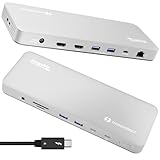
Overview: The Plugable TBT-UDM is a Mac-optimized Thunderbolt 4 dock prioritizing seamless dual 4K support and driverless operation. Designed specifically for M-series MacBooks, it simplifies setup for creatives and professionals seeking a clean, reliable desk solution. What Makes It Stand Out: Its standout feature is true plug-and-play dual 4K HDMI on all M4/M5 Macs and Pro/Max M-series chips without drivers or software. The aluminum build, lifetime North American support, and focus on eliminating “dongle mess” cater perfectly to Mac users frustrated by display limitations on base models. Value for Money: Excellent value for Mac users. It solves the common dual-display headache on newer MacBooks at a competitive price. The lifetime support and Mac-specific tuning provide peace of mind exceeding generic docks. Cheaper options lack its refined Mac compatibility and driverless dual 4K for M4/M5. Strengths and Weaknesses: Strengths: Effortless dual 4K on M4/M5 & Pro/Max Macs; driverless operation; clean aluminum design; excellent lifetime support; well-organized 13 ports. Weaknesses: Limited to 4K dual display (no 8K); base M1/M2 still single-display; fewer Thunderbolt ports than competitors; 100W charging max. Bottom Line: The top recommendation for M4/M5 and Pro/Max MacBook users needing hassle-free dual 4K monitors, offering unmatched Mac integration and user-friendly reliability.
6. Dell Thunderbolt Dock- WD19TBS 130w Power Delivery

Overview: The Dell WD19TBS is a versatile Thunderbolt 3 dock designed primarily for Dell commercial laptops but offering broad compatibility with HP, Lenovo, and other Thunderbolt-enabled systems. It delivers robust connectivity for professional workspaces requiring multi-monitor setups and streamlined peripheral management. What Makes It Stand Out: Its standout feature is universal compatibility across major business laptop brands, coupled with support for up to three high-resolution displays (including 5K single or dual 4K). The integrated VESA mount option and 0.8m cable promote a clean desk setup, while Dell Client Command Suite enables seamless, reboot-free firmware updates for IT management. Value for Money: Priced competitively for enterprise environments, it justifies its cost through reliable performance, extensive port selection (including dual Thunderbolt 3), and centralized manageability tools. While cheaper USB-C docks exist, the WD19TBS offers superior power delivery (130W) and certified Thunderbolt stability for demanding workflows. Strengths and Weaknesses: Strengths: Excellent cross-brand compatibility; robust 130W power delivery; efficient multi-display support; enterprise-grade manageability and security (MAC pass-thru, remote disable). Weaknesses: Limited to Thunderbolt 3 (not newer TB4); no Wi-Fi management; max three displays may fall short for some power users; VESA mount sold separately. Bottom Line: Ideal for IT-managed offices needing a dependable, widely compatible Thunderbolt 3 dock with strong power and display capabilities; highly recommended for Dell-centric or mixed-brand fleets despite lacking Thunderbolt 4 features.
7. Dell Pro Thunderbolt 4 Smart Dock SD25TB4 – USB-C Station 130W, 4 Displays 4K, 2X DP 1.4, HDMI 2.1, 2X Thunderbolt 4, 2.5GbE, Wi-Fi, Sustainable Design
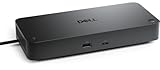
Overview: Dell’s SD25TB4 is a premium Thunderbolt 4 dock engineered for high-performance workstations, supporting up to four 4K displays and featuring advanced remote management capabilities. It targets creative professionals, data scientists, and enterprise users needing maximum connectivity and control. What Makes It Stand Out: It uniquely supports four 4K displays simultaneously via HDMI 2.1 and DP 1.4, a rarity in docks. The integrated Wi-Fi for remote management (via Dell Console/Intel AMT) allows firmware updates and configuration without a connected PC. Enhanced security includes WPA3, DMA protection, and sustainable materials. Value for Money: Positioned at a premium price, it delivers exceptional value for users requiring quad 4K output or centralized IT management. The 130W charging, dual TB4 ports for daisy-chaining, and 2.5GbE justify the cost over simpler docks, especially for AI/creative workloads needing expansive screen real estate. Strengths and Weaknesses: Strengths: Unmatched four 4K display support; revolutionary Wi-Fi remote management; top-tier security suite; high 130W power delivery; dual TB4 ports. Weaknesses: Premium pricing may deter casual users; complex setup for non-IT users; requires compatible systems for full quad-display functionality. Bottom Line: A powerhouse dock for professionals needing four 4K monitors or enterprise-grade remote manageability; highly recommended despite the cost for demanding workflows where screen space and IT control are critical.
8. Dell WD22TB4 Thunderbolt 4 Dock 180W - 40Gbps, 3-Year Warranty, USB-C/USB-A Dell Docking Station with 180W Adapter + Techtray Cables & Cloth - Supports Dual/Triple Monitor & 4K Displays (New)
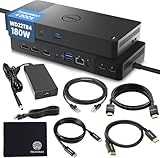
Overview: The Dell WD22TB4 is a feature-rich Thunderbolt 4 dock with an included 180W power adapter, supporting Windows, macOS, and Linux systems. It emphasizes broad compatibility and high power delivery, particularly for larger-screen laptops, while offering triple 4K display support under optimal conditions. What Makes It Stand Out: Its bundled 180W adapter (exceeding typical dock specs) ensures robust power for even power-hungry laptops. The extensive 13-port array—including dual Thunderbolt 4, dual DP 1.4, HDMI 2.0, and multiple USB ports—caters to complex setups. Crucially, macOS users gain dual 4K support on M1 Pro/Max chips. Value for Money: The inclusion of the 180W adapter and Techtray accessories adds tangible value over docks requiring separate purchases. At its price point, it competes well for users needing high wattage and triple-display capability, though macOS limitations on base M1/M2 Macs reduce versatility for some Apple users. Strengths and Weaknesses: Strengths: High 180W adapter inclusion; versatile triple 4K support (Windows/Linux); extensive port selection; strong macOS compatibility on Pro/Max chips; 3-year warranty. Weaknesses: Base M1/M2 Macs limited to one display; complex macOS dual-display setup may require DisplayLink; bulkier design. Bottom Line: An excellent choice for Windows/Linux users or Mac Pro/Max owners needing high power and multi-display support; recommended with caveats for standard MacBook users due to macOS display limitations.
9. Plugable 16-in-1 Thunderbolt 4 Dock – Dual 4K Monitors for M4/M5 MacBook Air/Pro, 100W Charging, 2X HDMI, 2X DisplayPort, 2.5G Ethernet, 7X USB, MicroSD/SD Card Reader, Windows & USB4 Compatible

Overview: Plugable’s award-winning 16-in-1 dock is optimized for seamless dual 4K monitor setups on modern Macs (including M-series) and Windows/USB4 systems. It emphasizes plug-and-play simplicity, especially for MacBook users, while packing extensive connectivity into a single solution. What Makes It Stand Out: It uniquely enables true plug-and-play dual 4K 60Hz output on M-series Macs without drivers—a major pain point resolver. The comprehensive 16 ports (including SD/microSD readers and 2.5G Ethernet) cater to creatives, while UL-certified 100W charging ensures safety. Its “Dock of the Year” award underscores real-world usability. Value for Money: Offers exceptional bang-for-buck by solving Mac dual-monitor headaches affordably. The breadth of ports (7 USB, dual video inputs) surpasses many competitors at similar prices, making it ideal for Mac-centric workflows where driver-free operation is paramount. Strengths and Weaknesses: Strengths: Driver-free dual 4K on M-series Macs; incredibly versatile 16-port array; reliable 100W charging; excellent value; USB4 compatibility. Weaknesses: Max 100W charging (less than some 130W+ docks); no Thunderbolt daisy-chaining support on Macs; limited enterprise management features. Bottom Line: The top recommendation for MacBook users needing effortless dual 4K monitors and rich connectivity; highly valuable for creatives and professionals prioritizing Mac compatibility over max power delivery.
10. Belkin Thunderbolt 3 Dock Pro w/ Thunderbolt 3 Cable - USB-C Hub - USB-C Docking Station for MacOS & Windows, Dual 4K @60Hz, 40Gbps Transfer Speed, 85W Upstream Charging, w/ Ethernet, SD & Audio Ports

Overview: Belkin’s Thunderbolt 3 Dock Pro is a well-rounded solution for Mac and Windows users seeking dual 4K display support, strong connectivity, and integrated power delivery. It includes a Thunderbolt cable and focuses on simplicity and reliability for professional desktop setups. What Makes It Stand Out: Its bundled 0.8m Thunderbolt 3 cable offers flexibility in desk arrangement. The 170W PSU enables robust 85W upstream charging—sufficient for most laptops—and the 12-port selection (including SD card reader and Ethernet) covers essential peripherals without clutter. Value for Money: Competitive pricing for a premium-branded dock with included cable. While lacking Thunderbolt 4 speeds, it delivers excellent value for users needing reliable dual 4K, solid charging, and core ports (SD, Ethernet) at a lower cost than newer TB4 models. Strengths and Weaknesses: Strengths: Includes convenient Thunderbolt cable; reliable dual 4K support; robust 85W charging; user-friendly SD card slot; strong Mac/Windows compatibility. Weaknesses: Thunderbolt 3 only (not future-proof); max 85W charging may not suffice for high-end laptops; no multi-display beyond dual 4K; no Wi-Fi management. Bottom Line: A dependable, user-friendly Thunderbolt 3 dock ideal for dual-monitor setups; recommended for those prioritizing simplicity and value over cutting-edge Thunderbolt 4 features or higher power delivery.
Core Considerations Before You Buy
Defining Your Workflow Requirements
Start by meticulously mapping your daily tasks. Are you routinely pushing multiple high-resolution displays for video editing or CAD work? Do you handle massive files requiring sustained high-speed data transfers to external storage? Or perhaps your priority is connecting specialized lab equipment or audio interfaces? Quantify your needs: note the exact number of monitors you use, their resolutions and refresh rates, the types of peripherals (especially niche ones like oscilloscopes or MIDI controllers), and your typical data transfer volumes. This clarity prevents overpaying for unused features or, worse, buying a dock that cripples your productivity the moment you plug in critical gear.
Understanding Thunderbolt Generations and Bandwidth
Not all Thunderbolt docks are created equal, primarily due to the underlying Thunderbolt standard. Thunderbolt 4 remains the current professional benchmark in 2026, offering a guaranteed minimum of 40Gbps bandwidth, support for dual 4K displays (or a single 8K), PCIe data transfer for fast storage, and essential features like wake-from-sleep and minimum power delivery. While Thunderbolt 3 docks are still available, they lack some Thunderbolt 4 mandates, potentially leading to inconsistent performance—especially with demanding multi-monitor setups or high-bandwidth peripherals. Crucially, verify the dock’s actual implementation; some may use a single Thunderbolt controller chip, while higher-end models might employ multiple controllers to prevent bandwidth saturation across all ports simultaneously.
Power Delivery: More Than Just Wattage
Power Delivery (PD) specs are critical but often misunderstood. A dock advertising “100W PD” might only deliver that maximum to the laptop when minimal other peripherals are connected. Under heavy peripheral load (multiple drives, high-res monitors), the available wattage for your laptop can drop significantly, potentially preventing charging or even causing your computer to drain while docked. Look for docks that clearly state “100W PD guaranteed” even with all ports in use, or consider models offering 140W PD for the latest high-power laptops. Also, check if the dock provides supplemental USB-C PD ports for charging secondary devices like tablets or phones without sacrificing laptop power.
Performance and Connectivity Deep Dive
Display Capabilities: Resolutions, Refresh Rates, and Color Accuracy
Your visual output is non-negotiable. Ensure the dock explicitly supports your monitor configuration’s resolution and refresh rate requirements (e.g., dual 4K@120Hz, 5K@60Hz, or 8K@30Hz). Pay close attention to the interface standards it uses—DisplayPort 1.4a or HDMI 2.1 are essential for higher resolutions and refresh rates. For color-critical work (photo/video editing, design), confirm support for wide color gamuts (P3, Adobe RGB) and proper color bit depth (10-bit). Some docks may technically drive the resolution but compromise on color fidelity; professional workflows demand docks that maintain full chroma subsampling (4:4:4) and accurate color reproduction across all connected displays.
Data Transfer Speeds and Sustained Performance
Theoretical peak speeds (like 40Gbps for Thunderbolt) rarely reflect real-world sustained performance. Factors like the dock’s internal architecture, cooling solutions, and the quality of its USB/NVMe controllers significantly impact actual throughput. If you regularly move large video files, 3D models, or datasets, prioritize docks known for consistent high-speed transfers, especially when multiple devices are connected. Look for models utilizing PCIe Gen 4 x4 lanes for the fastest possible external SSD speeds and robust thermal management (like aluminum housings or active cooling) to prevent thermal throttling during prolonged heavy use—a common pitfall with compact, poorly designed docks.
Ethernet: Speed and Reliability for Critical Connections
Built-in Ethernet is often a lifeline for professionals. Don’t assume “Gigabit” is sufficient; many modern workloads (cloud rendering, large file syncs, remote server access) benefit greatly from 2.5GbE or even 10GbE ports. Crucially, verify the Ethernet controller’s quality—cheap implementations can cause lag spikes, disconnections, or poor performance under load, which is disastrous during video conferences or critical downloads. If you need rock-solid, low-latency networking for virtual machines or remote desktop, prioritize docks using well-regarded controllers (like those from Realtek or Aquantia) known for driver stability and consistent throughput, especially important when juggling multiple network-dependent tasks.
Legacy Port Integration: Beyond the USB-C Future
While USB-C dominates, many professionals still rely on essential legacy hardware: USB-A peripherals (keyboards, mice, specialized dongles), SD card readers for photographers, audio jacks for headsets, or even HDMI for conference room projectors. Evaluate the dock’s mix of ports carefully. A high-end dock missing a simple USB-A port can force you into a chain of adapters, increasing points of failure. Consider the type of SD card reader (UHS-II support is vital for pro photographers) and the quality of the headphone amp (if you use high-impedance studio headphones). Future-proofing means balancing cutting-edge connectivity with pragmatic support for the gear you still depend on daily.
Design, Usability, and Integration
Physical Layout and Cable Management
A dock’s physical design impacts daily frustration levels more than you might think. Consider port placement: are frequently used ports (like the power connector or a frequently swapped USB drive) easily accessible, or buried awkwardly? Top-mounted ports can be hard to reach on a crowded desk. Look for docks with thoughtful cable routing channels or integrated clips to minimize the “rat’s nest” effect. Compact form factors save space but might lead to port crowding, making it difficult to plug in bulky connectors simultaneously. A slightly larger dock with well-spaced ports often provides a better long-term user experience than an ultra-miniature model that forces compromises.
Build Quality and Thermal Management
Professionals need reliability, not just specs. A dock built with flimsy plastic housings may crack, overheat, or fail prematurely under constant load. Prioritize models with robust metal casings (aluminum is ideal) that act as effective heat sinks. Check reviews specifically mentioning thermal performance during extended multi-monitor and high-data-transfer sessions. Overheating is a leading cause of intermittent disconnections and performance drops. Look for vents positioned to avoid being blocked when placed on a desk, and consider docks with passive cooling fins or even quiet fans in high-power models designed for sustained 40Gbps throughput across multiple devices.
Software, Firmware, and Compatibility
Don’t overlook the software layer. Some docks require specific drivers or management utilities for optimal performance, firmware updates, or advanced features like display arrangement presets. Check the manufacturer’s track record for timely driver updates, especially critical for compatibility with new macOS or Windows releases. Poorly maintained firmware can lead to bugs, security vulnerabilities, or incompatibility with the latest laptops. For macOS users, verify explicit compatibility with Apple Silicon Macs and support for features like Target Display Mode (if applicable) or seamless Handoff. Windows users should confirm compatibility with your specific OS version and any necessary WHQL certification.
Future-Proofing Your Investment
Assessing Upgrade Paths and Longevity
Technology evolves rapidly. Consider how long you intend to keep the dock (3-5 years is reasonable for a professional investment). Does it support emerging standards you might adopt soon, like USB4 Version 2.0 (80Gbps) passthrough compatibility (even if not fully utilizing it yet), or potential future display standards? While it won’t magically gain new features, a dock built on the latest Thunderbolt 4 foundation with robust internal architecture is more likely to remain compatible and performant as your laptop and peripherals evolve. Avoid docks relying on outdated chipsets with known limitations or discontinued support.
Frequently Asked Questions
Frequently Asked Questions
Can a Thunderbolt dock power my high-wattage laptop while driving multiple monitors and peripherals?
Yes, but carefully verify the dock’s guaranteed power delivery under full load. High-wattage laptops (especially mobile workstations) require docks offering 100W or 140W PD with clear specifications stating this power is maintained even when all ports are actively used with demanding peripherals like multiple high-res displays and fast storage.
How do I know if a dock will support my specific monitor setup (e.g., dual 4K at 144Hz)?
Check the dock’s detailed technical specifications for maximum supported resolution per port and the total concurrent display capability. Confirm it uses DisplayPort 1.4a (or HDMI 2.1 for HDMI ports) which are necessary for high resolutions and refresh rates. Manufacturer compatibility lists for specific monitor models can also be helpful.
Are all Thunderbolt docks compatible with both Windows and macOS?
Most Thunderbolt 4 docks offer broad compatibility, but nuances exist. Always verify explicit support for your specific OS version (e.g., latest macOS Sonoma/Ventura or Windows 11) on the manufacturer’s website. Some features (like audio over USB-C) or specific peripheral support might vary slightly between operating systems.
Why does my external SSD connected through the dock run slower than when plugged directly into my laptop?
This is often due to bandwidth sharing. The dock’s single Thunderbolt connection (40Gbps) must share bandwidth between all connected devices (displays, Ethernet, USB devices, storage). High-resolution displays consume significant bandwidth. Check if the dock uses a single controller chip; higher-end docks with dual controllers can dedicate more bandwidth to data transfer ports.
Do I need a special cable for my Thunderbolt dock, and does length matter?
Yes, you need a certified Thunderbolt 4 (or compatible USB4) cable. For full 40Gbps performance and power delivery, use an active cable for lengths over 0.8m (2.6ft). Passive cables work for shorter distances (typically up to 2m for 40Gbps, but check specs). Using a non-Thunderbolt USB-C cable will severely limit functionality and speed.
Can Thunderbolt docks cause Wi-Fi or Bluetooth interference?
Poorly shielded docks or cables can potentially cause interference with the laptop’s wireless signals, especially if the dock is placed very close to the laptop’s antennas (often near the screen hinge). Using high-quality, certified cables and positioning the dock slightly away from the laptop base can mitigate this. Metal-cased docks often provide better inherent shielding.
What’s the difference between a dock’s built-in Ethernet and using a separate USB Ethernet adapter?
A dock’s integrated Ethernet typically offers superior performance, stability, and lower CPU usage because it connects directly via the Thunderbolt/USB4 controller’s PCIe lanes, bypassing USB translation layers. Dedicated USB Ethernet adapters add another layer of potential bottlenecks and driver issues, often resulting in slightly higher latency and lower maximum throughput.
How important is firmware upgradability for a Thunderbolt dock?
Critically important for longevity and security. Firmware updates fix bugs, improve compatibility with new laptops/OS versions, patch security vulnerabilities, and sometimes add minor features. Choose a manufacturer known for providing regular, easy-to-install firmware updates via simple utilities, not complex procedures.
Can I daisy-chain multiple Thunderbolt docks for even more ports?
Technically possible, but generally not recommended for professional setups. Daisy-chaining adds complexity, potential points of failure, and can lead to bandwidth contention and instability, especially with multiple high-bandwidth devices or displays. A single, well-chosen dock with sufficient ports is far more reliable for critical work.
Are there significant security considerations when using a Thunderbolt dock?
Yes. Thunderbolt’s direct memory access (DMA) capability, while enabling high speed, poses a theoretical security risk if a malicious device is connected. Ensure your laptop’s BIOS/UEFI has “Thunderbolt Security Level” set to “User Authorization” or “Secure Connect” (not “No Security”). Keep dock firmware updated to address any potential vulnerabilities in the dock’s controller.